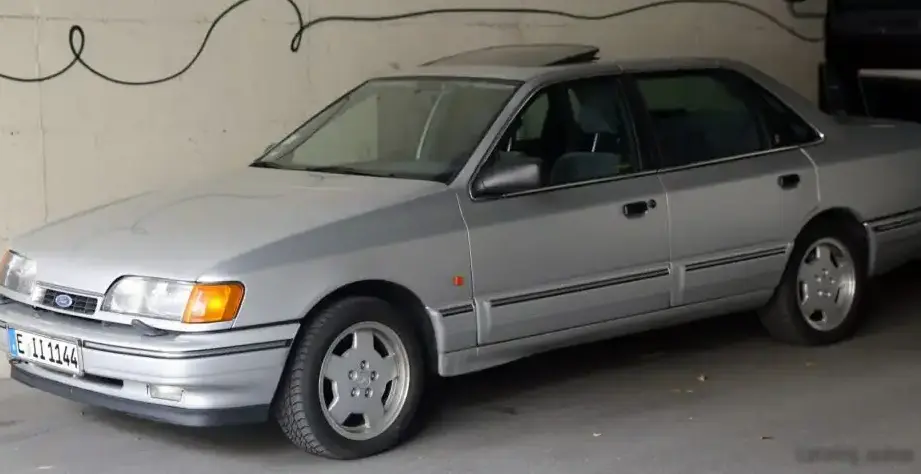
The Ford Scorpio I Turnier (GGE) 2.0 i, produced between 1991 and 1994, represented a significant offering in Ford’s European lineup. As a station wagon (estate) variant of the Scorpio I, it aimed to provide a practical and comfortable vehicle for families and those requiring substantial cargo space. This 2.0-liter, 120 horsepower version occupied a middle ground within the Scorpio range, positioned as a more affordable and fuel-efficient alternative to the higher-powered V6 models, while offering more performance than the base 1.8L engine. The Turnier body style, Ford’s term for its estate cars, was popular in Europe, and the Scorpio I Turnier sought to capitalize on this demand with a blend of practicality and Ford’s established engineering.
Technical Specifications
| Brand | Ford |
| Model | Scorpio |
| Generation | Scorpio I Turnier (GGE) |
| Type (Engine) | 2.0 i (120 Hp) |
| Start of production | 1991 |
| End of production | 1994 |
| Powertrain Architecture | Internal Combustion engine |
| Body type | Station wagon (estate) |
| Fuel Type | Petrol (Gasoline) |
| Power | 120 Hp @ 5600 rpm |
| Power per litre | 60.1 Hp/l |
| Torque | 171 Nm @ 2500 rpm |
| Torque (lb-ft) | 126.12 lb.-ft. @ 2500 rpm |
| Engine layout | Front, Longitudinal |
| Engine Model/Code | N9D |
| Engine displacement | 1998 cm3 |
| Engine displacement (cu. in.) | 121.93 cu. in. |
| Number of cylinders | 4 |
| Engine configuration | Inline |
| Cylinder Bore | 86 mm |
| Cylinder Bore (in.) | 3.39 in. |
| Piston Stroke | 86 mm |
| Piston Stroke (in.) | 3.39 in. |
| Number of valves per cylinder | 4 |
| Fuel injection system | Multi-port manifold injection |
| Engine aspiration | Naturally aspirated engine |
| Valvetrain | DOHC |
| Engine oil capacity | 4.5 l |
| Engine oil capacity (US qt) | 4.76 US qt |
| Engine oil capacity (UK qt) | 3.96 UK qt |
| Coolant capacity | 8.1 l |
| Coolant capacity (US qt) | 8.56 US qt |
| Coolant capacity (UK qt) | 7.13 UK qt |
Powertrain & Engine Architecture
The heart of the Scorpio I Turnier 2.0 i was the Ford N9D engine, a 1.998-liter inline-four cylinder powerplant. This engine utilized a multi-port fuel injection system, a significant advancement over earlier carbureted designs, contributing to improved fuel efficiency and smoother operation. The N9D featured a double overhead camshaft (DOHC) valvetrain, operating four valves per cylinder. This configuration allowed for enhanced breathing and improved volumetric efficiency, aiding in the engine’s power output. The engine was mounted longitudinally in the front of the vehicle, driving the rear wheels. While a five-speed manual transmission was available on other Scorpio models, the 2.0 i was typically paired with a four-speed automatic transmission, prioritizing ease of use over outright performance. This automatic transmission, while reliable, wasn’t known for its particularly quick shifts or advanced features by modern standards.
Driving Characteristics
The 120 horsepower and 171 Nm (126 lb-ft) of torque delivered by the 2.0-liter engine provided adequate, but not exhilarating, performance for the Scorpio I Turnier. Acceleration was respectable, but the automatic transmission did detract from the engine’s potential. The four-speed automatic’s gear ratios were geared more towards fuel economy and comfortable cruising than rapid acceleration. Compared to the manual transmission versions, the automatic felt noticeably slower, particularly during overtaking maneuvers. Against the higher-powered V6 Scorpio models, the 2.0 i felt significantly underpowered, but it offered a more economical driving experience. The suspension, tuned for comfort, provided a relatively smooth ride, although the Scorpio’s size and weight were always apparent in corners.
Equipment & Trim Levels
The 2.0 i Scorpio Turnier typically came with a reasonable level of standard equipment, reflecting its position as a mid-range offering. Standard features generally included central locking, power windows, and a basic stereo system. Interior upholstery was typically cloth, with options for upgraded materials available. The dashboard layout was functional and straightforward, typical of Ford designs of the era. Optional extras included air conditioning, a sunroof, and upgraded sound systems. The Turnier’s estate body style naturally provided a large cargo area, making it a practical choice for families or those needing to transport bulky items. Trim levels varied slightly depending on the specific market, but generally focused on cosmetic enhancements and additional comfort features.
Chassis & Braking
The Scorpio I Turnier utilized a traditional body-on-frame construction, contributing to its robust feel. The front suspension consisted of MacPherson struts, while the rear suspension employed a live axle with coil springs. Braking on the 2.0 i models typically featured disc brakes on the front wheels and drum brakes on the rear. This configuration was common for vehicles in this class at the time, balancing cost and performance. Anti-lock braking system (ABS) was available as an option, enhancing safety. Stabilizer bars were fitted to both the front and rear axles to reduce body roll during cornering, although the Scorpio’s weight still made it feel somewhat ponderous in tight turns.
Market Reception & Comparison
The Ford Scorpio I Turnier 2.0 i was generally well-received by automotive critics as a practical and comfortable family car. However, it wasn’t considered a particularly exciting vehicle to drive. Critics often praised its spacious interior and large cargo area, but noted that the 2.0-liter engine, especially when paired with the automatic transmission, felt somewhat underpowered. Fuel economy was considered reasonable for a vehicle of its size and class. Compared to rivals like the Opel/Vauxhall Carlton and Rover 800, the Scorpio offered a competitive package in terms of price and practicality. The 2.0 i variant offered a better balance between performance and fuel economy than the V6 models, making it a popular choice for those prioritizing affordability and everyday usability.
Legacy
The Ford Scorpio I Turnier 2.0 i, while not a particularly iconic or collectible vehicle, remains a reasonably reliable and affordable classic car today. The N9D engine is generally considered durable, although regular maintenance is essential to prevent issues. The automatic transmission, while not the most sophisticated, is also generally reliable if properly serviced. Parts availability can be a challenge, as the Scorpio is now an older vehicle, but many components are still available through specialist suppliers. In the used car market, the 2.0 i Turnier represents a good value proposition for those seeking a spacious and comfortable estate car with a classic 1990s feel. Its blend of practicality and affordability has ensured its continued presence on roads and in the hands of enthusiasts.