
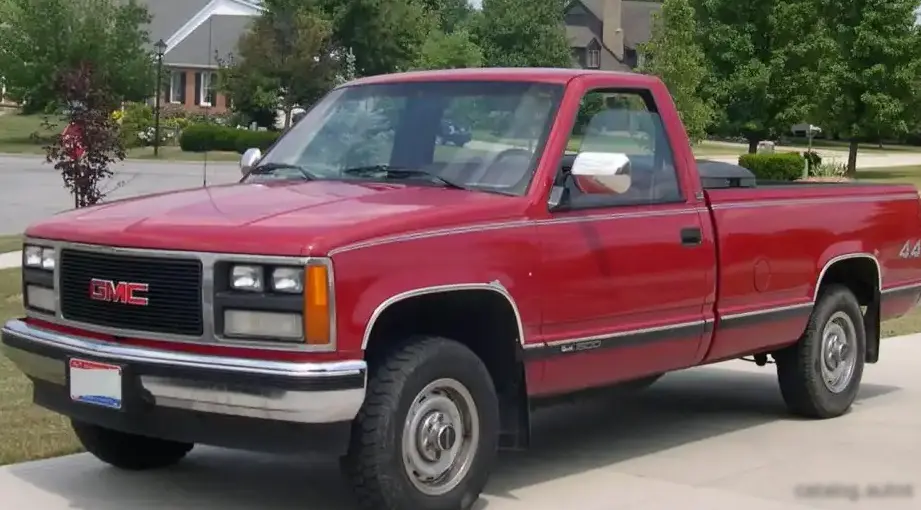
The GMC Sierra 1500, in its first generation (GMT400), represented GMC’s entry into the increasingly popular full-size pickup truck market. Produced from 1988 through 1992, this iteration of the Sierra aimed to provide a robust and capable work vehicle, while also offering a degree of comfort and refinement not always found in its class. The Regular Cab Long Wheelbase Wideside configuration, powered by the 4.3L V6 engine paired with an automatic transmission, occupied a significant position in the lineup as a value-oriented option, appealing to buyers prioritizing practicality and affordability over outright performance. This specific combination was a mainstay for fleet sales and individual owners needing a dependable truck for everyday tasks.
Technical Specifications
| Brand | GMC |
| Model | Sierra 1500 |
| Generation | Sierra 1500 I (GMT400) Regular cab LWB Wideside |
| Type (Engine) | 4.3 V6 (160 Hp) Automatic |
| Start of production | 1988 |
| End of production | 1992 |
| Powertrain Architecture | Internal Combustion engine |
| Body type | Pick-up |
| Seats | 3 |
| Doors | 2 |
| Fuel Type | Petrol (Gasoline) |
| Power | 160 Hp @ 4000 rpm |
| Torque | 319 Nm @ 2400 rpm / 235.28 lb.-ft. @ 2400 rpm |
| Engine layout | Front, Longitudinal |
| Number of cylinders | 6 |
| Engine configuration | V-engine |
| Cylinder Bore | 101.6 mm / 4 in |
| Piston Stroke | 88.39 mm / 3.48 in |
| Compression ratio | 9.3:1 |
| Fuel injection system | Single-point injection |
| Engine aspiration | Naturally aspirated engine |
| Max. weight | 2767 kg / 6100.19 lbs |
| Fuel tank capacity | 129 l / 34.08 US gal | 28.38 UK gal |
| Permitted trailer load with brakes (12%) | 3402 kg / 7500.13 lbs |
| Length | 5547 mm / 218.39 in |
| Width | 1951 mm / 76.81 in |
| Height | 1788 mm / 70.39 in |
| Wheelbase | 3340 mm / 131.5 in |
| Front overhang | 886 mm / 34.88 in |
| Rear overhang | 1321 mm / 52.01 in |
| Drivetrain Architecture | The Internal combustion engine (ICE) drives the rear wheels of the vehicle. |
| Drive wheel | Rear wheel drive |
| Number of gears and type of gearbox | 4 gears, automatic transmission |
| Front suspension | Independent coil spring |
| Rear suspension | Rigid axle suspension, Leaf spring |
| Front brakes | Disc |
| Rear brakes | Drum |
| Tires size | 225/75 R15 |
Powertrain & Engine Architecture
The heart of this Sierra 1500 variant was the 4.3L (262 cubic inch) V6 engine. This engine, internally designated as the LB4, was a member of GM’s small-block V6 family. It featured a 90-degree V-angle, a cast iron block, and aluminum cylinder heads. The engine utilized a throttle body injection (TBI) fuel system, a relatively simple single-point injection system that was common for the era. This system, while not as efficient or powerful as multi-port fuel injection, offered good reliability and ease of maintenance. The valvetrain employed two valves per cylinder, operated by a hydraulic lifter camshaft. The 4L40-E four-speed automatic transmission was the standard pairing for this engine. This transmission was known for its durability and relatively smooth shifting, although it wasn’t particularly geared for performance. The transmission’s gear ratios were optimized for towing and hauling, prioritizing low-end torque over rapid acceleration.
Driving Characteristics
The 160 horsepower and 235 lb-ft of torque produced by the 4.3L V6 and 4L40-E automatic combination resulted in a driving experience focused on utility rather than speed. Acceleration was modest, and passing maneuvers required careful planning. The automatic transmission’s shift points were calibrated for fuel economy and smooth operation, meaning it didn’t always feel responsive to sudden throttle inputs. However, the engine provided adequate power for everyday driving and light to moderate towing. The long wheelbase and leaf spring rear suspension contributed to a comfortable ride, especially when unladen, but also meant the truck could feel somewhat floaty over uneven surfaces. Compared to the available 5.7L V8, the 4.3L offered significantly less power, but also better fuel economy and a lower purchase price. The manual transmission options, when equipped with the V6, provided a more engaging driving experience and slightly improved fuel efficiency.
Equipment & Trim Levels
The base-level Sierra 1500 with the 4.3L V6 and automatic transmission typically came with a fairly spartan equipment list. Standard features included a basic AM/FM radio, vinyl upholstery, and manual windows and locks. Air conditioning was often an optional extra, as were power windows and locks. The interior was functional and durable, designed to withstand the rigors of work truck use. The Wideside bed configuration offered a wider cargo area than the standard bed, making it ideal for hauling larger items. Optional extras included a sliding rear window, a tilt steering wheel, and upgraded sound systems. The trim level was generally considered entry-level, appealing to buyers who prioritized function over luxury.
Chassis & Braking
The GMT400 Sierra 1500 utilized a body-on-frame construction, providing a robust and durable platform. The front suspension consisted of independent coil springs, offering a relatively comfortable ride. The rear suspension employed a traditional leaf spring setup, which was well-suited for carrying heavy loads. The braking system featured disc brakes on the front wheels and drum brakes on the rear. While adequate for the truck’s weight and intended use, the braking performance wasn’t particularly strong by modern standards. The steering was a recirculating ball system, which provided a solid feel but lacked the precision of more modern steering technologies. Tire size was typically 225/75R15, offering a good balance of ride comfort and durability.
Market Reception & Comparison
The 4.3L V6-powered Sierra 1500 was generally well-received as a practical and affordable work truck. Critics noted its adequate power for most tasks, its comfortable ride, and its relatively low price. However, it was often criticized for its lack of power compared to the V8 options. Fuel economy was considered decent for a full-size pickup truck of the era, but not exceptional. Compared to the Ford F-150 and Chevrolet C/K series trucks, the Sierra 1500 offered a similar level of capability and value. The 4.3L engine proved to be a reliable powerplant, although the TBI fuel injection system could require occasional maintenance. The automatic transmission was also generally reliable, but could be prone to overheating if subjected to heavy towing in hot weather.
Legacy
The GMT400 Sierra 1500, particularly the 4.3L V6 automatic variant, has become a popular choice among classic truck enthusiasts. Its affordability, simplicity, and reliability have made it a desirable vehicle for restoration and modification. Parts availability is generally good, and the engine is relatively easy to work on. While not a high-performance machine, the 4.3L V6-powered Sierra 1500 remains a capable and dependable truck that represents a significant era in American automotive history. Today, well-maintained examples command reasonable prices in the used car market, appealing to those seeking a classic pickup truck with a practical and straightforward design.

