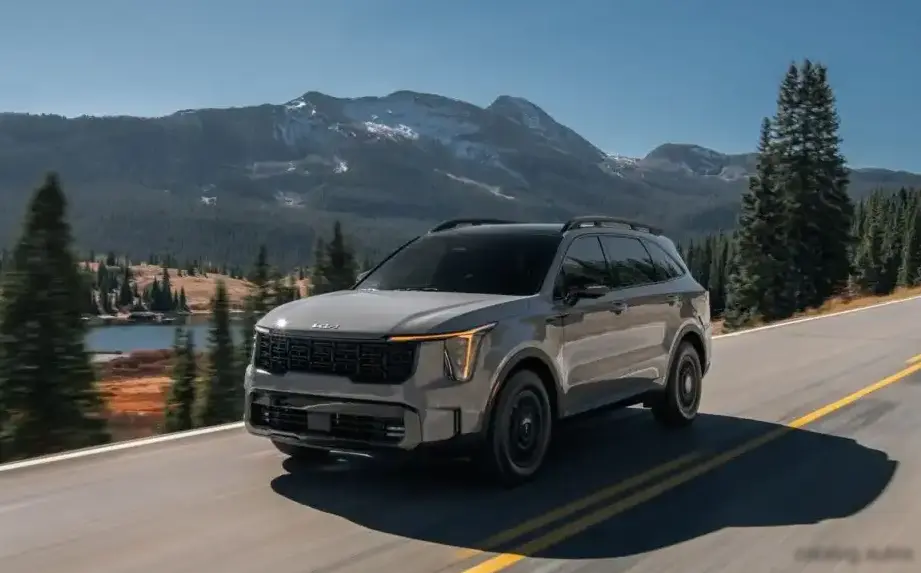
The Kia Sorento IV, specifically the facelifted 2024 model year equipped with the 1.6 T-GDI (227 Hp) Full Hybrid powertrain and All-Wheel Drive (AWD) paired with an automatic transmission, represents a significant offering in the mid-size SUV segment. Introduced in May 2024, this variant builds upon the fourth-generation Sorento (launched in 2020), incorporating styling updates and refining the already popular hybrid technology. Positioned as a mid-range to upper-mid-range trim within the Sorento lineup, it aims to balance fuel efficiency, performance, and all-weather capability for families and individuals seeking a versatile vehicle.
Technical Specifications
| Brand | Kia |
| Model | Sorento |
| Generation | Sorento IV (facelift 2024) |
| Type (Engine) | 1.6 T-GDI (227 Hp) Full Hybrid AWD Automatic |
| Start of production | May, 2024 |
| Powertrain Architecture | FHEV (Full Hybrid Electric Vehicle) |
| Body type | SUV |
| Seats | 6 |
| Doors | 5 |
| Fuel consumption (urban) | 6.9 l/100 km (34.1 US mpg, 40.9 UK mpg, 14.5 km/l) |
| Fuel consumption (extra urban) | 6.9 l/100 km (34.1 US mpg, 40.9 UK mpg, 14.5 km/l) |
| Fuel consumption (combined) | 6.9 l/100 km (34.1 US mpg, 40.9 UK mpg, 14.5 km/l) |
| Fuel Type | Petrol (Gasoline) |
| Acceleration 0 – 100 km/h | 9.1 sec |
| Acceleration 0 – 62 mph | 9.1 sec |
| Acceleration 0 – 60 mph | 8.6 sec |
| Maximum speed | 193 km/h (119.92 mph) |
| Weight-to-power ratio | 8.7 kg/Hp, 115.2 Hp/tonne |
| Weight-to-torque ratio | 5.6 kg/Nm, 177.6 Nm/tonne |
| Gross battery capacity | 1 kWh |
| Battery voltage | 270 V |
| Battery technology | Lithium-polymer (LiPo) |
| Battery weight | 40 kg (88.18 lbs) |
| Max speed (electric) | 120 km/h (74.56 mph) |
| Electric motor power | 60 Hp @ 1600-2000 rpm |
| Electric motor Torque | 264 Nm @ 0-1600 rpm (194.72 lb.-ft. @ 0-1600 rpm) |
| Electric motor type | Synchronous |
| System power | 227 Hp |
| System torque | 350 Nm (258.15 lb.-ft.) |
| Power | 178 Hp @ 5500 rpm |
| Power per litre | 111.4 Hp/l |
| Torque | 264 Nm @ 1500-4500 rpm (194.72 lb.-ft. @ 1500-4500 rpm) |
| Engine layout | Front, Transverse |
| Engine Model/Code | G4FT |
| Engine displacement | 1598 cm3 (97.52 cu. in.) |
| Number of cylinders | 4 |
| Engine configuration | Inline |
| Cylinder Bore | 75.6 mm (2.98 in.) |
| Piston Stroke | 89 mm (3.5 in.) |
| Compression ratio | 10.5:1 |
| Number of valves per cylinder | 4 |
| Fuel injection system | Direct injection |
| Engine aspiration | Turbocharger, Intercooler |
| Engine oil capacity | 4.8 l (5.07 US qt | 4.22 UK qt) |
| Coolant | 7.9 l (8.35 US qt | 6.95 UK qt) |
| Kerb Weight | 1971-1993 kg (4345.31 – 4393.81 lbs.) |
| Max. weight | 2580 kg (5687.93 lbs.) |
| Max load | 587-609 kg (1294.11 – 1342.62 lbs.) |
| Trunk (boot) space – minimum | 357 l (12.61 cu. ft.) |
| Trunk (boot) space – maximum | 2138 l (75.5 cu. ft.) |
| Permitted trailer load without brakes | 750 kg (1653.47 lbs.) |
| Length | 4816 mm (189.61 in.) |
| Width | 1900 mm (74.8 in.) |
| Height | 1694 mm (66.69 in.) |
| Wheelbase | 2814 mm (110.79 in.) |
| Front track | 1646 mm (64.8 in.) |
| Rear (Back) track | 1656 mm (65.2 in.) |
| Front overhang | 925 mm (36.42 in.) |
| Rear overhang | 1074 mm (42.28 in.) |
| Ride height (ground clearance) | 174 mm (6.85 in.) |
| Minimum turning circle (turning diameter) | 11.6 m (38.06 ft.) |
| Approach angle | 16.8° |
| Departure angle | 21.2° |
| Ramp-over (brakeover) angle | 15.1° |
| Drivetrain Architecture | The Internal combustion engine (ICE) and the electric motor permanently drive the front wheels of the vehicle, capable of running in full electric or mixed mode, and if necessary through the electrically or mechanically controlled clutch, the rear wheels are driven. |
| Drive wheel | All wheel drive (4×4) |
| Number of gears and type of gearbox | 6 gears, automatic transmission |
| Front suspension | Independent type McPherson |
| Rear suspension | Independent multi-link suspension |
| Front brakes | Ventilated discs, 325.12 mm |
| Rear brakes | Ventilated discs, 325.12 mm |
| Assisting systems | ABS (Anti-lock braking system) |
| Steering type | Steering rack and pinion |
| Power steering | Electric Steering |
| Tires size | 235/55 R19 |
| Wheel rims size | 7.5J x 19 |
Powertrain & Engine Architecture
At the heart of this Sorento variant lies the G4FT 1.6-liter turbocharged gasoline engine. This engine utilizes direct injection and a twin-scroll turbocharger to deliver a respectable 178 horsepower. The “T-GDI” designation stands for Turbocharged Gasoline Direct Injection. The engine is paired with a 60 horsepower electric motor, integrated into a six-speed automatic transmission. This combination creates a full hybrid system with a total system output of 227 horsepower and 350 Nm (258 lb-ft) of torque. The hybrid system employs a 1 kWh lithium-polymer battery pack, providing a limited all-electric range and assisting the gasoline engine during acceleration and cruising. The automatic transmission is specifically tuned to work seamlessly with the electric motor, optimizing efficiency and providing smooth gear changes.
Driving Characteristics
The 1.6 T-GDI Full Hybrid AWD Sorento offers a comfortable and refined driving experience. While not as overtly sporty as some competitors, the combined output of the engine and electric motor provides adequate acceleration, achieving 0-60 mph in approximately 8.6 seconds. The automatic transmission generally shifts smoothly, although occasional hesitation can be felt during quick acceleration. The AWD system provides enhanced traction in inclement weather conditions, making it a capable all-season vehicle. Compared to the higher-output 2.5-liter turbocharged engine option, this variant prioritizes fuel economy over outright performance. The electric motor assistance helps to fill in torque gaps at lower RPMs, resulting in a more responsive feel around town.
Equipment & Trim Levels
The 2024 Sorento IV facelift with this powertrain typically comes well-equipped, even in base trim levels. Standard features often include a large touchscreen infotainment system with Apple CarPlay and Android Auto compatibility, a suite of advanced driver-assistance systems (ADAS) such as lane-keeping assist, forward collision avoidance, and adaptive cruise control, and comfortable seating for up to seven passengers. Higher trim levels add features like leather upholstery, a panoramic sunroof, premium audio systems, and ventilated front seats. Interior upholstery is typically cloth in lower trims, upgrading to leather in higher specifications. Dashboard configurations are modern and user-friendly, with a focus on intuitive controls.
Chassis & Braking
The Sorento IV utilizes a robust chassis with independent suspension all around – McPherson struts at the front and a multi-link setup at the rear. This configuration provides a comfortable ride quality and decent handling characteristics. The AWD system is typically an on-demand system, automatically engaging the rear wheels when traction is needed. Braking duties are handled by ventilated disc brakes on all four wheels, providing ample stopping power. The suspension is tuned for comfort, with stabilizer bars to minimize body roll during cornering. The weight of the hybrid components does add to the overall vehicle weight, which can slightly impact handling agility.
Market Reception & Comparison
The Kia Sorento, in general, has been well-received by critics and consumers alike, praised for its spacious interior, comfortable ride, and value for money. The 1.6 T-GDI Full Hybrid AWD variant specifically appeals to buyers seeking a fuel-efficient and practical SUV with all-weather capability. Compared to the non-hybrid Sorento models, this variant offers significantly improved fuel economy. Compared to other hybrid SUVs in its class, such as the Toyota Highlander Hybrid, the Sorento offers a more stylish design and a more engaging driving experience, though the Toyota often holds an edge in long-term reliability reputation.
Legacy
The Kia Sorento IV, and particularly the 1.6 T-GDI Full Hybrid AWD version, represents a step forward in Kia’s commitment to electrification and fuel efficiency. While long-term reliability data is still emerging for this specific powertrain combination, Kia has generally improved its reliability ratings in recent years. The hybrid system is expected to provide years of reliable service with proper maintenance. On the used car market, these models are expected to hold their value well due to their fuel efficiency and practicality, making them an attractive option for buyers seeking a well-rounded mid-size SUV.