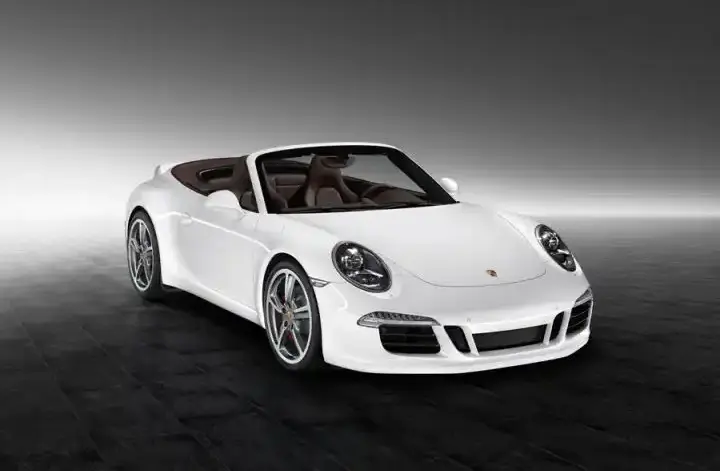
The Porsche 911 Turbo S Cabriolet (991) represents the pinnacle of open-top performance within the 991 generation of the iconic 911. Produced from 2013 to 2016, this variant combined the exhilarating performance of the Turbo S coupe with the added enjoyment of open-air driving. It occupied the highest performance tier within the 991 Cabriolet range, offering a significant step up in power and technology compared to the standard Carrera and Carrera S models. The 991 generation itself was a significant evolution of the 911, featuring a longer wheelbase, a wider track, and a more sophisticated chassis, all contributing to improved handling and stability.
Technical Specifications
| Brand | Porsche |
| Model | 911 |
| Generation | 911 Cabriolet (991) |
| Type (Engine) | Turbo S 3.8 (560 Hp) PDK |
| Start of production | 2013 |
| End of production | 2016 |
| Powertrain Architecture | Internal Combustion engine |
| Body type | Cabriolet |
| Seats | 4 |
| Doors | 2 |
| Fuel consumption (economy) – urban | 13.2 l/100 km (17.8 US mpg, 21.4 UK mpg, 7.6 km/l) |
| Fuel consumption (economy) – extra urban | 7.7 l/100 km (30.5 US mpg, 36.7 UK mpg, 13 km/l) |
| Fuel consumption (economy) – combined | 9.7 l/100 km (24.2 US mpg, 29.1 UK mpg, 10.3 km/l) |
| CO2 emissions | 227 g/km |
| Fuel Type | Petrol (Gasoline) |
| Acceleration 0 – 100 km/h | 3.1 sec |
| Acceleration 0 – 62 mph | 3.1 sec |
| Acceleration 0 – 60 mph | 2.9 sec |
| Maximum speed | 318 km/h (197.6 mph) |
| Emission standard | Euro 6 |
| Weight-to-power ratio | 3 kg/Hp, 335.3 Hp/tonne |
| Weight-to-torque ratio | 2.4 kg/Nm, 419.2 Nm/tonne |
| Power | 560 Hp @ 6500-6750 rpm |
| Power per litre | 147.4 Hp/l |
| Torque | 700 Nm @ 2100-4250 rpm (516.29 lb.-ft. @ 2100-4250 rpm) |
| Engine layout | Rear, Longitudinal |
| Engine Model/Code | MA1.71S |
| Engine displacement | 3800 cm3 (231.89 cu. in.) |
| Number of cylinders | 6 |
| Engine configuration | Boxer |
| Cylinder Bore | 102 mm (4.02 in.) |
| Piston Stroke | 77.5 mm (3.05 in.) |
| Compression ratio | 9.8:1 |
| Number of valves per cylinder | 4 |
| Fuel injection system | Direct injection |
| Engine aspiration | Twin-Turbo, Intercooler |
| Engine oil capacity | 7.5 l (7.93 US qt | 6.6 UK qt) |
| Coolant | 26.3 l (27.79 US qt | 23.14 UK qt) |
| Kerb Weight | 1670 kg (3681.72 lbs.) |
| Max. weight | 2045 kg (4508.45 lbs.) |
| Max load | 375 kg (826.73 lbs.) |
| Fuel tank capacity | 68 l (17.96 US gal | 14.96 UK gal) |
| Length | 4506 mm (177.4 in.) |
| Width | 1880 mm (74.02 in.) |
| Height | 1295 mm (50.98 in.) |
| Wheelbase | 2450 mm (96.46 in.) |
| Front track | 1539 mm (60.59 in.) |
| Rear (Back) track | 1590 mm (62.6 in.) |
| Drag coefficient (Cd) | 0.31 |
| Minimum turning circle | 10.9 m (35.76 ft.) |
| Drive wheel | All wheel drive (4×4) |
| Number of gears and type of gearbox | 7 gears, automatic transmission PDK |
| Front suspension | Independent type McPherson |
| Rear suspension | Independent multi-link suspension |
| Front brakes | Ventilated discs, 380 mm |
| Rear brakes | Ventilated discs, 380 mm |
| Assisting systems | ABS (Anti-lock braking system) |
| Steering type | Steering rack and pinion |
| Tires size | 245/35 ZR20; 305/30 ZR20 |
| Wheel rims size | 9J x 20; 11.5J x 20 |
Powertrain & Engine Architecture
At the heart of the 911 Turbo S Cabriolet lies the MA1.71S engine, a 3.8-liter twin-turbocharged flat-six (boxer) engine. This engine utilizes direct fuel injection, a technology that precisely meters fuel directly into the combustion chamber, optimizing combustion efficiency and power output. The twin-turbocharger setup employs variable turbine geometry (VTG) to provide rapid response and minimize turbo lag. The engine produces 560 horsepower at 6,500-6,750 rpm and a substantial 700 Nm (516 lb-ft) of torque available from a low 2,100 rpm all the way to 4,250 rpm. This broad torque curve contributes to the car’s exceptional acceleration. The engine is longitudinally mounted at the rear of the vehicle, a hallmark of the 911 design. The engine is paired with Porsche’s seven-speed PDK (Porsche Doppelkupplung) dual-clutch automatic transmission. This transmission offers incredibly fast and smooth gear changes, enhancing both performance and driving comfort. The PDK transmission allows for both fully automatic operation and manual gear selection via steering wheel-mounted paddles.
Driving Characteristics
The 911 Turbo S Cabriolet delivers a truly exhilarating driving experience. The combination of the powerful engine, the quick-shifting PDK transmission, and the all-wheel-drive system results in breathtaking acceleration. The 0-60 mph sprint takes just 2.9 seconds, and the car can reach a top speed of 197.6 mph. The all-wheel-drive system provides excellent traction, allowing the car to put its power down effectively even in challenging conditions. The Cabriolet configuration adds a unique dimension to the driving experience, allowing occupants to enjoy the sound of the engine and the sensation of open-air motoring. Compared to the standard 991 Carrera Cabriolet, the Turbo S offers a significantly more potent and responsive driving experience. While the Carrera provides a more accessible and comfortable ride, the Turbo S prioritizes performance and driver engagement. The PDK transmission, while offering convenience, provides a more direct and engaging experience than a traditional torque-converter automatic.
Equipment & Trim Levels
The 911 Turbo S Cabriolet came standard with a comprehensive list of features, reflecting its position as the flagship model. Standard equipment included a power-retractable soft top, leather upholstery, heated and ventilated front seats, a premium sound system, and a navigation system. The interior featured carbon fiber trim accents and sport seats with increased bolstering. Optional extras included adaptive cruise control, a sport exhaust system, and various customization options for the interior and exterior. Buyers could choose from a wide range of paint colors, interior leather options, and wheel designs to personalize their vehicle.
Chassis & Braking
The 911 Turbo S Cabriolet features a sophisticated chassis designed to maximize performance and handling. The suspension utilizes Porsche Active Suspension Management (PASM), an electronically adjustable damping system that allows the driver to select between different suspension settings. The car is equipped with ventilated disc brakes on all four wheels, providing exceptional stopping power. The front brakes measure 380 mm in diameter, while the rear brakes are also 380 mm. The braking system is further enhanced by Porsche Ceramic Composite Brakes (PCCB) as an optional extra. The car’s all-wheel-drive system is a sophisticated torque-vectoring system that distributes power between the front and rear axles as needed to optimize traction and stability.
Market Reception & Comparison
The 911 Turbo S Cabriolet was widely praised by automotive critics for its exceptional performance, handling, and refinement. Reviewers lauded the car’s blistering acceleration, its precise steering, and its comfortable ride. Compared to other high-performance convertibles of the time, the 911 Turbo S Cabriolet stood out for its unique combination of performance and practicality. While some competitors offered similar levels of power, few could match the 911’s all-weather capability and its everyday usability. Fuel economy, while not a primary concern for buyers of this vehicle, was respectable for its performance class, averaging around 24.2 US mpg in combined driving.
Legacy
The 911 Turbo S Cabriolet (991) remains a highly sought-after vehicle in the used car market. Its combination of performance, luxury, and exclusivity has ensured its enduring appeal. The MA1.71S engine has proven to be a robust and reliable powerplant, provided it has been properly maintained. Regular servicing and adherence to Porsche’s recommended maintenance schedule are crucial for ensuring the long-term health of the engine and transmission. Today, these cars represent a significant investment, but they offer a unique and rewarding driving experience that few other vehicles can match. The 991 Turbo S Cabriolet solidified the 911’s reputation as the benchmark for high-performance sports cars.