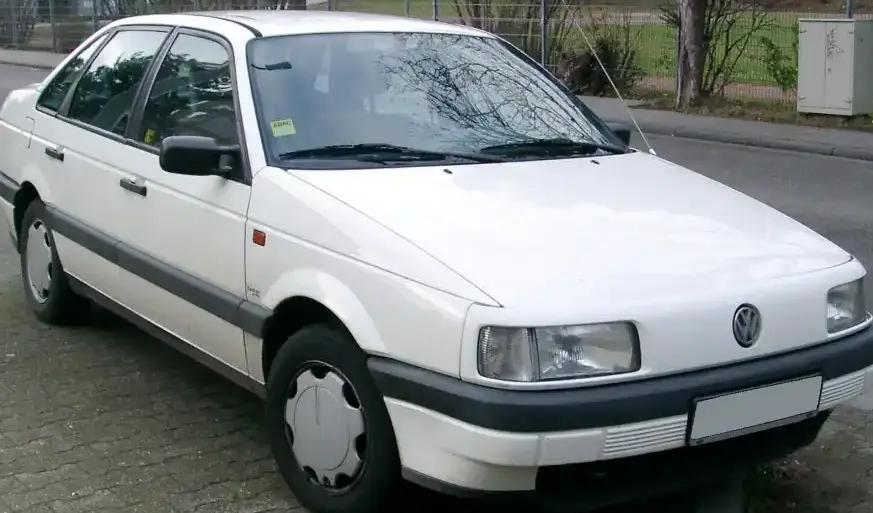
The Volkswagen Passat B3, produced from 1988 to 1993, represented a significant step forward for Volkswagen’s mid-size offering. The 2.0-liter (115 hp) automatic variant, manufactured between 1990 and 1993, occupied a middle ground in the B3 Passat lineup, offering a balance between performance and convenience. Positioned above the base 1.6-liter models and below the more powerful VR6, this configuration aimed to appeal to buyers seeking a comfortable and refined driving experience without sacrificing practicality. It was a key model in the European market, where automatics were gaining popularity, and saw limited import into the North American market.
Technical Specifications
| Brand | Volkswagen |
| Model | Passat |
| Generation | Passat (B3) |
| Type (Engine) | 2.0 (115 Hp) Automatic |
| Start of production | 1990 |
| End of production | 1993 |
| Powertrain Architecture | Internal Combustion engine |
| Body type | Sedan |
| Seats | 5 |
| Doors | 4 |
| Fuel consumption (urban) | 11.4 l/100 km (20.6 US mpg) |
| Fuel consumption (extra urban) | 6.6 l/100 km (35.6 US mpg) |
| Fuel consumption (combined) | 8.3 l/100 km (28.3 US mpg) |
| Fuel Type | Petrol (Gasoline) |
| Acceleration 0 – 100 km/h | 12.7 sec |
| Acceleration 0 – 62 mph | 12.7 sec |
| Acceleration 0 – 60 mph | 12.1 sec |
| Maximum speed | 192 km/h (119.3 mph) |
| Weight-to-power ratio | 10 kg/Hp |
| Weight-to-torque ratio | 6.7 kg/Nm |
| Power | 115 Hp @ 5400 rpm |
| Torque | 172 Nm @ 3200 rpm (126.86 lb.-ft. @ 3200 rpm) |
| Engine layout | Front, Longitudinal |
| Engine Model/Code | 2E |
| Engine displacement | 1984 cm3 (121.07 cu. in.) |
| Number of cylinders | 4 |
| Engine configuration | Inline |
| Cylinder Bore | 82.5 mm (3.25 in.) |
| Piston Stroke | 92.8 mm (3.65 in.) |
| Compression ratio | 10.3:1 |
| Number of valves per cylinder | 2 |
| Fuel injection system | Multi-port manifold injection |
| Engine aspiration | Naturally aspirated |
| Engine oil capacity | 4 l (4.23 US qt | 3.52 UK qt) |
| Coolant capacity | 5 l (5.28 US qt | 4.4 UK qt) |
| Kerb Weight | 1155 kg (2546.34 lbs.) |
| Max. weight | 1700 kg (3747.86 lbs.) |
| Max load | 545 kg (1201.52 lbs.) |
| Trunk (boot) space – minimum | 495 l (17.48 cu. ft.) |
| Trunk (boot) space – maximum | 820 l (28.96 cu. ft.) |
| Fuel tank capacity | 70 l (18.49 US gal | 15.4 UK gal) |
| Length | 4575 mm (180.12 in.) |
| Width | 1705 mm (67.13 in.) |
| Height | 1460 mm (57.48 in.) |
| Wheelbase | 2625 mm (103.35 in.) |
| Front track | 1480 mm (58.27 in.) |
| Rear (Back) track | 1420 mm (55.91 in.) |
| Drivetrain Architecture | Front wheel drive |
| Number of gears | 4 |
| Gearbox type | Automatic transmission |
| Front suspension | Coil spring |
| Rear suspension | Coil spring |
| Front brakes | Disc |
| Rear brakes | Disc |
| Assisting systems | ABS (Anti-lock braking system) |
| Steering type | Steering rack and pinion |
| Power steering | Hydraulic |
| Tires size | 185/65 R14 |
| Wheel rims size | 6J x 14 |
INTRODUCTION
The Volkswagen Passat B3, launched in 1988, was a pivotal model for Volkswagen, representing a move towards more modern styling and engineering. The 2.0-liter automatic variant, produced from 1990-1993, was a popular choice for drivers prioritizing comfort and ease of use. Built on the Volkswagen B3 platform (also shared with the Audi 80/90), the Passat B3 offered a more spacious interior and improved ride quality compared to its predecessor, the B2 Passat. This particular engine and transmission combination was aimed at buyers who wanted a step up from the base models but didn’t require the performance of the more expensive VR6.
Powertrain & Engine Architecture
The heart of the Passat 2.0 Automatic is the 2E engine, a 1984cc inline-four cylinder gasoline engine. This engine utilized a multi-port fuel injection system, providing a good balance between fuel efficiency and power delivery. The 2E engine featured a single overhead camshaft (SOHC) valvetrain with two valves per cylinder. The engine’s longitudinal mounting allowed for front-wheel drive via a four-speed automatic transmission. This transmission, while not known for its sportiness, provided smooth and reliable gear changes, contributing to the car’s comfortable driving experience. The automatic transmission was a key selling point for drivers who preferred the convenience of not having to manually shift gears, particularly in urban environments.
Driving Characteristics
The 115 hp and 172 Nm (126.86 lb-ft) of torque produced by the 2.0-liter engine, coupled with the four-speed automatic transmission, resulted in a respectable, though not exhilarating, driving experience. Acceleration from 0-60 mph took around 12.1 seconds, and the top speed was approximately 119.3 mph. Compared to the five-speed manual version of the same engine, the automatic suffered a slight performance penalty due to the transmission’s inherent efficiency losses. However, the automatic offered a smoother and more relaxed driving experience, particularly on long journeys. The gear ratios were tuned for comfortable cruising, with a focus on fuel economy rather than outright acceleration. The automatic transmission’s shift points were generally well-chosen, providing adequate power for most driving situations.
Equipment & Trim Levels
The 2.0-liter automatic Passat typically came with a reasonable level of standard equipment. This included power steering, central locking, and electric windows. Interior upholstery was typically cloth, with options for upgraded velour or leather available. Dashboard configuration was relatively simple and functional, with clear instrumentation. Optional extras included a sunroof, air conditioning, and upgraded audio systems. Trim levels varied slightly depending on the market, but generally, the 2.0 Automatic sat in the mid-range of the Passat B3 lineup, offering a good balance of features and affordability.
Chassis & Braking
The Passat B3 featured an independent suspension setup at all four wheels, utilizing coil springs and shock absorbers. The front suspension employed MacPherson struts, while the rear suspension used a semi-independent torsion beam. This setup provided a comfortable ride and decent handling characteristics. Braking was handled by disc brakes on all four wheels, with ABS (Anti-lock Braking System) available as an option, and becoming increasingly common as standard equipment towards the end of the B3’s production run. The B3 Passat’s chassis was relatively lightweight, contributing to its decent fuel economy and handling.
Market Reception & Comparison
The 2.0-liter automatic Passat B3 received generally positive reviews from automotive critics. It was praised for its comfortable ride, spacious interior, and reasonable fuel economy. However, some critics noted that the automatic transmission could feel sluggish at times, and the engine lacked the punch of the VR6. Compared to the 1.6-liter models, the 2.0-liter offered a noticeable performance improvement. Compared to the VR6, it was more affordable and offered better fuel economy, but at the expense of performance. Reliability was generally good, although the automatic transmission could be prone to issues if not properly maintained.
Legacy
The Passat B3 2.0 Automatic remains a relatively common sight on European roads today, testament to its durability and reliability. The 2E engine is known to be a robust and long-lasting unit, provided it receives regular maintenance. The automatic transmission, while not the most sophisticated, is generally reliable if fluid changes are performed on schedule. In the used car market, these Passats are often sought after by enthusiasts looking for a classic Volkswagen that is both comfortable and affordable to maintain. Parts availability is generally good, making it a relatively easy car to keep on the road. The B3 Passat, and particularly the 2.0 Automatic variant, represents a significant chapter in Volkswagen’s history, bridging the gap between the older, more basic Passats and the more modern, technologically advanced models that followed.