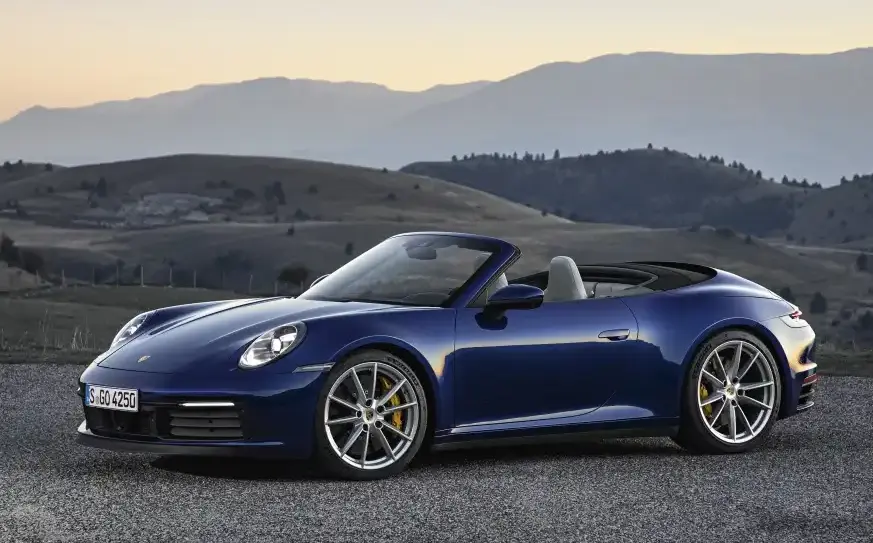
The Porsche 911 Cabriolet (992) Carrera GTS 3.0, equipped with the PDK dual-clutch transmission and producing 480 horsepower, represents a compelling blend of performance and open-air driving enjoyment. Introduced in November 2021 and continuing through May 2024, this variant occupies a significant position within the 992 generation, offering a step up in power and refinement from the base Carrera models while remaining more approachable than the even more potent Turbo variants. It builds upon the established 911 formula, delivering a thrilling driving experience with the added flexibility of a convertible top.
Technical Specifications
| Brand | Porsche |
| Model | 911 |
| Generation | 911 Cabriolet (992) |
| Type (Engine) | Carrera GTS 3.0 (480 Hp) PDK |
| Start of production | November, 2021 |
| End of production | May, 2024 |
| Powertrain Architecture | Internal Combustion engine |
| Body type | Cabriolet |
| Seats | 4 |
| Doors | 2 |
| Combined fuel consumption (WLTP) | 10.9-11.3 l/100 km (21.6 – 20.8 US mpg, 25.9 – 25 UK mpg, 9.2 – 8.8 km/l) |
| CO2 emissions (WLTP) | 248-256 g/km |
| Fuel consumption (economy) – urban (NEDC) | 13.5 l/100 km (17.4 US mpg, 20.9 UK mpg, 7.4 km/l) |
| Fuel consumption (economy) – extra urban (NEDC) | 7.7 l/100 km (30.5 US mpg, 36.7 UK mpg, 13 km/l) |
| Fuel consumption (economy) – combined (NEDC) | 9.8 l/100 km (24 US mpg, 28.8 UK mpg, 10.2 km/l) |
| CO2 emissions (NEDC) | 224 g/km |
| Fuel Type | Petrol (Gasoline) |
| Acceleration 0 – 100 km/h | 3.6 sec |
| Acceleration 0 – 62 mph | 3.6 sec |
| Acceleration 0 – 60 mph | 3.4 sec |
| Acceleration 0 – 200 km/h | 12.3 sec |
| Maximum speed | 309 km/h (192 mph) |
| Emission standard | Euro 6d-ISC-FCM |
| Weight-to-power ratio | 3.4 kg/Hp, 297.2 Hp/tonne |
| Weight-to-torque ratio | 2.8 kg/Nm, 352.9 Nm/tonne |
| Power | 480 Hp @ 6500 rpm |
| Power per litre | 161 Hp/l |
| Torque | 570 Nm @ 2300-5000 rpm (420.41 lb.-ft. @ 2300-5000 rpm) |
| Maximum engine speed | 7500 rpm |
| Engine layout | Rear, Longitudinal |
| Engine Model/Code | DKKA |
| Engine displacement | 2981 cm3 (181.91 cu. in.) |
| Number of cylinders | 6 |
| Engine configuration | Boxer |
| Cylinder Bore | 91 mm (3.58 in.) |
| Piston Stroke | 76.4 mm (3.01 in.) |
| Number of valves per cylinder | 4 |
| Fuel injection system | Direct injection |
| Engine aspiration | BiTurbo, Intercooler |
| Valvetrain | VarioCam Plus |
| Engine oil capacity | 8 l (8.45 US qt | 7.04 UK qt) |
| Kerb Weight | 1615 kg (3560.47 lbs.) |
| Max. weight | 2040 kg (4497.43 lbs.) |
| Max load | 425 kg (936.96 lbs.) |
| Trunk (boot) space – minimum | 163 l (5.76 cu. ft.) |
| Fuel tank capacity | 64 l (16.91 US gal | 14.08 UK gal) |
| Length | 4533 mm (178.46 in.) |
| Width | 1852 mm (72.91 in.) |
| Width including mirrors | 2024 mm (79.69 in.) |
| Height | 1300 mm (51.18 in.) |
| Wheelbase | 2450 mm (96.46 in.) |
| Drag coefficient (Cd) | 0.31 |
| Minimum turning circle | 11.2 m (36.75 ft.) |
| Drivetrain Architecture | Rear wheel drive |
| Number of gears and type of gearbox | 8 gears, automatic transmission PDK |
| Front suspension | Independent type McPherson |
| Rear suspension | Independent multi-link suspension |
| Front brakes | Ventilated discs, 408 mm |
| Rear brakes | Ventilated discs, 380 mm |
| Front tires | 245/35 R20 |
| Rear tires | 305/30 R21 |
INTRODUCTION
The 992-generation Porsche 911 Carrera GTS Cabriolet, powered by a 3.0-liter twin-turbocharged flat-six engine producing 480 horsepower, arrived as a significant evolution of the iconic sports car. Launched in late 2021, it represents the sweet spot for many enthusiasts, offering a substantial performance upgrade over the standard Carrera models without venturing into the more exclusive and expensive Turbo territory. The “GTS” designation historically signifies a focus on driving dynamics, and this iteration continues that tradition, combining increased power with enhanced chassis components and a sport-tuned exhaust note. The Cabriolet body style adds the allure of open-top motoring, making it a versatile and engaging performance car.
Powertrain & Engine Architecture
At the heart of the 911 Carrera GTS Cabriolet lies the DKKA engine, a 2.981-liter (181.91 cubic inches) twin-turbocharged flat-six. This engine builds upon the base Carrera’s powerplant, utilizing larger turbochargers and revised engine mapping to achieve its 480 hp output at 6500 rpm and 570 Nm (420.41 lb-ft) of torque available from 2300 to 5000 rpm. The engine employs direct fuel injection and Porsche’s VarioCam Plus variable valve timing system, optimizing performance and efficiency across the rev range. The PDK (Porsche Doppelkupplung) 8-speed dual-clutch transmission is standard, providing incredibly quick and smooth gear changes. This transmission features a sophisticated electronic control unit that adapts to driving style and conditions. The engine is longitudinally mounted at the rear of the vehicle, a defining characteristic of the 911.
Driving Characteristics
The 911 Carrera GTS Cabriolet with PDK delivers a remarkably responsive and engaging driving experience. The twin-turbochargers minimize turbo lag, providing strong and linear power delivery throughout the rev range. The PDK transmission’s quick shifts contribute to a 0-60 mph time of approximately 3.4 seconds and a top speed of 192 mph. Compared to the base Carrera, the GTS feels noticeably more potent, particularly in the mid-range. While the manual transmission option offers a more traditional driving experience, the PDK’s efficiency and speed make it a compelling choice for both daily driving and spirited performance. The Cabriolet’s chassis is reinforced to maintain rigidity despite the absence of a fixed roof, resulting in minimal body flex. The standard Porsche Active Suspension Management (PASM) system allows drivers to adjust the damper settings for a more comfortable or sport-focused ride.
Equipment & Trim Levels
The Carrera GTS Cabriolet comes well-equipped as standard. Interior features typically include leather upholstery, power-adjustable sport seats, a Porsche Communication Management (PCM) infotainment system with a touchscreen display, and a high-quality sound system. Standard exterior features include a sport exhaust system, unique GTS styling elements, and 20-inch front and 21-inch rear wheels. Optional extras are extensive, allowing buyers to personalize their vehicle with features such as adaptive cruise control, a premium sound system, carbon fiber interior trim, and various exterior color options. The GTS trim generally sits above the base Carrera and Carrera S in terms of standard equipment and performance, but below the Turbo models.
Chassis & Braking
The 992-generation 911 features a sophisticated chassis designed for exceptional handling and stability. The front suspension utilizes independent McPherson struts, while the rear employs an independent multi-link setup. The GTS model benefits from a slightly lowered ride height and stiffer springs compared to the base Carrera. Braking performance is equally impressive, with ventilated discs measuring 408 mm at the front and 380 mm at the rear. The braking system is equipped with ABS (Anti-lock Braking System) and Porsche Stability Management (PSM). Optional carbon ceramic brakes are available for even greater stopping power and fade resistance. Rear-wheel steering is also an available option, enhancing agility and maneuverability.
Market Reception & Comparison
The 911 Carrera GTS Cabriolet has been widely praised by automotive critics for its exceptional performance, refined driving dynamics, and overall versatility. It’s often lauded as the “sweet spot” in the 911 lineup, offering a compelling balance between performance and everyday usability. Compared to the base Carrera Cabriolet, the GTS provides a significant power boost and more engaging driving experience. Against the Carrera S, the GTS offers a similar level of performance with a more focused and sporty character. Fuel economy, while not a primary concern for 911 buyers, is respectable for a high-performance sports car, with combined fuel consumption ranging from 10.9 to 11.3 l/100 km.
Legacy
The 992-generation 911 Carrera GTS Cabriolet is expected to hold its value well in the used car market due to the enduring appeal of the 911 nameplate and the desirable GTS specification. The PDK transmission, while requiring periodic maintenance, is generally considered reliable. The twin-turbocharged engine, while more complex than naturally aspirated predecessors, has proven to be robust when properly maintained. As with all Porsches, regular servicing and adherence to recommended maintenance schedules are crucial for long-term reliability. The 992 GTS represents a significant step forward in the evolution of the 911, combining modern technology with the classic Porsche driving experience.