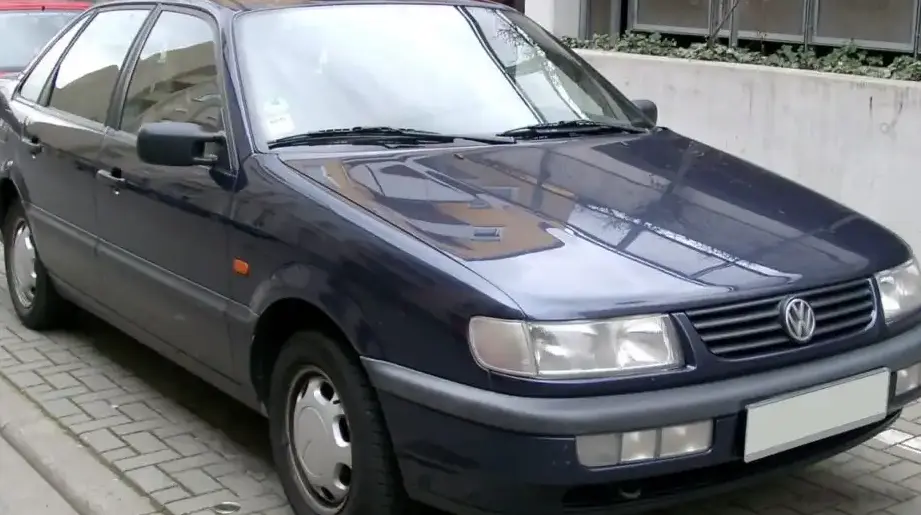
The Volkswagen Passat B4 1.8, producing 90 horsepower, was a mainstay of the Passat lineup from 1993 to 1996. Positioned as an entry-level to mid-range offering, it represented a balance between affordability and practicality within the broader B4 generation (1993-1997). Built on the Volkswagen Group’s B4 platform – also underpinning the Audi A4, SEAT Cordoba, and Škoda Octavia – the 1.8 model aimed to provide comfortable family transportation with reasonable fuel economy. This variant was particularly popular in European markets where fuel costs were higher and a focus on sensible motoring prevailed. In the United States, the B4 Passat was offered with larger engines, making the 1.8L version more common in Europe and other international markets.
Technical Specifications
| Brand | Volkswagen |
| Model | Passat |
| Generation | Passat (B4) |
| Type (Engine) | 1.8 (90 Hp) |
| Start of production | 1993 |
| End of production | 1996 |
| Powertrain Architecture | Internal Combustion engine |
| Body type | Sedan |
| Seats | 5 |
| Doors | 4 |
| Fuel consumption (urban) | 10.4 l/100 km (22.6 US mpg) |
| Fuel consumption (extra urban) | 5.8 l/100 km (40.6 US mpg) |
| Fuel Type | Petrol (Gasoline) |
| Acceleration 0 – 100 km/h | 14.4 sec |
| Acceleration 0 – 62 mph | 14.4 sec |
| Acceleration 0 – 60 mph | 13.7 sec |
| Maximum speed | 178 km/h (110.6 mph) |
| Emission standard | Euro 2 |
| Weight-to-power ratio | 13.3 kg/Hp |
| Weight-to-torque ratio | 8.3 kg/Nm |
| Power | 90 Hp @ 5500 rpm |
| Torque | 145 Nm @ 2500 rpm (106.95 lb.-ft. @ 2500 rpm) |
| Engine layout | Front, Transverse |
| Engine Model/Code | ABS, ADZ |
| Engine displacement | 1781 cm3 (108.68 cu. in.) |
| Number of cylinders | 4 |
| Engine configuration | Inline |
| Cylinder Bore | 81 mm (3.19 in.) |
| Piston Stroke | 86.4 mm (3.4 in.) |
| Compression ratio | 10:1 |
| Number of valves per cylinder | 2 |
| Fuel injection system | Single-point injection |
| Engine aspiration | Naturally aspirated engine |
| Valvetrain | SOHC |
| Engine oil capacity | 3.8 l (4.02 US qt | 3.34 UK qt) |
| Coolant capacity | 5 l (5.28 US qt | 4.4 UK qt) |
| Kerb Weight | 1199 kg (2643.34 lbs.) |
| Max. weight | 1750 kg (3858.09 lbs.) |
| Max load | 551 kg (1214.75 lbs.) |
| Trunk (boot) space – minimum | 578 l (20.41 cu. ft.) |
| Trunk (boot) space – maximum | 990 l (34.96 cu. ft.) |
| Fuel tank capacity | 70 l (18.49 US gal | 15.4 UK gal) |
| Max. roof load | 75 kg (165.35 lbs.) |
| Permitted trailer load with brakes (12%) | 1200 kg (2645.55 lbs.) |
| Permitted trailer load without brakes | 600 kg (1322.77 lbs.) |
| Length | 4605 mm (181.3 in.) |
| Width | 1720 mm (67.72 in.) |
| Height | 1430 mm (56.3 in.) |
| Wheelbase | 2625 mm (103.35 in.) |
| Front track | 1479 mm (58.23 in.) |
| Rear track | 1422 mm (55.98 in.) |
| Minimum turning circle | 10.7 m (35.1 ft.) |
| Drivetrain Architecture | Front wheel drive |
| Number of gears | 5 |
| Gearbox type | Automatic transmission |
| Front suspension | Coil spring, Wishbone, Transverse stabilizer |
| Rear suspension | Wishbone, Transverse stabilizer, Coil spring |
| Front brakes | Disc |
| Rear brakes | Drum |
| Steering type | Steering rack and pinion |
| Power steering | Hydraulic |
| Tires size | 185/65 R14 |
| Wheel rims size | 6J x 14 |
Powertrain & Engine Architecture
The heart of the Passat B4 1.8 was the Volkswagen ABS or ADZ engine code, a 1.8-liter inline-four cylinder gasoline engine. This engine featured a single overhead camshaft (SOHC) valvetrain with two valves per cylinder. Crucially, this version utilized single-point fuel injection (SPI), a simpler and less expensive system compared to the multi-point injection found in higher-spec Passats. SPI delivered fuel into the intake manifold rather than directly into each cylinder, resulting in slightly reduced efficiency and power output. The engine’s 81mm bore and 86.4mm stroke contributed to its 1781cc displacement. The automatic transmission paired with this engine was typically a four-speed unit, designed for smooth, comfortable operation rather than sporty performance. This transmission was chosen to appeal to drivers prioritizing ease of use over driver engagement.
Driving Characteristics
The 90 horsepower and 145 Nm (107 lb-ft) of torque produced by the 1.8L engine, when coupled with the four-speed automatic transmission, resulted in a driving experience focused on practicality. Acceleration was modest, taking around 14.4 seconds to reach 60 mph. The automatic transmission’s gear ratios were optimized for fuel economy and smooth cruising, rather than rapid acceleration. Compared to the five-speed manual version of the same engine, the automatic felt noticeably slower, particularly during overtaking maneuvers. Higher-output Passat variants, such as those equipped with the 1.9 TDI diesel or the 2.0L gasoline engine, offered significantly more performance. However, the 1.8 automatic provided a relaxed and comfortable ride, well-suited for daily commuting and long-distance journeys.
Equipment & Trim Levels
The 1.8L automatic Passat B4 typically came with a base level of equipment. Standard features generally included power steering, central locking, and basic cloth upholstery. Air conditioning was often an optional extra, as were power windows and upgraded audio systems. Trim levels varied slightly depending on the market, but generally, the 1.8 automatic represented the entry point into the Passat range. Higher trim levels added features like alloy wheels, upgraded interior trim, and more sophisticated audio systems. The interior dashboard configuration was relatively simple and functional, prioritizing usability over aesthetic flair.
Chassis & Braking
The Passat B4 1.8 featured a MacPherson strut front suspension and a semi-independent torsion beam rear suspension. This setup provided a comfortable ride, although it wasn’t particularly sporty. The front brakes were typically ventilated discs, while the rear brakes were drum brakes – a cost-saving measure common in entry-level models. A transverse stabilizer bar was fitted to both the front and rear axles to reduce body roll during cornering. The steering was rack and pinion, providing reasonably precise control.
Market Reception & Comparison
The Passat B4 1.8 automatic was generally well-received as a sensible and affordable family car. Critics praised its comfortable ride and reasonable fuel economy, but noted its lack of outright performance. Compared to the more powerful Passat variants, the 1.8 automatic offered a lower price point but sacrificed performance. The 1.9 TDI diesel, for example, provided significantly better fuel economy and more torque, making it a popular choice for drivers covering long distances. The 2.0L gasoline engine offered a noticeable performance boost, but at a higher cost. The 1.8 automatic appealed to buyers who prioritized comfort and affordability over sporty driving dynamics.
Legacy
The Volkswagen Passat B4 1.8 automatic, while not the most exciting variant in the lineup, proved to be a reliable and durable car. The ABS and ADZ engines are known for their longevity, provided they were properly maintained. Today, these cars are relatively affordable on the used car market, making them attractive to budget-conscious buyers. However, finding well-maintained examples can be challenging, as many have accumulated high mileage. Common issues include wear and tear on the automatic transmission and potential corrosion, particularly in regions with harsh winters. Despite these potential issues, the Passat B4 1.8 automatic remains a testament to Volkswagen’s commitment to building practical and dependable family cars.