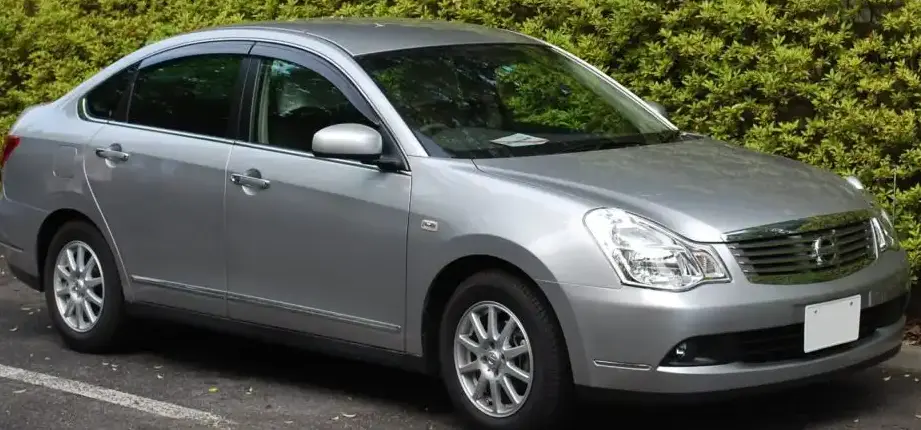
The Nissan Bluebird Sylphy II 2.0i, manufactured between 2006 and 2012, was a key model in Nissan’s enduring Bluebird lineage. Designed as a comfortable and practical compact sedan, the Sylphy II aimed to deliver a refined driving experience, appealing to families and commuters alike. This specific 2.0i variant, featuring a continuously variable transmission (CVT), occupied a mid-range position within the Sylphy II lineup, striking a balance between performance and fuel economy. Its primary market was in Asian countries, notably Japan and China, where the Bluebird name carried significant brand recognition and a reputation for dependability.
Technical Specifications
| Brand | Nissan |
| Model | Bluebird |
| Generation | Bluebird Sylphy II |
| Type (Engine) | 2.0i (133 Hp) CVT |
| Start of production | 2006 |
| End of production | 2012 |
| Powertrain Architecture | Internal Combustion engine |
| Body type | Sedan |
| Seats | 5 |
| Doors | 4 |
| Fuel consumption (urban) | 10.8-14.3 l/100 km (21.8 – 16.4 US mpg) |
| Fuel consumption (extra urban) | 6.8-9 l/100 km (34.6 – 26.1 US mpg) |
| Fuel consumption (combined) | 9.6 l/100 km (24.5 US mpg) |
| Fuel Type | Petrol (Gasoline) |
| Acceleration 0 – 100 km/h | 10.7 sec |
| Acceleration 0 – 62 mph | 10.7 sec |
| Acceleration 0 – 60 mph | 10.2 sec |
| Maximum speed | 198 km/h (123.03 mph) |
| Weight-to-power ratio | 9.2 kg/Hp |
| Weight-to-torque ratio | 6.4 kg/Nm |
| Power | 133 Hp @ 5200 rpm |
| Torque | 191 Nm @ 4400 rpm (140.87 lb.-ft. @ 4400 rpm) |
| Engine layout | Front, Transverse |
| Engine Model/Code | MR20DE |
| Engine displacement | 1997 cm3 (121.86 cu. in.) |
| Number of cylinders | 4 |
| Engine configuration | Inline |
| Cylinder Bore | 84 mm (3.31 in.) |
| Piston Stroke | 90.1 mm (3.55 in.) |
| Compression ratio | 10:1 |
| Number of valves per cylinder | 4 |
| Fuel injection system | Multi-port manifold injection |
| Engine aspiration | Naturally aspirated engine |
| Valvetrain | DOHC |
| Engine oil capacity | 3.8 l (4.02 US qt | 3.34 UK qt) |
| Coolant capacity | 7.1 l (7.5 US qt | 6.25 UK qt) |
| Kerb Weight | 1230 kg (2711.69 lbs.) |
| Max. weight | 1505 kg (3317.96 lbs.) |
| Max load | 275 kg (606.27 lbs.) |
| Fuel tank capacity | 52 l (13.74 US gal | 11.44 UK gal) |
| Length | 4610 mm (181.5 in.) |
| Width | 1695 mm (66.73 in.) |
| Height | 1510 mm (59.45 in.) |
| Wheelbase | 2700 mm (106.3 in.) |
| Front track | 1475 mm (58.07 in.) |
| Rear track | 1480 mm (58.27 in.) |
| Ride height (ground clearance) | 165 mm (6.5 in.) |
| Drag coefficient (Cd) | 0.30 |
| Minimum turning circle | 11 m (36.09 ft.) |
| Drivetrain Architecture | Front wheel drive |
| Number of gears and type of gearbox | 1 gears, automatic transmission CVT |
| Front brakes | Ventilated discs |
| Rear brakes | Drum |
| Steering type | Steering rack and pinion |
| Tires size | 195/60 R16 |
| Wheel rims size | 16 |
Powertrain & Engine Architecture
The Nissan Bluebird Sylphy II 2.0i’s engine is the MR20DE, a 1.997-liter inline-four cylinder gasoline engine. This engine employs multi-point fuel injection and a double overhead camshaft (DOHC) valvetrain, contributing to its smooth operation and respectable power output. The MR20DE is well-regarded for its durability and relatively uncomplicated design, making it a reasonably affordable engine to maintain. It generates 133 horsepower at 5200 rpm and 191 Nm (140.87 lb-ft) of torque at 4400 rpm. The engine is coupled with a continuously variable transmission (CVT). Nissan’s CVT, in this generation, was engineered to prioritize fuel efficiency and seamless acceleration rather than outright performance. Unlike conventional automatic transmissions with fixed gear ratios, the CVT offers a virtually limitless number of ratios within its operating range, enabling the engine to remain within its optimal power band.
Driving Characteristics
The 2.0i CVT version of the Sylphy II provides a comfortable, though not particularly sporty, driving experience. The CVT eliminates the noticeable shifts of a traditional automatic, resulting in smooth acceleration. However, the CVT can sometimes exhibit a “rubber band” effect, where engine speed increases rapidly under hard acceleration without a proportional increase in vehicle speed. This is a characteristic often found in earlier CVT designs. The 133 hp engine delivers sufficient power for everyday driving, but it doesn’t offer the quick acceleration of some competitors or even higher-trim Sylphy models. The emphasis is clearly on fuel economy and ease of operation, making it well-suited for city commuting and extended highway travel. The steering is light and responsive, enhancing the car’s overall ease of handling.
Equipment & Trim Levels
The 2.0i CVT trim of the Sylphy II generally included standard features such as air conditioning, power windows and door locks, a basic audio system (typically with a CD player and AM/FM radio), and alloy wheels. Upgraded trim levels offered enhancements like automatic climate control, a more advanced audio system with MP3 playback capability, and optional features like a sunroof and leather upholstery. Interior materials were generally of good quality for the price range, emphasizing practicality and longevity. The dashboard layout was functional and straightforward, prioritizing user-friendliness over elaborate styling.
Chassis & Braking
The Sylphy II utilizes a front-wheel-drive layout with a MacPherson strut suspension in the front and a torsion beam suspension in the rear. This suspension configuration provides a comfortable ride, effectively absorbing bumps and road imperfections. The front brakes are ventilated discs, offering adequate stopping power, while the rear brakes are drums, a cost-saving measure common in this vehicle segment. The steering system is rack and pinion, providing precise control and a relatively tight turning radius. The car’s relatively light weight (1230 kg / 2711.69 lbs) helps to compensate for the engine’s modest output.
Market Reception & Comparison
The Nissan Bluebird Sylphy II 2.0i CVT was generally well-received in its target markets. Reviewers commended its comfortable ride, fuel efficiency, and reliability. However, some critics pointed out its lack of sporty handling and the somewhat underwhelming performance of the CVT. When compared to other compact sedans available at the time, such as the Toyota Corolla and Honda Civic, the Sylphy II offered a competitive package, particularly in terms of value for money. The 1.8L versions of the Sylphy II provided improved fuel economy but less power, while higher-trim 2.0L models with additional features carried a higher price tag.
Legacy
The MR20DE engine, in particular, has proven to be a durable and reliable powerplant. Numerous examples of the Sylphy II 2.0i remain on the road today, a testament to Nissan’s engineering prowess. The CVT, while not as robust as a traditional automatic transmission, has also demonstrated reasonable reliability with proper maintenance. In the used car market, the Sylphy II 2.0i CVT represents a practical and affordable option for buyers seeking a comfortable and fuel-efficient compact sedan. Its reputation for reliability and low operating costs makes it a popular choice for first-time car buyers and those seeking a dependable daily driver.