
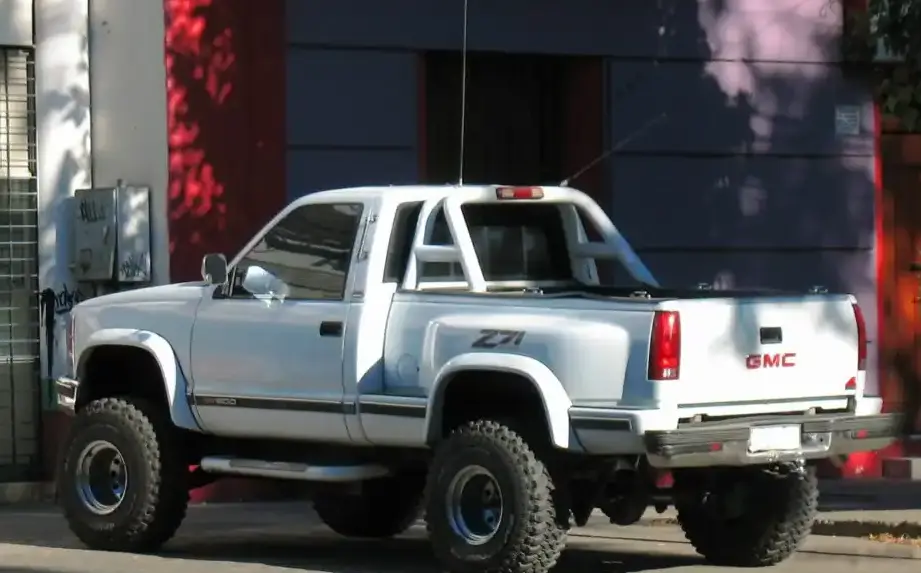
The GMC Sierra 1500, in its first generation (GMT400), represented GMC’s entry into the increasingly popular full-size pickup truck market. Produced from 1988 through 1992, this iteration of the Sierra aimed to provide a robust and capable work truck, while also offering a degree of comfort and style. The Regular Cab SWB (Short Wheelbase) Sportside configuration, equipped with the 4.3L V6 engine producing 160 horsepower and paired with a four-speed automatic transmission and four-wheel drive, occupied a significant position in the lineup as a versatile and accessible option for both personal and commercial use. This particular combination balanced affordability with the added capability of a 4×4 system.
Technical Specifications
| Brand | GMC |
| Model | Sierra 1500 |
| Generation | Sierra 1500 I (GMT400) Regular cab SWB Sportside |
| Type (Engine) | 4.3 V6 (160 Hp) 4WD Automatic |
| Start of production | 1988 |
| End of production | 1992 |
| Powertrain Architecture | Internal Combustion engine |
| Body type | Pick-up |
| Seats | 3 |
| Doors | 2 |
| Fuel Type | Petrol (Gasoline) |
| Power | 160 Hp @ 4000 rpm |
| Torque | 319 Nm @ 2400 rpm / 235.28 lb.-ft. @ 2400 rpm |
| Engine layout | Front, Longitudinal |
| Number of cylinders | 6 |
| Engine configuration | V-engine |
| Cylinder Bore | 101.6 mm / 4 in |
| Piston Stroke | 88.39 mm / 3.48 in |
| Compression ratio | 9.3:1 |
| Fuel injection system | Single-point injection |
| Engine aspiration | Naturally aspirated engine |
| Max. weight | 2540 kg / 5599.74 lbs |
| Fuel tank capacity | 95 l / 25.1 US gal | 20.9 UK gal |
| Permitted trailer load with brakes (12%) | 3856 kg / 8501.02 lbs |
| Length | 5065 mm / 199.41 in |
| Width | 1958 mm / 77.09 in |
| Height | 1788 mm / 70.39 in |
| Wheelbase | 2985 mm / 117.52 in |
| Front overhang | 886 mm / 34.88 in |
| Rear overhang | 1194 mm / 47.01 in |
| Drivetrain Architecture | The Internal combustion engine (ICE) drives the rear wheels permanently, and the front wheels are driven through an electrically or mechanically operated clutch if necessary. |
| Drive wheel | All wheel drive (4×4) |
| Number of gears and type of gearbox | 4 gears, automatic transmission |
| Front suspension | Independent torsion bar, double wishbone |
| Rear suspension | Rigid axle suspension, Leaf spring |
| Front brakes | Disc |
| Rear brakes | Drum |
| Tires size | 225/75 R16 |
Powertrain & Engine Architecture
The heart of this Sierra 1500 variant was the 4.3L (262 cubic inch) V6 engine, designated as the LB4. This engine was a member of GM’s small-block V6 family, known for its durability and relatively simple design. The LB4 utilized a 90-degree V-angle and featured a cast iron block with aluminum cylinder heads. Fuel delivery was managed by a Central Port Injection (CPI) system, a form of single-point injection where fuel injectors were located in the intake manifold runners. This system, while less sophisticated than multi-port fuel injection, offered a balance of cost-effectiveness and improved fuel efficiency over carburetion. The engine’s valvetrain employed two valves per cylinder, operated by a hydraulic lifter camshaft. The four-speed automatic transmission (likely the 4L60) was a common choice for GM trucks of this era. It provided smooth shifting and adequate performance for everyday driving and light-duty hauling. The transmission was electronically controlled, offering improved shift quality and adaptability.
Driving Characteristics
The 160 horsepower and 235 lb-ft of torque produced by the 4.3L V6, when coupled with the four-speed automatic, resulted in a driving experience that prioritized usability over outright performance. Acceleration was adequate for typical driving situations, but the truck wasn’t particularly quick. The automatic transmission’s gear ratios were tuned for towing and hauling, meaning that the engine often operated at higher RPMs during acceleration. Compared to the available 5.7L V8, the 4.3L offered significantly less power, making it less suitable for demanding tasks or frequent towing of heavy loads. However, the V6 provided better fuel economy and a smoother, quieter ride. The 4WD system, when engaged, provided enhanced traction in slippery conditions, making the truck capable in off-road situations, though it wasn’t designed for serious off-roading.
Equipment & Trim Levels
The Regular Cab SWB Sportside trim, with the 4.3L V6 and automatic transmission, typically fell into the mid-range of the Sierra 1500 lineup. Standard features generally included a basic interior with vinyl upholstery, a tilt steering wheel, and an AM/FM radio. The Sportside designation indicated a more stylish exterior with bright trim and a stepside bed. Optional extras included air conditioning, power windows and locks, a cruise control, and upgraded audio systems. The interior was functional and durable, designed to withstand the rigors of truck ownership. The dashboard layout was straightforward, with clearly labeled controls and gauges.
Chassis & Braking
The GMT400 platform utilized a body-on-frame construction, providing a robust and durable chassis. The front suspension consisted of an independent torsion bar setup with double wishbone control arms, offering a comfortable ride and decent handling. The rear suspension employed a traditional leaf spring setup, which was well-suited for carrying heavy loads. Braking duties were handled by disc brakes at the front and drum brakes at the rear. While adequate for the truck’s weight and intended use, the braking system wasn’t particularly powerful by modern standards. The 4WD system employed a part-time transfer case, allowing the driver to switch between two-wheel drive and four-wheel drive as needed.
Market Reception & Comparison
The 4.3L V6-powered Sierra 1500 was generally well-received as a practical and affordable pickup truck. Critics praised its durability and fuel efficiency, but noted its lack of power compared to the V8 options. The automatic transmission was considered a good match for the engine, providing smooth shifting and ease of use. Compared to the 5.7L V8, the 4.3L offered better fuel economy, but significantly less towing capacity and overall performance. The 4.3L was often favored by buyers who prioritized fuel efficiency and affordability over raw power. The 1.9L TDI versions were not available in the US market.
Legacy
The GMT400 Sierra 1500, particularly the 4.3L V6/automatic 4WD variant, has proven to be a relatively reliable and long-lasting truck. The 4.3L V6 engine is known for its durability, and with proper maintenance, can accumulate high mileage. Today, these trucks are often found in the used car market, offering an affordable and capable option for those seeking a classic American pickup. While not as sought-after as the V8-powered models, the 4.3L Sierra 1500 remains a popular choice for those who value practicality, reliability, and affordability. Parts availability is generally good, making maintenance and repairs relatively straightforward.

