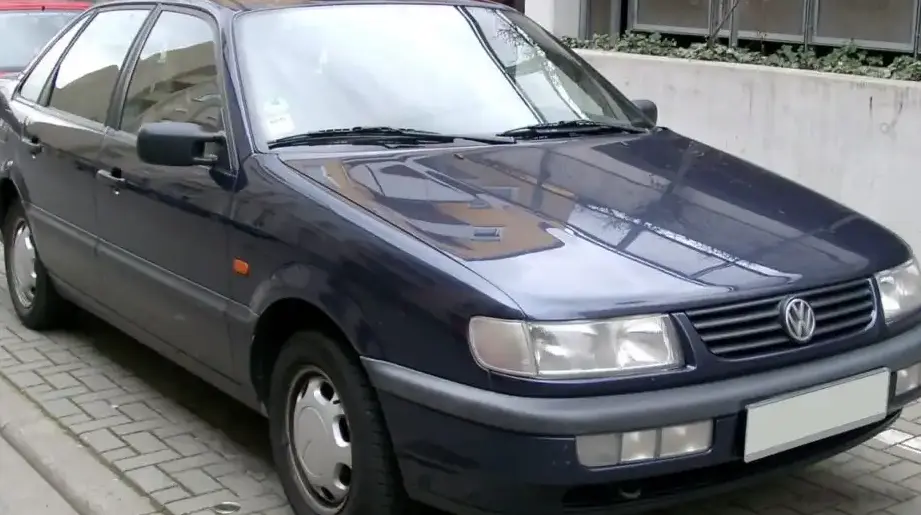
The Volkswagen Passat B4 2.0 16V, produced between 1993 and 1996, represented a significant evolution of Volkswagen’s mid-size offering. Positioned as a more performance-oriented variant within the B4 Passat range (which spanned from 1993-1997), the 2.0 16V offered a substantial upgrade over the base 1.8L and 1.9 TDI models. It was primarily marketed in Europe, where it competed with other sporty sedans like the Ford Mondeo and Opel Vectra. The B4 generation itself was a major redesign of the Passat, moving away from the boxy styling of the B3 and adopting a more aerodynamic and modern appearance. This model was built on the Volkswagen Group’s B4 platform, shared with models like the Audi A4 and the SEAT Cordoba.
Technical Specifications
| Brand | Volkswagen |
| Model | Passat |
| Generation | Passat (B4) |
| Type (Engine) | 2.0 16V (150 Hp) |
| Start of production | 1993 |
| End of production | 1996 |
| Powertrain Architecture | Internal Combustion engine |
| Body type | Sedan |
| Seats | 5 |
| Doors | 4 |
| Fuel consumption (urban) | 11.4 l/100 km (20.6 US mpg) |
| Fuel consumption (extra urban) | 6.3 l/100 km (37.3 US mpg) |
| Fuel Type | Petrol (Gasoline) |
| Acceleration 0 – 100 km/h | 9.7 sec |
| Acceleration 0 – 62 mph | 9.7 sec |
| Acceleration 0 – 60 mph | 9.2 sec |
| Maximum speed | 213 km/h (132.35 mph) |
| Emission standard | Euro 2 |
| Weight-to-power ratio | 8.4 kg/Hp |
| Weight-to-torque ratio | 7 kg/Nm |
| Power | 150 Hp @ 6000 rpm |
| Power per litre | 75.6 Hp/l |
| Torque | 180 Nm @ 4800 rpm (132.76 lb.-ft. @ 4800 rpm) |
| Engine layout | Front, Transverse |
| Engine Model/Code | ABF |
| Engine displacement | 1984 cm3 (121.07 cu. in.) |
| Number of cylinders | 4 |
| Engine configuration | Inline |
| Cylinder Bore | 82.5 mm (3.25 in.) |
| Piston Stroke | 92.8 mm (3.65 in.) |
| Compression ratio | 10.5:1 |
| Number of valves per cylinder | 4 |
| Fuel injection system | Multi-port manifold injection |
| Engine aspiration | Naturally aspirated engine |
| Valvetrain | DOHC |
| Engine oil capacity | 4 l (4.23 US qt | 3.52 UK qt) |
| Coolant capacity | 5 l (5.28 US qt | 4.4 UK qt) |
| Kerb Weight | 1259 kg (2775.62 lbs.) |
| Max. weight | 1860 kg (4100.6 lbs.) |
| Max load | 601 kg (1324.98 lbs.) |
| Trunk (boot) space – minimum | 578 l (20.41 cu. ft.) |
| Trunk (boot) space – maximum | 990 l (34.96 cu. ft.) |
| Fuel tank capacity | 70 l (18.49 US gal | 15.4 UK gal) |
| Max. roof load | 75 kg (165.35 lbs.) |
| Permitted trailer load with brakes (12%) | 1500 kg (3306.93 lbs.) |
| Permitted trailer load without brakes | 650 kg (1433 lbs.) |
| Length | 4605 mm (181.3 in.) |
| Width | 1720 mm (67.72 in.) |
| Height | 1430 mm (56.3 in.) |
| Wheelbase | 2625 mm (103.35 in.) |
| Front track | 1485 mm (58.46 in.) |
| Rear track | 1428 mm (56.22 in.) |
| Minimum turning circle | 10.7 m (35.1 ft.) |
| Drivetrain Architecture | Front wheel drive |
| Number of gears | 5 |
| Gearbox type | Manual transmission |
| Front suspension | Coil spring, Wishbone, Transverse stabilizer |
| Rear suspension | Wishbone, Transverse stabilizer, Coil spring |
| Front brakes | Ventilated discs |
| Rear brakes | Disc |
| Assisting systems | ABS (Anti-lock braking system) |
| Steering type | Steering rack and pinion |
| Power steering | Hydraulic |
| Tires size | 205/50 R15 |
| Wheel rims size | 6J x 15 |
Powertrain & Engine Architecture
The heart of the Passat B4 2.0 16V is the ABF engine code, a 1.984-liter, inline-four cylinder gasoline engine. This engine is notable for its dual overhead camshafts (DOHC) and four valves per cylinder, contributing to its higher power output compared to the single overhead cam (SOHC) 1.8L engines available in other Passat B4 trims. The ABF utilized Bosch Motronic fuel injection, a multi-port system that precisely meters fuel into the intake ports. This system, combined with the 10.5:1 compression ratio, allowed for efficient combustion and a respectable 150 horsepower at 6000 rpm and 180 Nm (132.76 lb-ft) of torque at 4800 rpm. The engine’s transverse mounting and front-wheel-drive configuration were standard for the B4 Passat. The five-speed manual transmission was the most common pairing for this engine, offering precise gear changes and enhancing the driving experience. While an automatic transmission was available, it was less frequently chosen by enthusiasts due to its impact on performance.
Driving Characteristics
The Passat B4 2.0 16V offered a noticeably more engaging driving experience than its lower-powered siblings. The 150 hp engine provided brisk acceleration, achieving 0-60 mph in approximately 9.2 seconds and a top speed of 132.35 mph. The five-speed manual transmission allowed drivers to fully exploit the engine’s powerband, while the well-tuned suspension provided a comfortable yet controlled ride. Compared to the 1.8L models, the 2.0 16V felt significantly more responsive, particularly during overtaking maneuvers. The automatic transmission option, while offering convenience, resulted in some power loss and a less direct connection to the engine. The steering was precise and well-weighted, contributing to a confident feel on both city streets and winding roads.
Equipment & Trim Levels
The 2.0 16V trim typically included features such as power windows, central locking, and a basic stereo system. Higher-spec versions could be equipped with options like air conditioning, alloy wheels, a sunroof, and upgraded upholstery. Interior trim levels varied, with cloth seats being standard and leather options available as an upgrade. The dashboard layout was functional and straightforward, typical of Volkswagen’s design philosophy at the time. Safety features included ABS anti-lock brakes, which were becoming increasingly common on European vehicles during this period.
Chassis & Braking
The Passat B4 2.0 16V utilized a MacPherson strut front suspension and a semi-independent wishbone rear suspension. This setup provided a good balance between ride comfort and handling. The front brakes were ventilated discs, offering excellent stopping power, while the rear brakes were solid discs. The ABS system further enhanced braking performance, particularly in slippery conditions. Stabilizer bars were fitted to both the front and rear axles to reduce body roll during cornering.
Market Reception & Comparison
The Passat B4 2.0 16V was generally well-received by automotive critics. It was praised for its performance, handling, and build quality. Compared to the base 1.8L models, the 2.0 16V offered a significant performance upgrade, making it a more appealing choice for drivers who enjoyed a more spirited driving experience. The 1.9 TDI models, while offering excellent fuel economy, were often considered less refined and less powerful. The 2.0 16V struck a good balance between performance and practicality, making it a popular choice for those seeking a versatile family sedan.
Legacy
The ABF engine, found in the Passat B4 2.0 16V, is known for its durability and reliability when properly maintained. Today, these cars are becoming increasingly sought after by enthusiasts and classic car collectors. While age and mileage can take their toll, well-preserved examples are still capable of providing years of reliable service. Common maintenance issues include wear and tear on suspension components, corrosion, and potential oil leaks. However, parts availability remains relatively good, making it easier to keep these vehicles on the road. The Passat B4 2.0 16V represents a sweet spot in the B4 lineup, offering a compelling combination of performance, practicality, and classic Volkswagen charm.