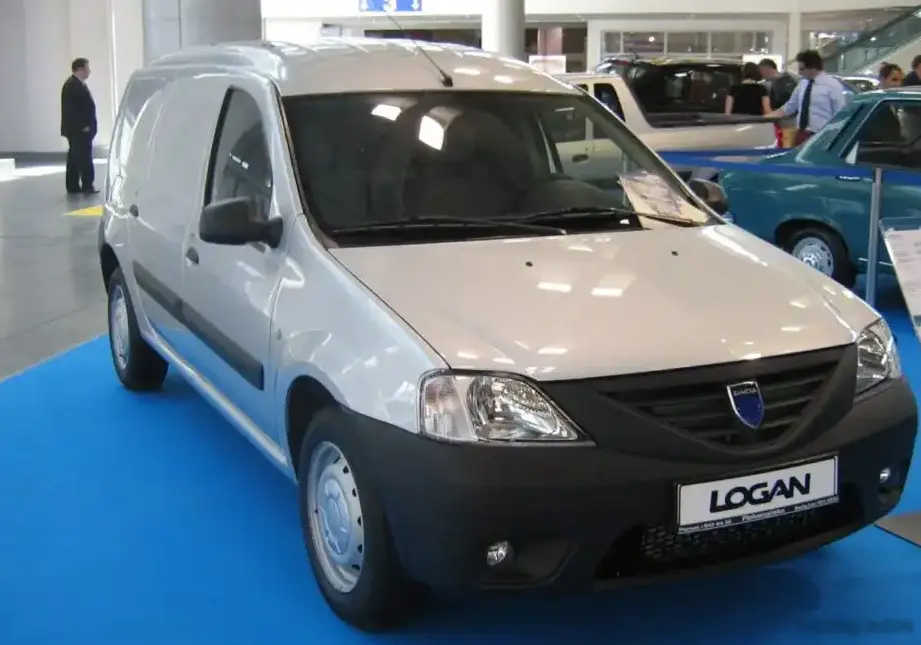
The Dacia Logan I Van 1.5 dCi, producing 68 horsepower, was a commercially-oriented variant of the first-generation Dacia Logan, manufactured from January 2007 to August 2012. Positioned as a budget-friendly workhorse, the Van version offered a significantly expanded cargo capacity compared to the standard Logan passenger car. It primarily served the needs of small businesses and tradespeople in European markets, offering a practical and affordable solution for light commercial duties. This variant was built on the Series 1 Logan platform (often referred to as the 1HX0), sharing its basic architecture with the Renault Clio II and Renault Mégane II. The 1.5 dCi engine, while not the most powerful in the Logan range, provided a balance of fuel efficiency and adequate performance for its intended purpose.
Technical Specifications
| Brand | Dacia |
| Model | Logan |
| Generation | Logan I Van |
| Type (Engine) | 1.5 dCi (68 Hp) |
| Start of production | January, 2007 |
| End of production | August, 2012 |
| Powertrain Architecture | Internal Combustion engine |
| Body type | Station wagon (estate) |
| Doors | 5 |
| Fuel consumption (urban) | 6.2 l/100 km (37.9 US mpg, 45.6 UK mpg, 16.1 km/l) |
| Fuel consumption (extra urban) | 4.8 l/100 km (49 US mpg, 58.9 UK mpg, 20.8 km/l) |
| Fuel consumption (combined) | 5.3 l/100 km (44.4 US mpg, 53.3 UK mpg, 18.9 km/l) |
| Fuel Type | Diesel |
| Acceleration 0 – 100 km/h | 17.7 sec |
| Acceleration 0 – 62 mph | 17.7 sec |
| Acceleration 0 – 60 mph | 16.8 sec |
| Maximum speed | 150 km/h (93.21 mph) |
| Emission standard | Euro 4 |
| Weight-to-power ratio | 18.8 kg/Hp, 53.1 Hp/tonne |
| Weight-to-torque ratio | 8 kg/Nm, 125 Nm/tonne |
| Power | 68 Hp @ 4000 rpm |
| Power per litre | 46.5 Hp/l |
| Torque | 160 Nm @ 2000 rpm (118.01 lb.-ft. @ 2000 rpm) |
| Engine layout | Front, Transverse |
| Engine Model/Code | K9K 792 |
| Engine displacement | 1461 cm3 (89.16 cu. in.) |
| Number of cylinders | 4 |
| Engine configuration | Inline |
| Cylinder Bore | 76 mm (2.99 in.) |
| Piston Stroke | 80.5 mm (3.17 in.) |
| Compression ratio | 18.3:1 |
| Number of valves per cylinder | 2 |
| Fuel injection system | Diesel Commonrail |
| Engine aspiration | Turbocharger, Intercooler |
| Valvetrain | OHC |
| Engine oil capacity | 4.5 l (4.76 US qt | 3.96 UK qt) |
| Coolant capacity | 4.5 l (4.76 US qt | 3.96 UK qt) |
| Kerb Weight | 1280 kg (2821.92 lbs.) |
| Max. weight | 1796 kg (3959.5 lbs.) |
| Max load | 516 kg (1137.59 lbs.) |
| Trunk (boot) space – maximum | 2350 l (82.99 cu. ft.) |
| Fuel tank capacity | 50 l (13.21 US gal | 11 UK gal) |
| Length | 4450 mm (175.2 in.) |
| Width | 1740 mm (68.5 in.) |
| Height | 1636 mm (64.41 in.) |
| Wheelbase | 2900 mm (114.17 in.) |
| Drivetrain Architecture | The Internal combustion engine (ICE) drives the front wheels of the vehicle. |
| Drive wheel | Front wheel drive |
| Number of gears and type of gearbox | 5 gears, manual transmission |
| Front brakes | Disc |
| Rear brakes | Drum |
| Assisting systems | ABS (Anti-lock braking system) |
| Tires size | 185/65 R15 |
Powertrain & Engine Architecture
The heart of the Logan I Van 1.5 dCi was the K9K 792 engine, a 1.5-liter inline-four cylinder diesel. This engine was a product of Renault’s collaboration with Nissan and was widely used across various models within the Renault-Nissan-Dacia portfolio. The K9K engine family is known for its robust construction and relatively simple design, contributing to its reliability. The 68 horsepower version utilized a turbocharger with an intercooler to boost power output, but it was intentionally detuned compared to higher-output variants found in other Logan models. Fuel was delivered via a Diesel Commonrail direct injection system, providing improved fuel atomization and more efficient combustion. The engine featured a single overhead camshaft (OHC) valvetrain with two valves per cylinder. The Van was exclusively offered with a five-speed manual transmission, chosen for its durability and cost-effectiveness. This transmission was not particularly sophisticated, but it was well-matched to the engine’s torque characteristics.
Driving Characteristics
The 1.5 dCi 68 hp engine in the Logan I Van delivered modest performance. Acceleration was slow, with a 0-60 mph time around 16.8 seconds. The focus was clearly on fuel economy and load-carrying capacity rather than outright speed. The engine produced its peak torque of 160 Nm (118 lb-ft) at 2000 rpm, providing reasonable pulling power for hauling cargo. The five-speed manual transmission had relatively long gear ratios, prioritizing fuel efficiency at cruising speeds. Compared to the 1.6-liter petrol engine offered in some Logan variants, the 1.5 dCi provided significantly better fuel economy but lacked the petrol engine’s responsiveness. The Van’s suspension was tuned for comfort and durability, capable of handling substantial loads without excessive body roll. However, the ride could become harsh when the vehicle was unladen.
Equipment & Trim Levels
The Logan I Van 1.5 dCi was typically offered in a single, utilitarian trim level. Standard equipment was minimal, reflecting its commercial focus. Features generally included a basic dashboard, cloth upholstery, power steering, and central locking. Air conditioning and a radio were often optional extras. The interior was designed for practicality and ease of cleaning, with durable materials used throughout. The Van’s defining feature was its expanded cargo area, accessed through rear doors and a large tailgate. The rear seats were typically removed to maximize cargo space, resulting in a substantial 2350-liter capacity.
Chassis & Braking
The Logan I Van utilized a simple yet effective chassis design. The front suspension consisted of MacPherson struts, while the rear suspension employed a torsion beam axle. This setup provided a good balance of ride comfort and load-carrying capacity. Braking was handled by front disc brakes and rear drum brakes. Anti-lock Braking System (ABS) was standard, enhancing safety during emergency braking situations. The Van’s tires were typically 185/65 R15, chosen for their durability and affordability. The suspension components were robustly engineered to withstand the demands of commercial use.
Market Reception & Comparison
The Dacia Logan I Van 1.5 dCi was well-received in its target market as a no-frills, affordable work vehicle. Critics praised its spacious cargo area, fuel efficiency, and low running costs. However, the engine’s limited power and the basic interior were often cited as drawbacks. Compared to other small vans available at the time, such as the Fiat Doblo or Renault Kangoo, the Logan Van offered a lower price point but lacked some of their refinement and features. The 1.5 dCi engine proved to be relatively reliable, although regular maintenance was essential to ensure longevity. Fuel economy was a strong point, consistently achieving around 44-53 mpg in real-world driving conditions.
Legacy
The Dacia Logan I Van 1.5 dCi remains a popular choice in the used commercial vehicle market, particularly among small businesses and tradespeople seeking an affordable and practical van. The K9K 792 engine, while not known for its performance, has proven to be remarkably durable when properly maintained. Common issues include turbocharger wear and potential problems with the fuel injection system, but these are generally manageable with regular servicing. The Logan Van’s simple construction and readily available parts contribute to its low cost of ownership. It represents a significant milestone in Dacia’s history, establishing the brand as a provider of affordable and reliable vehicles for the European market.