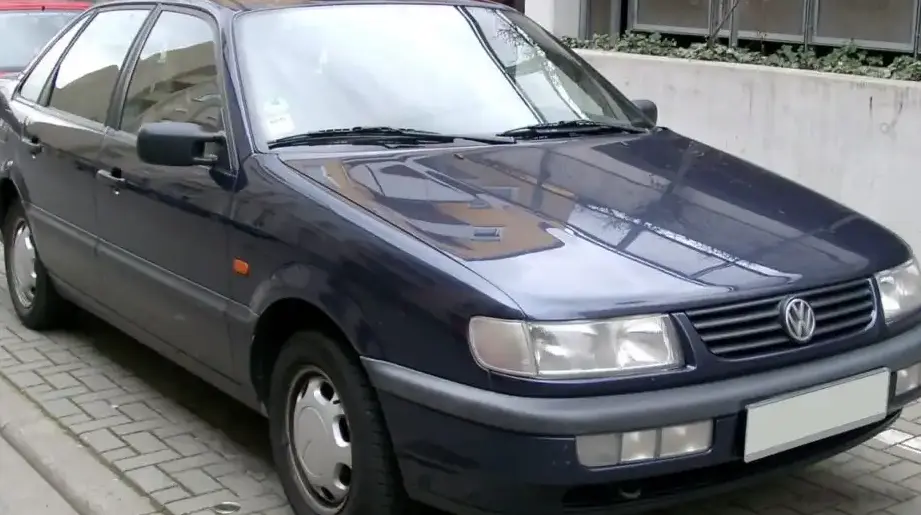
The Volkswagen Passat B4 2.8 VR6, produced between 1993 and 1996, represented a significant step forward in the Passat lineage. Positioned as the performance variant within the B4 generation (which itself spanned 1993-1997), the VR6 offered a compelling blend of comfort, space, and spirited driving. It was a key model for Volkswagen in Europe, offering a more premium alternative to mainstream sedans while establishing a reputation for engineering excellence. In the United States, the B4 Passat was sold in limited numbers, primarily appealing to enthusiasts seeking a European driving experience. This particular 2.8-liter VR6 configuration was the top-tier engine option for the B4 Passat, offering a substantial power increase over the four-cylinder models.
Technical Specifications
| Brand | Volkswagen |
| Model | Passat |
| Generation | Passat (B4) |
| Type (Engine) | 2.8 VR6 (174 Hp) |
| Start of production | 1993 |
| End of production | 1996 |
| Powertrain Architecture | Internal Combustion engine |
| Body type | Sedan |
| Seats | 5 |
| Doors | 4 |
| Fuel consumption (urban) | 12.5 l/100 km (18.8 US mpg) |
| Fuel consumption (extra urban) | 7.4 l/100 km (31.8 US mpg) |
| Fuel Type | Petrol (Gasoline) |
| Acceleration 0 – 100 km/h | 8.7 sec |
| Acceleration 0 – 62 mph | 8.7 sec |
| Acceleration 0 – 60 mph | 8.3 sec |
| Maximum speed | 224 km/h (139.19 mph) |
| Emission standard | Euro 2 |
| Weight-to-power ratio | 7.6 kg/Hp |
| Weight-to-torque ratio | 5.6 kg/Nm |
| Power | 174 Hp @ 5800 rpm |
| Power per litre | 62.3 Hp/l |
| Torque | 235 Nm @ 4200 rpm (173.33 lb.-ft. @ 4200 rpm) |
| Engine layout | Front, Transverse |
| Engine Model/Code | AAA |
| Engine displacement | 2792 cm3 (170.38 cu. in.) |
| Number of cylinders | 6 |
| Engine configuration | VR-engine |
| Cylinder Bore | 81 mm (3.19 in.) |
| Piston Stroke | 90.3 mm (3.56 in.) |
| Compression ratio | 10:1 |
| Number of valves per cylinder | 2 |
| Fuel injection system | Multi-port manifold injection |
| Engine aspiration | Naturally aspirated engine |
| Valvetrain | DOHC |
| Engine oil capacity | 6 l (6.34 US qt | 5.28 UK qt) |
| Coolant capacity | 8.2 l (8.66 US qt | 7.21 UK qt) |
| Kerb Weight | 1325 kg (2921.12 lbs.) |
| Max. weight | 1910 kg (4210.83 lbs.) |
| Max load | 585 kg (1289.7 lbs.) |
| Trunk (boot) space – minimum | 578 l (20.41 cu. ft.) |
| Trunk (boot) space – maximum | 990 l (34.96 cu. ft.) |
| Fuel tank capacity | 70 l (18.49 US gal | 15.4 UK gal) |
| Max. roof load | 75 kg (165.35 lbs.) |
| Permitted trailer load with brakes (12%) | 1500 kg (3306.93 lbs.) |
| Permitted trailer load without brakes | 700 kg (1543.24 lbs.) |
| Length | 4605 mm (181.3 in.) |
| Width | 1720 mm (67.72 in.) |
| Height | 1430 mm (56.3 in.) |
| Wheelbase | 2625 mm (103.35 in.) |
| Front track | 1485 mm (58.46 in.) |
| Rear track | 1428 mm (56.22 in.) |
| Front overhang | 915 mm (36.02 in.) |
| Rear overhang | 1065 mm (41.93 in.) |
| Minimum turning circle | 10.7 m (35.1 ft.) |
| Drivetrain Architecture | Front wheel drive |
| Number of gears | 5 |
| Gearbox type | Manual transmission |
| Front suspension | Coil spring, Wishbone, Transverse stabilizer |
| Rear suspension | Wishbone, Transverse stabilizer, Coil spring |
| Front brakes | Ventilated discs |
| Rear brakes | Disc |
| Assisting systems | ABS (Anti-lock braking system) |
| Steering type | Steering rack and pinion |
| Power steering | Hydraulic |
| Tires size | 205/50 R15 |
| Wheel rims size | 6J x 15 |
INTRODUCTION
The Volkswagen Passat B4 2.8 VR6, launched in 1993, was a significant evolution of the Passat model. Building upon the B3 platform, the B4 featured revised styling, improved interior refinement, and, crucially, the introduction of the VR6 engine as a top-tier option. The VR6, a narrow-angle V6, offered a unique blend of smoothness and performance. The B4 generation aimed to bridge the gap between mainstream family sedans and more premium offerings, and the 2.8 VR6 variant was positioned as the flagship model, appealing to drivers seeking a more engaging and refined driving experience. It was sold alongside 1.8L and 2.0L four-cylinder options, as well as a turbocharged 1.9L TDI diesel.
Powertrain & Engine Architecture
The heart of the Passat B4 2.8 VR6 is the AAA engine code, a 2.8-liter naturally aspirated VR6 engine. This engine is notable for its compact design, achieved by arranging the cylinders in a narrow V-angle (15 degrees). This configuration allows it to be packaged more easily into a front-wheel-drive chassis. The engine utilizes multi-port fuel injection and a dual overhead camshaft (DOHC) valvetrain, contributing to its smooth power delivery. The VR6 produces 174 horsepower at 5800 rpm and 235 Nm (173.33 lb-ft) of torque at 4200 rpm. The engine’s power is delivered through a five-speed manual transmission, although a four-speed automatic transmission was also available, albeit less common and generally considered to diminish the engine’s potential. The automatic transmission was a conventional hydraulic unit, lacking the sophistication of modern electronically controlled gearboxes.
Driving Characteristics
The Passat B4 2.8 VR6 offered a noticeably more engaging driving experience than its four-cylinder counterparts. The VR6 engine provided strong acceleration, with a 0-60 mph time of around 8.3 seconds and a top speed of 139.19 mph. The engine’s torque curve was relatively flat, providing good responsiveness across a wide range of engine speeds. The five-speed manual transmission allowed drivers to fully exploit the engine’s power, while the automatic, while offering convenience, resulted in some power loss and a less direct connection to the engine. The B4’s suspension, featuring coil springs and wishbone setups front and rear, provided a comfortable ride while maintaining reasonable handling characteristics. The steering, utilizing a hydraulic rack and pinion system, was precise and well-weighted.
Equipment & Trim Levels
The 2.8 VR6 typically came with a higher level of standard equipment than the lower-trim Passats. Features included central locking, power windows, power steering, and ABS anti-lock brakes. Interior upholstery was typically cloth, although leather options were available. The dashboard featured a comprehensive instrument cluster with clear gauges and a central information display. Optional extras included a sunroof, air conditioning, and upgraded audio systems. The VR6 trim often featured unique badging and alloy wheels to distinguish it from other Passat models.
Chassis & Braking
The Passat B4 2.8 VR6 utilized a front-wheel-drive chassis with independent suspension at all four corners. The front suspension employed coil springs and wishbones, while the rear suspension featured a wishbone setup with coil springs. Braking duties were handled by ventilated discs at the front and solid discs at the rear. The ABS anti-lock braking system was standard, enhancing safety and control during hard braking. Stabilizer bars were fitted to both the front and rear axles to reduce body roll during cornering.
Market Reception & Comparison
The Passat B4 2.8 VR6 was generally well-received by automotive critics. It was praised for its smooth and powerful engine, comfortable ride, and spacious interior. However, some critics noted that the front-wheel-drive layout limited its handling potential compared to rear-wheel-drive competitors. Compared to the four-cylinder Passats, the VR6 offered a significant performance upgrade, but at a higher price point. The VR6 also consumed more fuel than the smaller-engined models. Compared to the later Passat B5, the B4 was considered to be less refined, but it offered a more classic and engaging driving experience.
Legacy
The Passat B4 2.8 VR6 has developed a loyal following among enthusiasts. The AAA VR6 engine is known for its durability and relatively straightforward maintenance. While not immune to age-related issues, the engine is generally considered to be reliable if properly maintained. Today, well-maintained examples of the B4 2.8 VR6 are sought after by collectors and enthusiasts who appreciate its unique character and performance. Parts availability is generally good, although some specific components may be becoming increasingly difficult to find. The B4 VR6 remains a testament to Volkswagen’s engineering prowess and a reminder of a time when front-wheel-drive sedans could still offer a genuinely engaging driving experience.