
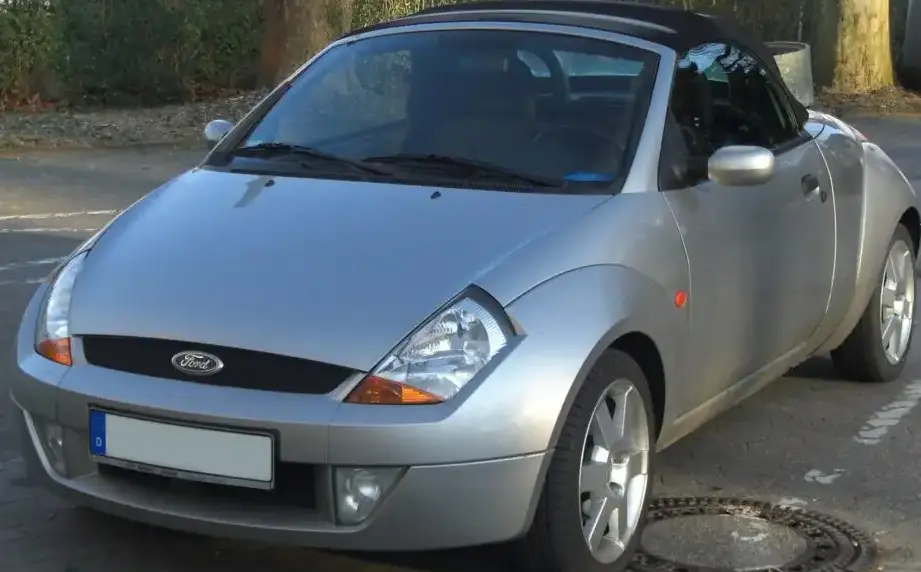
The Ford StreetKa (RL2) 1.6i, produced from October 2002 to April 2006, represented Ford’s entry into the small, affordable roadster market. Built on a shortened Ford Fiesta Mk5 platform, the StreetKa aimed to deliver a fun-to-drive experience with a focus on style and accessibility. This 95 horsepower variant occupied a mid-range position within the StreetKa lineup, offering a balance between performance and economy, slotting below the later, more powerful 1.6-liter Duratec engine options. It was primarily marketed towards younger drivers and those seeking a sporty, open-top vehicle for urban and leisure driving, particularly in Europe where the compact roadster segment was popular.
Technical Specifications
| Brand | Ford |
| Model | Streetka |
| Generation | Streetka (RL2) |
| Type (Engine) | 1.6i (95 Hp) |
| Start of production | October, 2002 |
| End of production | April, 2006 |
| Powertrain Architecture | Internal Combustion engine |
| Body type | Roadster |
| Seats | 2 |
| Doors | 2 |
| Fuel consumption (urban) | 10.6 l/100 km (22.2 US mpg, 26.6 UK mpg, 9.4 km/l) |
| Fuel consumption (extra urban) | 6.4 l/100 km (36.8 US mpg, 44.1 UK mpg, 15.6 km/l) |
| Fuel consumption (combined) | 7.9 l/100 km (29.8 US mpg, 35.8 UK mpg, 12.7 km/l) |
| Fuel Type | Petrol (Gasoline) |
| Acceleration 0 – 100 km/h | 12.1 sec |
| Acceleration 0 – 62 mph | 12.1 sec |
| Acceleration 0 – 60 mph | 11.5 sec |
| Maximum speed | 173 km/h (107.5 mph) |
| Emission standard | Euro 4 |
| Weight-to-power ratio | 12 kg/Hp, 83.6 Hp/tonne |
| Weight-to-torque ratio | 8.4 kg/Nm, 118.8 Nm/tonne |
| Power | 95 Hp @ 5500 rpm |
| Power per litre | 59.4 Hp/l |
| Torque | 135 Nm @ 4250 rpm (99.57 lb.-ft. @ 4250 rpm) |
| Engine layout | Front, Transverse |
| Engine displacement | 1599 cm3 (97.58 cu. in.) |
| Number of cylinders | 4 |
| Engine configuration | Inline |
| Cylinder Bore | 82.1 mm (3.23 in.) |
| Piston Stroke | 75.5 mm (2.97 in.) |
| Compression ratio | 9.5:1 |
| Number of valves per cylinder | 2 |
| Fuel injection system | Multi-port manifold injection |
| Engine aspiration | Naturally aspirated engine |
| Valvetrain | SOHC |
| Engine oil capacity | 4.35 l (4.6 US qt | 3.83 UK qt) |
| Coolant | 5.25 l (5.55 US qt | 4.62 UK qt) |
| Kerb Weight | 1136 kg (2504.45 lbs.) |
| Fuel tank capacity | 40 l (10.57 US gal | 8.8 UK gal) |
| Length | 3650 mm (143.7 in.) |
| Width | 1679 mm (66.1 in.) |
| Height | 1342 mm (52.83 in.) |
| Wheelbase | 2448 mm (96.38 in.) |
| Minimum turning circle | 11.1 m (36.42 ft.) |
| Drivetrain Architecture | Front wheel drive |
| Number of gears | 5 gears, manual transmission |
| Rear suspension | Torsion |
| Front brakes | Ventilated discs |
| Rear brakes | Disc |
| Assisting systems | ABS (Anti-lock braking system) |
| Steering type | Steering rack and pinion |
| Power steering | Hydraulic Steering |
| Tires size | 195/45 R16 |
| Wheel rims size | 6J x 16 |
Powertrain & Engine Architecture
The StreetKa 1.6i utilized the Ford Zetec-S 1.6-liter inline-four cylinder engine, an evolution of the earlier Zetec series. This engine, internally designated as the Sigma series, featured a single overhead camshaft (SOHC) design with two valves per cylinder. The multi-port fuel injection system delivered fuel to the cylinders, optimizing combustion for both power and efficiency. The engine produced 95 horsepower at 5500 rpm and 135 Nm (99.57 lb-ft) of torque at 4250 rpm. This power was delivered through a five-speed manual transmission, the only gearbox option available for this variant. The engine’s transverse mounting and front-wheel-drive configuration were typical for compact European cars of the era. The engine’s relatively simple design contributed to its reliability and ease of maintenance.
Driving Characteristics
The 1.6i StreetKa offered a lively, if not outright rapid, driving experience. The 95 hp engine provided adequate power for spirited driving on winding roads, but acceleration was modest, taking approximately 12.1 seconds to reach 62 mph. The five-speed manual transmission was well-matched to the engine’s characteristics, offering precise shifts and allowing the driver to keep the engine in its optimal power band. Compared to the later, more powerful Duratec 1.6-liter variants, the 1.6i felt less urgent in acceleration, but its lighter weight and responsive steering made it enjoyable to drive. The relatively short wheelbase contributed to a nimble feel, but also meant the ride could be somewhat firm on uneven surfaces. The power delivery was linear, making it predictable and easy to control.
Equipment & Trim Levels
The StreetKa 1.6i typically came equipped with a relatively basic, but functional, level of equipment. Standard features included power steering, ABS brakes, and a driver’s airbag. Interior appointments were simple, with cloth upholstery and a straightforward dashboard layout. Optional extras included air conditioning, alloy wheels, and a CD player. The StreetKa was designed to be an affordable roadster, so luxury features were kept to a minimum. The focus was on providing a fun and engaging driving experience rather than opulent comfort. Trim levels were limited, with most variations stemming from the addition of optional packages.
Chassis & Braking
The StreetKa’s chassis was based on a shortened version of the Ford Fiesta Mk5 platform. The front suspension utilized MacPherson struts, while the rear suspension employed a torsion beam setup. This configuration provided a good balance between handling and ride comfort, although the torsion beam rear suspension limited independent wheel movement. The braking system consisted of ventilated discs at the front and solid discs at the rear, providing adequate stopping power for the vehicle’s weight and performance. The hydraulic power steering offered light and precise steering feel, enhancing the driving experience.
Market Reception & Comparison
The Ford StreetKa was generally well-received by automotive critics as an affordable and stylish roadster. The 1.6i variant was praised for its lively handling and fuel efficiency, but some reviewers noted its modest power output. Compared to rivals such as the Mazda MX-5, the StreetKa offered a lower price point but lacked the same level of refinement and performance. Fuel economy was respectable for its class, averaging around 30 mpg in combined driving. Reliability was generally good, with the Zetec-S engine proving to be durable and relatively trouble-free. However, some owners reported issues with the soft top mechanism and electrical components.
Legacy
The Ford StreetKa, particularly the 1.6i variant, has become a popular choice among enthusiasts seeking an affordable and fun-to-drive roadster. The Zetec-S engine is known for its reliability and ease of maintenance, making it a relatively inexpensive car to own and operate. On the used car market, StreetKas in good condition command reasonable prices. While not as highly regarded as some of its rivals, the StreetKa remains a charming and enjoyable vehicle that offers a unique driving experience. Its simple design and readily available parts make it a popular choice for restoration projects and track day enthusiasts.
