
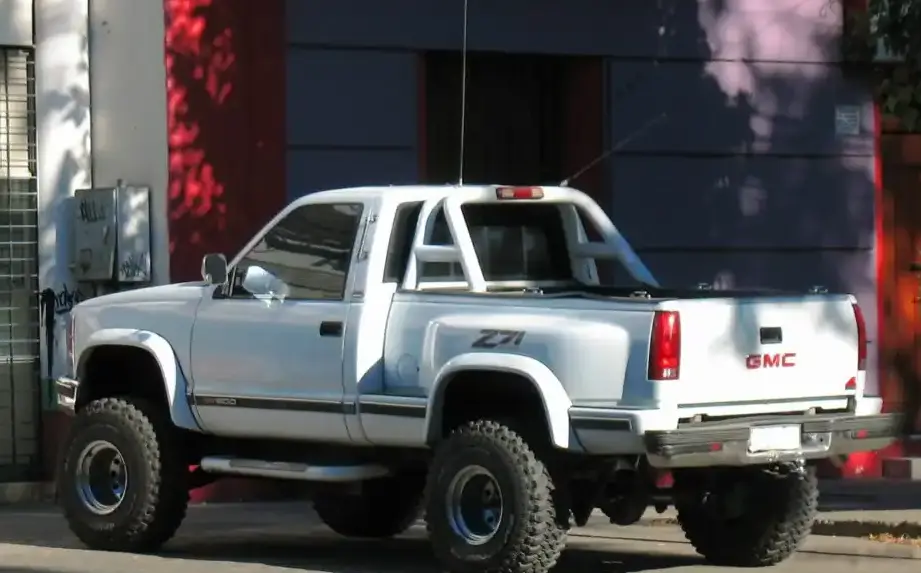
The GMC Sierra 1500, in its first generation (GMT400), represented GMC’s entry into the increasingly popular full-size pickup truck market. Produced from 1988 through 1992, this iteration of the Sierra aimed to provide a blend of work-truck capability and everyday usability. The Regular Cab SWB (Short Wheelbase) Sportside configuration, equipped with the 5.7-liter V8 engine producing 210 horsepower and paired with a four-speed automatic transmission and four-wheel drive, occupied a significant position within the lineup, offering a balance between power, convenience, and affordability. This particular variant was targeted towards buyers needing a capable truck for both work and personal use, without the expense of higher trim levels or the complexity of newer technologies.
Technical Specifications
| Brand | GMC |
| Model | Sierra 1500 |
| Generation | Sierra 1500 I (GMT400) Regular cab SWB Sportside |
| Type (Engine) | 5.7 V8 (210 Hp) 4WD Automatic |
| Start of production | 1988 |
| End of production | 1992 |
| Powertrain Architecture | Internal Combustion engine |
| Body type | Pick-up |
| Seats | 3 |
| Doors | 2 |
| Fuel Type | Petrol (Gasoline) |
| Power | 210 Hp @ 4000 rpm |
| Torque | 407 Nm @ 2800 rpm / 300.19 lb.-ft. @ 2800 rpm |
| Engine layout | Front, Longitudinal |
| Number of cylinders | 8 |
| Engine configuration | V-engine |
| Cylinder Bore | 101.6 mm / 4 in |
| Piston Stroke | 88.39 mm / 3.48 in |
| Compression ratio | 9.3:1 |
| Fuel injection system | Multi-port manifold injection |
| Engine aspiration | Naturally aspirated engine |
| Max. weight | 2540 kg / 5599.74 lbs |
| Fuel tank capacity | 95 l / 25.1 US gal | 20.9 UK gal |
| Length | 5065 mm / 199.41 in |
| Width | 1958 mm / 77.09 in |
| Height | 1788 mm / 70.39 in |
| Wheelbase | 2985 mm / 117.52 in |
| Front overhang | 886 mm / 34.88 in |
| Rear overhang | 1194 mm / 47.01 in |
| Drivetrain Architecture | The Internal combustion engine (ICE) drives the rear wheels permanently, and the front wheels are driven through an electrically or mechanically operated clutch if necessary. |
| Drive wheel | All wheel drive (4×4) |
| Number of gears and type of gearbox | 4 gears, automatic transmission |
| Front suspension | Independent torsion bar, double wishbone |
| Rear suspension | Rigid axle suspension, Leaf spring |
| Front brakes | Disc |
| Rear brakes | Drum |
| Tires size | 225/75 R16 |
Powertrain & Engine Architecture
The heart of this Sierra 1500 variant was the 5.7-liter (350 cubic inch) small-block Chevrolet V8 engine. This engine, internally designated as the L05, was a staple of General Motors’ truck and SUV lineup for many years. It featured a cast iron block and cylinder heads, a 9.3:1 compression ratio, and a multi-port fuel injection system. The multi-port injection, a relatively modern feature for the time, improved fuel efficiency and throttle response compared to earlier carbureted designs. The engine’s valvetrain utilized a two-valve per cylinder configuration, operated by a hydraulic lifter camshaft. The 4L40 four-speed automatic transmission was the standard pairing for this engine. This transmission was known for its durability and relatively smooth shifting, although it lacked the overdrive gear found in some later transmissions, impacting highway fuel economy. The 4WD system employed a part-time transfer case, allowing the driver to switch between two-wheel drive and four-wheel drive as needed.
Driving Characteristics
The 210 horsepower and 300 lb-ft of torque provided by the 5.7L V8 and 4L40 automatic offered adequate, but not exceptional, performance. Acceleration was reasonable for the era, but the lack of overdrive in the transmission meant engine speeds were higher at highway cruising speeds. The automatic transmission’s gear ratios were optimized for towing and hauling, prioritizing low-end torque over outright speed. Compared to the available 6.2L diesel engine, the 5.7L V8 offered quicker acceleration but significantly lower fuel economy and reduced towing capacity. Against the smaller 4.3L V6 option, the 5.7L provided a noticeable power increase, making it the preferred choice for those regularly hauling heavy loads or towing trailers. The short wheelbase contributed to a somewhat choppy ride, especially when unloaded, but also enhanced maneuverability in tight spaces.
Equipment & Trim Levels
The Regular Cab SWB Sportside trim represented a mid-range offering within the Sierra 1500 lineup. Standard features typically included a basic AM/FM radio, vinyl upholstery, and a tilt steering wheel. The “Sportside” designation indicated a slightly more refined interior and exterior appearance compared to the base “Work Truck” models. Optional extras included air conditioning, power windows and locks, a cruise control, and upgraded sound systems. The interior was functional and durable, designed to withstand the rigors of daily use. The dashboard layout was straightforward, with clearly labeled controls. Exterior features included bright trim, a chrome grille, and standard running boards.
Chassis & Braking
The GMT400 platform utilized a body-on-frame construction, providing a robust and durable chassis. The front suspension consisted of an independent torsion bar setup with double wishbone control arms, offering a reasonable level of ride comfort and handling. The rear suspension employed a traditional leaf spring setup, which was well-suited for carrying heavy loads. Braking duties were handled by front disc brakes and rear drum brakes. While adequate for the truck’s weight, the braking system lacked the sophistication of later designs. The 225/75R16 tires provided a good balance of on-road and off-road traction.
Market Reception & Comparison
The 1988-1992 GMC Sierra 1500 with the 5.7L V8 and automatic transmission was generally well-received by critics and consumers. It was praised for its reliability, durability, and overall value. However, some reviewers noted the lack of refinement compared to newer pickup trucks on the market. Fuel economy was a common criticism, particularly given the rising gasoline prices during this period. Compared to the Ford F-150 and Chevrolet C/K series trucks, the Sierra 1500 offered a similar level of performance and features, but often at a slightly higher price point. The 5.7L V8 offered a good compromise between power and fuel economy, making it a popular choice for buyers who needed a capable truck without the expense of a larger engine.
Legacy
The GMT400 Sierra 1500, particularly the 5.7L V8 automatic variant, has proven to be a remarkably durable and long-lasting vehicle. Many examples are still on the road today, a testament to the quality of its construction and the reliability of the powertrain. The 5.7L V8 engine is known for its longevity and relatively simple maintenance requirements. While parts availability may be becoming more challenging, many aftermarket suppliers continue to offer components for these trucks. In the used car market, these Sierras are often sought after by enthusiasts and collectors, as well as those looking for a dependable and affordable work truck. They represent a significant piece of American automotive history, embodying the ruggedness and practicality of the full-size pickup truck.

