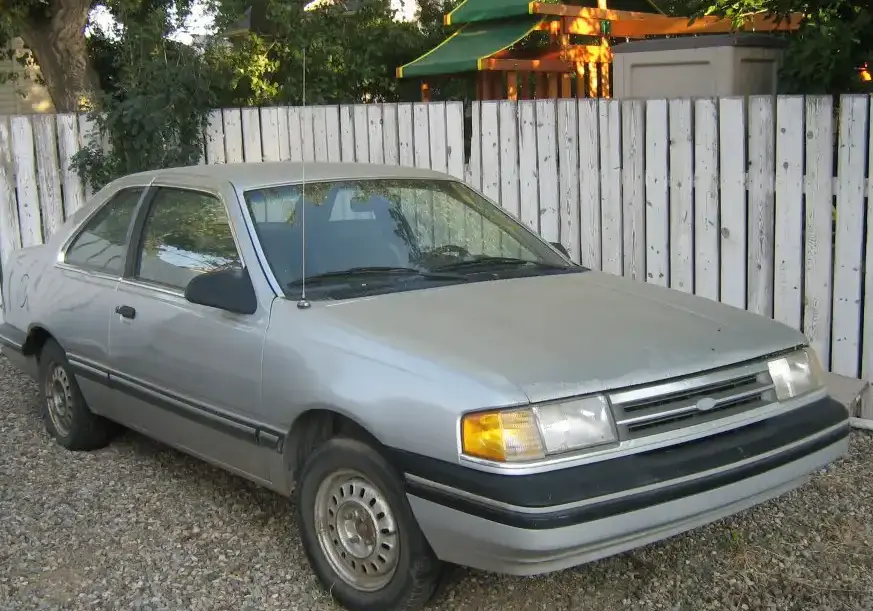
The Ford Tempo Coupe 2.3, producing 102 horsepower, was a mainstay of the American compact car market from 1987 through 1995. Positioned as a relatively affordable and practical option, the Coupe variant of the Tempo aimed to provide a stylish alternative to the sedan while maintaining the model’s reputation for fuel efficiency and dependability. It was part of the first generation of the Tempo, which was initially introduced in 1983 as a replacement for the Ford Fairmount and Mercury Topaz. The 2.3-liter engine and five-speed manual transmission combination represented a mid-range offering within the Tempo lineup, slotting below the more powerful, though less common, 3.0-liter V6 option.
Technical Specifications
| Brand | Ford |
| Model | Tempo |
| Generation | Tempo Coupe |
| Type (Engine) | 2.3 (102 Hp) |
| Start of production | 1987 |
| End of production | 1995 |
| Powertrain Architecture | Internal Combustion engine |
| Body type | Coupe |
| Seats | 5 |
| Doors | 2 |
| Fuel consumption (urban) | 11 l/100 km (21.4 US mpg) |
| Fuel consumption (extra urban) | 7 l/100 km (33.6 US mpg) |
| Fuel Type | Petrol (Gasoline) |
| Maximum speed | 160 km/h (99.42 mph) |
| Weight-to-power ratio | 11.6 kg/Hp |
| Weight-to-torque ratio | 6.7 kg/Nm |
| Power | 102 Hp @ 4400 rpm |
| Power per litre | 44.2 Hp/l |
| Torque | 176 Nm @ 2600 rpm (129.81 lb.-ft. @ 2600 rpm) |
| Engine layout | Front, Transverse |
| Engine displacement | 2307 cm3 (140.78 cu. in.) |
| Number of cylinders | 4 |
| Engine configuration | Inline |
| Cylinder Bore | 93.5 mm (3.68 in.) |
| Piston Stroke | 84 mm (3.31 in.) |
| Compression ratio | 9:1 |
| Number of valves per cylinder | 2 |
| Fuel injection system | Multi-port manifold injection |
| Engine aspiration | Naturally aspirated engine |
| Valvetrain | OHC |
| Engine oil capacity | 4.7 l (4.97 US qt | 4.14 UK qt) |
| Coolant | 7.5 l (7.93 US qt | 6.6 UK qt) |
| Kerb Weight | 1180 kg (2601.45 lbs.) |
| Trunk (boot) space (minimum) | 375 l (13.24 cu. ft.) |
| Fuel tank capacity | 60 l (15.85 US gal | 13.2 UK gal) |
| Length | 4490 mm (176.77 in.) |
| Width | 1735 mm (68.31 in.) |
| Height | 1340 mm (52.76 in.) |
| Wheelbase | 2540 mm (100 in.) |
| Front track | 1395 mm (54.92 in.) |
| Rear track | 1460 mm (57.48 in.) |
| Drivetrain Architecture | Front wheel drive |
| Number of gears and type of gearbox | 5 gears, manual transmission |
| Front suspension | Coil spring |
| Rear suspension | Coil spring |
| Front brakes | Ventilated discs |
| Rear brakes | Drum |
| Assisting systems | ABS (Anti-lock braking system) |
| Steering type | Steering rack and pinion |
| Power steering | Hydraulic Steering |
| Tires size | 185/70 R14 |
Powertrain & Engine Architecture
The heart of the Tempo Coupe 2.3 was the 2.3-liter inline-four cylinder engine, internally designated as the 2.3L HSC. This engine was a relatively simple design, featuring a single overhead camshaft (OHC) operating two valves per cylinder. Fuel delivery was handled by a multi-port fuel injection system, which improved efficiency and responsiveness compared to earlier carbureted designs. The 9:1 compression ratio was a compromise between performance and the ability to run on readily available 87-octane gasoline. The engine’s 102 horsepower at 4400 rpm and 129.81 lb-ft of torque at 2600 rpm were considered adequate for the vehicle’s weight class. The five-speed manual transmission offered a reasonable balance between fuel economy and driver control. Gear ratios were fairly conventional, prioritizing acceleration in the lower gears and highway cruising in the higher gears.
Driving Characteristics
The Tempo Coupe 2.3 with the manual transmission provided a fairly unremarkable, but competent, driving experience. Acceleration was adequate for merging onto highways and passing slower traffic, but it wasn’t a particularly sporty vehicle. The 2.3-liter engine felt somewhat strained at higher RPMs, and the engine lacked the refinement of some of its Japanese competitors. The five-speed manual transmission allowed drivers to keep the engine in its optimal power band, but the shift quality was not particularly precise. Compared to the optional 3.0-liter V6, the 2.3-liter engine offered significantly less power, resulting in slower acceleration and a less engaging driving experience. However, the 2.3-liter engine was more fuel-efficient and generally less expensive to maintain.
Equipment & Trim Levels
The Tempo Coupe 2.3 typically came standard with features considered essential for the time, including a basic AM/FM radio, cloth upholstery, and manual windows and locks. Air conditioning was a popular option. Higher trim levels, such as the GLX, added features like upgraded interior trim, power windows and locks, and a better sound system. Optional extras included a sunroof, cruise control, and upgraded wheels. The interior design was functional but somewhat spartan, reflecting the Tempo’s focus on affordability. The dashboard layout was straightforward and easy to use, with clearly labeled controls.
Chassis & Braking
The Tempo Coupe utilized a relatively simple chassis design, with coil spring suspension at all four wheels. The front suspension featured MacPherson struts, while the rear suspension used a twist-beam axle. This setup provided a comfortable ride, but handling was not particularly sharp. The front brakes were ventilated discs, providing adequate stopping power, while the rear brakes were drums, which were less effective. Anti-lock brakes (ABS) were available as an option, improving braking performance in slippery conditions. The steering was rack-and-pinion, with hydraulic power assist, providing reasonably light and precise steering feel.
Market Reception & Comparison
The Ford Tempo Coupe 2.3 was generally well-received by critics as a practical and affordable compact car. However, it was often criticized for its lack of refinement and its somewhat uninspired driving dynamics. Compared to other cars in its class, such as the Honda Civic and Toyota Corolla, the Tempo offered a lower price point but lacked the same level of build quality and driving enjoyment. Fuel economy was a strong point for the Tempo, and it was generally considered to be a reliable vehicle. The 2.3-liter engine proved to be durable and relatively easy to maintain. The manual transmission version was favored by drivers who prioritized fuel economy and driver control.
Legacy
The Ford Tempo, including the 2.3-liter Coupe variant, enjoyed a long production run and sold in significant numbers. While not a particularly memorable or iconic vehicle, it served as a dependable and affordable transportation option for many American families. The 2.3-liter HSC engine proved to be a robust and reliable powerplant, and many examples are still on the road today. In the used car market, the Tempo Coupe 2.3 is often sought after by enthusiasts looking for a simple, inexpensive, and easy-to-maintain classic car. Its relatively low running costs and readily available parts make it an attractive option for those seeking a vintage vehicle without the complexities of more exotic models.