
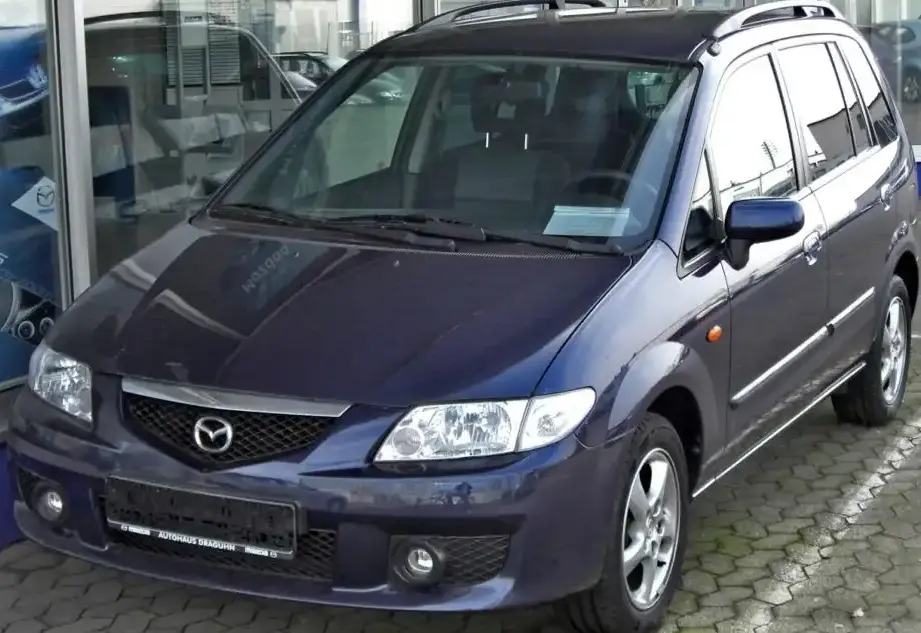
The Mazda Premacy, known as the Mazda Livina in some markets, is a compact minivan produced by Mazda from 1999 to 2005. The first generation, designated CP, was introduced in June 1999 and continued through October 2001, with this particular iteration featuring a 1.8-liter gasoline engine producing 114 horsepower. This variant occupied a mid-range position within the Premacy lineup, offering a balance between affordability and practicality for families. It was primarily sold in Japan and Europe, aiming to compete with vehicles like the Renault Scenic and Toyota Yaris Verso. The CP Premacy was notable for its relatively spacious interior and flexible seating arrangements within a compact footprint.
Technical Specifications
| Brand | Mazda |
| Model | Premacy |
| Generation | Premacy (CP) |
| Type (Engine) | 1.8 (114 Hp) |
| Start of production | June, 1999 |
| End of production | October, 2001 |
| Powertrain Architecture | Internal Combustion engine |
| Body type | Minivan |
| Seats | 5 |
| Doors | 5 |
| Fuel Type | Petrol (Gasoline) |
| Acceleration 0 – 100 km/h | 11 sec |
| Acceleration 0 – 62 mph | 11 sec |
| Acceleration 0 – 60 mph | 10.5 sec |
| Maximum speed | 180 km/h (111.85 mph) |
| Weight-to-power ratio | 11 kg/Hp, 91.2 Hp/tonne |
| Weight-to-torque ratio | 8 kg/Nm, 125.6 Nm/tonne |
| Power | 114 Hp @ 6000 rpm |
| Power per litre | 62 Hp/l |
| Torque | 157 Nm @ 4000 rpm (115.8 lb.-ft. @ 4000 rpm) |
| Engine layout | Front, Transverse |
| Engine displacement | 1840 cm3 (112.28 cu. in.) |
| Number of cylinders | 4 |
| Engine configuration | Inline |
| Cylinder Bore | 83 mm (3.27 in.) |
| Piston Stroke | 85 mm (3.35 in.) |
| Compression ratio | 9:1 |
| Number of valves per cylinder | 4 |
| Fuel injection system | Multi-port manifold injection |
| Engine aspiration | Naturally aspirated engine |
| Valvetrain | DOHC |
| Kerb Weight | 1250 kg (2755.78 lbs.) |
| Max. weight | 1760 kg (3880.14 lbs.) |
| Max load | 510 kg (1124.36 lbs.) |
| Trunk (boot) space – minimum | 370 l (13.07 cu. ft.) |
| Fuel tank capacity | 58 l (15.32 US gal | 12.76 UK gal) |
| Length | 4295 mm (169.09 in.) |
| Width | 1705 mm (67.13 in.) |
| Height | 1600 mm (62.99 in.) |
| Wheelbase | 2670 mm (105.12 in.) |
| Front track | 1475 mm (58.07 in.) |
| Rear (Back) track | 1480 mm (58.27 in.) |
| Drivetrain Architecture | The Internal combustion engine (ICE) drives the front wheels of the vehicle. |
| Drive wheel | Front wheel drive |
| Number of gears and type of gearbox | 5 gears, manual transmission |
| Front suspension | Coil spring |
| Rear suspension | Coil spring |
| Front brakes | Disc |
| Rear brakes | Drum |
| Assisting systems | ABS (Anti-lock braking system) |
| Steering type | Steering rack and pinion |
| Power steering | Hydraulic Steering |
| Tires size | 195/55 R15 |
Powertrain & Engine Architecture
The heart of this Premacy variant is the Mazda F8 engine, an 1.8-liter inline-four cylinder gasoline engine. This engine, internally designated as having various codes depending on the market, utilizes a naturally aspirated configuration and a multi-port fuel injection system. The double overhead camshaft (DOHC) valvetrain, with four valves per cylinder, contributes to its relatively efficient breathing. The 9:1 compression ratio was a common specification for Mazda engines of this era, balancing performance and fuel economy. The engine’s 114 horsepower at 6000 rpm and 157 Nm (115.8 lb-ft) of torque at 4000 rpm were delivered through a five-speed manual transmission. While an automatic transmission was available in some markets, this specific configuration is often associated with the manual gearbox, offering drivers more control over the engine’s power band.
Driving Characteristics
The 1.8-liter engine in the Premacy provided adequate, though not exhilarating, performance. Acceleration from 0-60 mph took around 10.5 to 11 seconds, making it suitable for everyday commuting and family transportation. The five-speed manual transmission allowed for reasonable control, but the engine’s relatively modest torque output meant that frequent downshifts were necessary when tackling hills or overtaking. Compared to the higher-output 2.0-liter engine offered in some markets, the 1.8-liter felt less responsive. However, it offered better fuel economy and a lighter feel, making it more enjoyable to drive in urban environments. The manual transmission also provided a more engaging driving experience than the available automatic option, which could feel sluggish.
Equipment & Trim Levels
The 1.8-liter Premacy typically came with a fairly standard equipment list. Base models included power steering, central locking, electric front windows, and an AM/FM radio. Higher trim levels added features such as air conditioning, alloy wheels, and a more sophisticated audio system. Interior upholstery was typically cloth, with a practical and durable design. The rear seats could be folded down to increase cargo space, offering flexibility for families. Optional extras included a sunroof, upgraded audio systems, and metallic paint finishes.
Chassis & Braking
The Premacy CP utilized a front-wheel-drive layout with coil spring suspension on both the front and rear axles. The front brakes were disc brakes, providing adequate stopping power, while the rear brakes were drum brakes, a cost-saving measure common in this class of vehicle. Anti-lock Braking System (ABS) was available, enhancing safety in emergency braking situations. The steering was a rack and pinion system with hydraulic power assistance, providing a reasonably responsive feel. The suspension was tuned for comfort, prioritizing ride quality over sporty handling.
Market Reception & Comparison
The Mazda Premacy 1.8 was generally well-received by critics as a practical and affordable family vehicle. It was praised for its spacious interior, flexible seating arrangements, and relatively fuel-efficient engine. However, some reviewers noted that the 1.8-liter engine lacked the power of its larger counterparts. Compared to the 2.0-liter version, the 1.8 offered better fuel economy – around 30-35 mpg combined – but at the expense of performance. The 1.8L was often seen as the entry-level choice, appealing to buyers prioritizing value and practicality over outright speed. It competed directly with other compact minivans like the Renault Scenic, Toyota Yaris Verso, and Opel Zafira.
Legacy
The Mazda Premacy CP, particularly the 1.8-liter variant, has proven to be a relatively reliable vehicle. The F8 engine is known for its durability, and with regular maintenance, it can withstand high mileage. However, like any vehicle of this age, it is prone to wear and tear. Common issues include corrosion, particularly in areas exposed to salt, and potential problems with the suspension components. In the used car market, the Premacy 1.8 remains an affordable option for those seeking a practical and spacious family vehicle. Its simplicity and relatively low running costs make it an attractive choice for budget-conscious buyers. While it may not offer the latest technology or performance, it continues to provide reliable transportation for many years.
