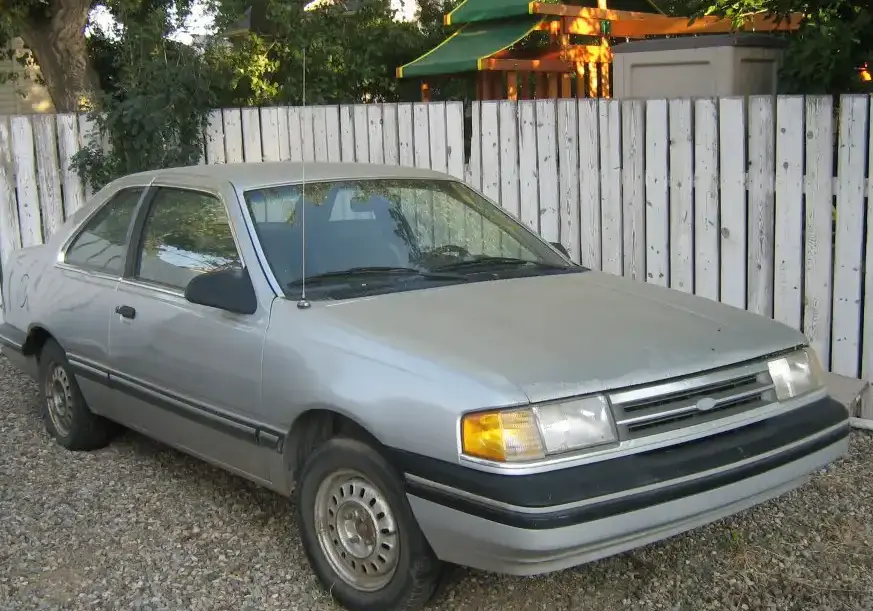
The Ford Tempo Coupe 2.3, producing 99 horsepower, was a mainstay of the American compact car market from 1987 through 1995. Positioned as an affordable and practical option, the 2.3-liter engine and five-speed manual transmission combination represented a mid-range offering within the Tempo lineup, slotting below the more powerful (but less common) four-cylinder options and above the base model. The Tempo, and specifically the coupe variant, aimed to provide fuel efficiency and reasonable space for a small family, competing with vehicles like the Chevrolet Cavalier and Dodge Spirit. It was part of Ford’s effort to modernize its compact offerings and move away from the Fox platform that underpinned earlier models.
Technical Specifications
| Brand | Ford |
| Model | Tempo |
| Generation | Tempo Coupe |
| Type (Engine) | 2.3 (99 Hp) |
| Start of production | 1987 |
| End of production | 1995 |
| Powertrain Architecture | Internal Combustion engine |
| Body type | Coupe |
| Seats | 5 |
| Doors | 2 |
| Fuel consumption (urban) | 12 l/100 km (19.6 US mpg) |
| Fuel consumption (extra urban) | 7 l/100 km (33.6 US mpg) |
| Fuel Type | Petrol (Gasoline) |
| Maximum speed | 165 km/h (102.53 mph) |
| Weight-to-power ratio | 11.6 kg/Hp |
| Weight-to-torque ratio | 6.8 kg/Nm |
| Power | 99 Hp @ 4400 rpm |
| Power per litre | 42.9 Hp/l |
| Torque | 168 Nm @ 2200 rpm (123.91 lb.-ft. @ 2200 rpm) |
| Engine layout | Front, Transverse |
| Engine displacement | 2307 cm3 (140.78 cu. in.) |
| Number of cylinders | 4 |
| Engine configuration | Inline |
| Cylinder Bore | 93.5 mm (3.68 in.) |
| Piston Stroke | 84 mm (3.31 in.) |
| Compression ratio | 9.1:1 |
| Number of valves per cylinder | 2 |
| Fuel injection system | Multi-port manifold injection |
| Engine aspiration | Naturally aspirated |
| Engine oil capacity | 4.7 l (4.97 US qt | 4.14 UK qt) |
| Coolant | 7.5 l (7.93 US qt | 6.6 UK qt) |
| Kerb Weight | 1145 kg (2524.29 lbs.) |
| Trunk (boot) space (minimum) | 375 l (13.24 cu. ft.) |
| Fuel tank capacity | 60 l (15.85 US gal | 13.2 UK gal) |
| Length | 4490 mm (176.77 in.) |
| Width | 1735 mm (68.31 in.) |
| Height | 1340 mm (52.76 in.) |
| Wheelbase | 2540 mm (100 in.) |
| Front track | 1395 mm (54.92 in.) |
| Rear track | 1460 mm (57.48 in.) |
| Drivetrain Architecture | Front wheel drive |
| Number of gears and type of gearbox | 5 gears, manual transmission |
| Front suspension | Coil spring |
| Rear suspension | Coil spring |
| Front brakes | Ventilated discs |
| Rear brakes | Drum |
| Assisting systems | ABS (Anti-lock braking system) |
| Steering type | Steering rack and pinion |
| Power steering | Hydraulic |
| Tires size | 185/70 R14 |
Powertrain & Engine Architecture
The heart of the Tempo Coupe 2.3 was the 2.3-liter inline-four cylinder engine. This engine, part of Ford’s “Lima” family, utilized a cast iron block and aluminum cylinder head. It featured a single overhead camshaft (OHC) design operating two valves per cylinder. Fuel delivery was managed by a multi-port fuel injection system, which improved efficiency and responsiveness compared to earlier carbureted designs. The 99 horsepower output at 4400 rpm and 168 Nm (123.91 lb-ft) of torque at 2200 rpm were respectable for its class, though not particularly exciting. The five-speed manual transmission offered a relatively direct driving experience, with gear ratios geared towards fuel economy and everyday usability. The transmission was a standard manual unit, known for its durability but not particularly refined shift quality.
Driving Characteristics
The 2.3-liter Tempo Coupe with a manual transmission provided adequate, if unremarkable, performance. Acceleration was modest, taking around 10-11 seconds to reach 60 mph. The engine felt relatively smooth at cruising speeds, but could become noisy under hard acceleration. The five-speed manual allowed drivers to keep the engine in its optimal power band, but the overall experience was geared towards practicality rather than sporty driving. Compared to the automatic transmission versions, the manual offered better fuel economy and a more engaging driving experience. It also felt more responsive, particularly when merging onto highways or passing other vehicles. The suspension, tuned for comfort, provided a reasonably smooth ride, but handling was somewhat vague and lacked precision.
Equipment & Trim Levels
The Tempo Coupe 2.3 typically came with a fairly basic level of standard equipment. This included features like cloth upholstery, a basic AM/FM radio, and manual windows and locks. Air conditioning was a popular option, as were power steering and upgraded sound systems. Higher trim levels, though not commonly seen with the 2.3 engine, could add features like cruise control, upgraded interior trim, and alloy wheels. The interior design was functional but lacked the aesthetic appeal of some competitors. The dashboard layout was straightforward, with easy-to-read gauges and logically placed controls.
Chassis & Braking
The Tempo Coupe utilized a front-wheel-drive layout with independent coil spring suspension in the front and a solid axle with coil springs in the rear. The front brakes were ventilated discs, providing adequate stopping power, while the rear brakes were drums. An anti-lock braking system (ABS) was available as an option, enhancing safety. The chassis was relatively lightweight, contributing to the car’s fuel efficiency. Steering was handled by a hydraulic power steering system, which provided reasonable assistance at low speeds. The tires were typically 185/70 R14, offering a balance of comfort and grip.
Market Reception & Comparison
The Ford Tempo Coupe 2.3 was generally well-received as an affordable and reliable compact car. Critics praised its fuel efficiency and practicality, but noted its lack of excitement and somewhat bland styling. Compared to other trims in the Tempo lineup, the 2.3-liter manual offered a better balance of performance and fuel economy than the base engine, while being more affordable than the higher-output options. Reliability was generally good, although some owners reported issues with the fuel injection system and minor electrical problems. Fuel economy figures averaged around 19.6 mpg in the city and 33.6 mpg on the highway.
Legacy
The Ford Tempo, while not a particularly memorable car, played an important role in Ford’s transition to more modern compact car designs. The 2.3-liter engine proved to be relatively durable and is still found in many used Tempos today. While not highly sought after by collectors, well-maintained examples can provide affordable and reliable transportation. The Tempo’s legacy lies in its practicality and affordability, representing a solid, if unspectacular, option for budget-conscious buyers in the late 1980s and early 1990s. Its simple design and readily available parts make it a relatively easy car to maintain and repair, contributing to its continued presence on the road.