
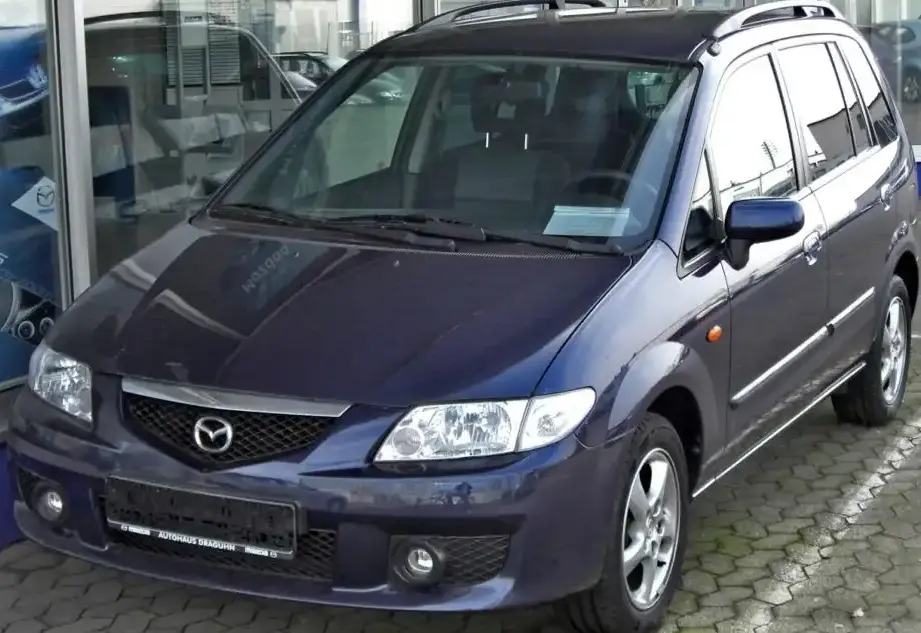
The Mazda Premacy, known as the Mazda Familia Wagon in Japan, was a compact minivan produced by Mazda from 1999 to 2000 (CP generation). Positioned as a practical and family-oriented vehicle, the Premacy aimed to offer a spacious interior and versatile seating arrangements within a relatively small footprint. The 1.9-liter (100 horsepower) variant represented a mid-range offering in the Premacy lineup, balancing affordability with acceptable performance for everyday driving. This model was primarily sold in European and Asian markets, offering an alternative to larger, more expensive MPVs.
Technical Specifications
| Brand | Mazda |
| Model | Premacy |
| Generation | Premacy (CP) |
| Type (Engine) | 1.9 (100 Hp) |
| Start of production | 1999 |
| End of production | 2000 |
| Powertrain Architecture | Internal Combustion engine |
| Body type | Minivan |
| Seats | 5 |
| Doors | 5 |
| Fuel consumption (urban) | 10.9 l/100 km (21.6 US mpg) |
| Fuel consumption (extra urban) | 6.9 l/100 km (34.1 US mpg) |
| Fuel consumption (combined) | 8.4 l/100 km (28 US mpg) |
| Fuel Type | Petrol (Gasoline) |
| Acceleration 0 – 100 km/h | 11 sec |
| Acceleration 0 – 62 mph | 11 sec |
| Acceleration 0 – 60 mph | 10.5 sec |
| Maximum speed | 175 km/h (108.74 mph) |
| Weight-to-power ratio | 12.5 kg/Hp |
| Weight-to-torque ratio | 8.2 kg/Nm |
| Power | 100 Hp @ 5500 rpm |
| Power per litre | 54.3 Hp/l |
| Torque | 152 Nm @ 4000 rpm (112.11 lb.-ft. @ 4000 rpm) |
| Engine layout | Front, Transverse |
| Engine displacement | 1840 cm3 (112.28 cu. in.) |
| Number of cylinders | 4 |
| Engine configuration | Inline |
| Cylinder Bore | 83 mm (3.27 in.) |
| Piston Stroke | 85 mm (3.35 in.) |
| Compression ratio | 9.7:1 |
| Number of valves per cylinder | 4 |
| Fuel injection system | Multi-port manifold injection |
| Engine aspiration | Naturally aspirated engine |
| Valvetrain | DOHC |
| Kerb Weight | 1250 kg (2755.78 lbs.) |
| Max. weight | 1760 kg (3880.14 lbs.) |
| Max load | 510 kg (1124.36 lbs.) |
| Trunk (boot) space – minimum | 420 l (14.83 cu. ft.) |
| Trunk (boot) space – maximum | 1848 l (65.26 cu. ft.) |
| Fuel tank capacity | 58 l (15.32 US gal | 12.76 UK gal) |
| Length | 4295 mm (169.09 in.) |
| Width | 1705 mm (67.13 in.) |
| Height | 1600 mm (62.99 in.) |
| Wheelbase | 2670 mm (105.12 in.) |
| Front track | 1475 mm (58.07 in.) |
| Rear (Back) track | 1480 mm (58.27 in.) |
| Drivetrain Architecture | The Internal combustion engine (ICE) drives the front wheels of the vehicle. |
| Drive wheel | Front wheel drive |
| Number of gears and type of gearbox | 5 gears, manual transmission |
| Front suspension | Coil spring |
| Rear suspension | Coil spring |
| Front brakes | Disc |
| Rear brakes | Drum |
| Assisting systems | ABS (Anti-lock braking system) |
| Steering type | Steering rack and pinion |
| Power steering | Hydraulic Steering |
| Tires size | 185/65 R14 |
Powertrain & Engine Architecture
The heart of the Premacy 1.9 was the Mazda F9 engine, a 1.895-liter inline-four cylinder gasoline engine. This engine, part of Mazda’s F-series, featured a double overhead camshaft (DOHC) valvetrain and multi-port fuel injection. The engine produced 100 horsepower at 5500 rpm and 152 Nm (112 lb-ft) of torque at 4000 rpm. The compression ratio was set at 9.7:1. The engine’s design prioritized fuel efficiency and smooth operation over outright performance. The 5-speed manual transmission was the standard offering, providing reasonable control over the engine’s power band. The transmission was chosen to balance fuel economy and drivability.
Driving Characteristics
The 1.9-liter engine, paired with the 5-speed manual transmission, provided adequate, though not exhilarating, performance. Acceleration from 0 to 60 mph took approximately 10.5 seconds, and the top speed was around 108.74 mph. The engine felt somewhat strained when fully loaded or climbing hills, requiring frequent downshifts to maintain speed. Compared to higher-spec Premacy models equipped with larger engines, the 1.9 offered a more relaxed driving experience, prioritizing comfort and fuel economy over sporty handling. The gear ratios were tuned for everyday usability, with a focus on maximizing fuel efficiency at cruising speeds.
Equipment & Trim Levels
The 1.9-liter Premacy typically came with a modest level of standard equipment. This included power steering, central locking, electric front windows, and an AM/FM radio. Air conditioning was often an optional extra. Interior upholstery was typically cloth, with a simple and functional dashboard layout. Higher trim levels, available in some markets, added features such as alloy wheels, upgraded audio systems, and additional safety equipment. The overall interior design emphasized practicality and durability rather than luxury.
Chassis & Braking
The Premacy’s chassis featured a coil spring suspension at both the front and rear, providing a comfortable ride quality. The front brakes were discs, while the rear brakes were drums. Anti-lock Braking System (ABS) was included as a standard safety feature. The suspension was tuned for comfort and stability, rather than sporty handling. The relatively lightweight construction of the vehicle helped to offset the modest engine output, resulting in acceptable handling characteristics. Stabilizer bars were included to reduce body roll during cornering.
Market Reception & Comparison
The Mazda Premacy 1.9 was generally well-received as a practical and affordable family vehicle. Critics praised its spacious interior, versatile seating arrangements, and fuel efficiency. However, some reviewers noted that the 1.9-liter engine lacked the power to comfortably handle a fully loaded vehicle or challenging road conditions. Compared to other compact MPVs available at the time, such as the Renault Scenic or the Opel Zafira, the Premacy offered a competitive combination of price, space, and fuel economy. The 1.9L version was often seen as the entry-level choice, appealing to budget-conscious buyers.
Legacy
The Mazda Premacy, particularly the 1.9-liter variant, has proven to be a relatively reliable vehicle in the used car market. The F9 engine is known for its durability, and routine maintenance is generally straightforward. While not known for exceptional performance, the 1.9-liter engine’s simplicity contributes to its long-term reliability. Today, these vehicles are often sought after by buyers looking for an affordable and practical family vehicle. Parts availability can be a concern in some markets, but overall, the Premacy 1.9 remains a viable option for those seeking a dependable and economical MPV.
