
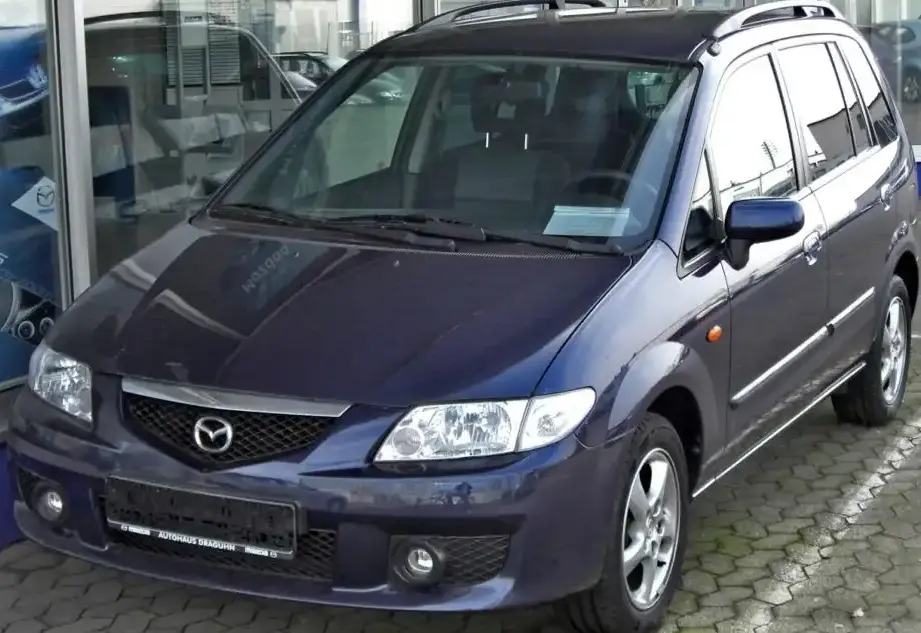
The Mazda Premacy, known as the Mazda5 in North America, is a compact minivan produced by Mazda from 1999 to 2018, spanning three generations. The CP generation, manufactured between 2001 and 2005, represented a significant evolution of the original, offering increased space and refinement. This article focuses specifically on the 2.0-liter 16-valve (131 horsepower) variant paired with a four-speed automatic transmission, a popular configuration in many markets, particularly Europe and Asia. This trim level occupied a mid-range position within the CP Premacy lineup, offering a balance between affordability and features.
Technical Specifications
| Brand | Mazda |
| Model | Premacy |
| Generation | Premacy (CP) |
| Type (Engine) | 2.0 16V (131 Hp) Automatic |
| Start of production | November, 2001 |
| End of production | May, 2005 |
| Powertrain Architecture | Internal Combustion engine |
| Body type | Minivan |
| Seats | 5 |
| Doors | 5 |
| Fuel consumption (urban) | 12.6 l/100 km (18.7 US mpg, 22.4 UK mpg, 7.9 km/l) |
| Fuel consumption (extra urban) | 7.5 l/100 km (31.4 US mpg, 37.7 UK mpg, 13.3 km/l) |
| Fuel consumption (combined) | 9.4 l/100 km (25 US mpg, 30.1 UK mpg, 10.6 km/l) |
| Fuel Type | Petrol (Gasoline) |
| Acceleration 0 – 100 km/h | 12.1 sec |
| Acceleration 0 – 62 mph | 12.1 sec |
| Acceleration 0 – 60 mph | 11.5 sec |
| Maximum speed | 179 km/h (111.23 mph) |
| Weight-to-power ratio | 10 kg/Hp, 100 Hp/tonne |
| Weight-to-torque ratio | 7.7 kg/Nm, 130.5 Nm/tonne |
| Power | 131 Hp @ 6000 rpm |
| Power per litre | 65.8 Hp/l |
| Torque | 171 Nm @ 4500 rpm (126.12 lb.-ft. @ 4500 rpm) |
| Engine layout | Front, Transverse |
| Engine Model/Code | FS7E, FS7G |
| Engine displacement | 1991 cm3 (121.5 cu. in.) |
| Number of cylinders | 4 |
| Engine configuration | Inline |
| Cylinder Bore | 83 mm (3.27 in.) |
| Piston Stroke | 92 mm (3.62 in.) |
| Compression ratio | 9.7:1 |
| Number of valves per cylinder | 4 |
| Fuel injection system | Multi-port manifold injection |
| Engine aspiration | Naturally aspirated engine |
| Valvetrain | DOHC |
| Engine oil capacity | 3.5 l (3.7 US qt | 3.08 UK qt) |
| Coolant | 7.5 l (7.93 US qt | 6.6 UK qt) |
| Kerb Weight | 1310 kg (2888.06 lbs.) |
| Max. weight | 1795 kg (3957.3 lbs.) |
| Max load | 485 kg (1069.24 lbs.) |
| Trunk (boot) space – minimum | 420 l (14.83 cu. ft.) |
| Trunk (boot) space – maximum | 1848 l (65.26 cu. ft.) |
| Fuel tank capacity | 58 l (15.32 US gal | 12.76 UK gal) |
| Length | 4340 mm (170.87 in.) |
| Width | 1710 mm (67.32 in.) |
| Height | 1570 mm (61.81 in.) |
| Wheelbase | 2670 mm (105.12 in.) |
| Front track | 1475 mm (58.07 in.) |
| Rear (Back) track | 1480 mm (58.27 in.) |
| Drivetrain Architecture | The Internal combustion engine (ICE) drives the front wheels of the vehicle. |
| Drive wheel | Front wheel drive |
| Number of gears and type of gearbox | 4 gears, automatic transmission |
| Front suspension | Coil spring |
| Rear suspension | Coil spring |
| Front brakes | Ventilated discs |
| Rear brakes | Disc |
| Assisting systems | ABS (Anti-lock braking system) |
| Steering type | Steering rack and pinion |
| Power steering | Hydraulic Steering |
| Tires size | 195/55 R15 |
| Wheel rims size | 15 |
INTRODUCTION
The Mazda Premacy CP, launched in 2001, was a key model for Mazda, designed to compete in the increasingly popular compact minivan segment. It offered a more stylish and driver-focused alternative to more utilitarian offerings from competitors like the Toyota Sienta or Renault Scenic. The 2.0-liter 16V automatic variant was positioned as a comfortable and practical choice for families seeking a versatile vehicle with reasonable performance. It was particularly well-received in markets where manual transmissions were less common, and automatic gearboxes were preferred for ease of use in urban environments.
Powertrain & Engine Architecture
The heart of this Premacy variant is the FS-DE engine, a 1991cc inline-four cylinder gasoline engine. This engine, part of Mazda’s FS family, utilizes a double overhead camshaft (DOHC) valvetrain with four valves per cylinder, contributing to its relatively high output for its displacement. The FS-DE employs multi-point fuel injection, delivering fuel directly to each intake port for optimized combustion. The engine codes FS7E and FS7G were used depending on the specific market and emissions regulations. Paired with this engine is a four-speed automatic transmission, providing smooth and convenient gear changes. While not the most modern transmission by today’s standards, it was a reliable unit designed for durability and ease of maintenance. The transmission’s gear ratios were tuned for a balance of fuel efficiency and acceptable acceleration, prioritizing comfortable cruising over outright performance.
Driving Characteristics
The 131 horsepower and 126 lb-ft of torque produced by the 2.0-liter engine, when coupled with the four-speed automatic, resulted in a driving experience that prioritized comfort and usability over sporty performance. Acceleration from 0-60 mph took around 11.5 to 12.1 seconds, which was adequate for everyday driving but not particularly brisk. The automatic transmission, while smooth, did exhibit some typical characteristics of older four-speed units, such as noticeable shifts and a tendency to ‘hunt’ for gears on inclines. Compared to the manual transmission versions of the same engine, the automatic offered less direct control and slightly reduced fuel economy. However, it provided a more relaxed driving experience, particularly in congested urban traffic. The power delivery was linear, making it easy to modulate the throttle and maintain a consistent speed.
Equipment & Trim Levels
The 2.0-liter automatic Premacy typically came equipped with a reasonable level of standard features. These included power windows and door locks, air conditioning, and a basic audio system. Higher trim levels offered options such as alloy wheels, a sunroof, upgraded upholstery, and a more sophisticated audio system with CD player. Interior upholstery was typically cloth, with a focus on durability and practicality. The dashboard layout was functional and straightforward, with easy-to-read gauges and logically placed controls. Optional extras often included rear parking sensors, a trip computer, and metallic paint finishes.
Chassis & Braking
The Premacy CP utilized a front-wheel-drive layout with independent coil spring suspension at the front and a twist-beam rear suspension. This setup provided a comfortable ride quality, absorbing bumps and imperfections in the road surface effectively. The front brakes were ventilated discs, offering good stopping power, while the rear brakes were solid discs. Anti-lock Braking System (ABS) was standard, enhancing safety by preventing wheel lockup during hard braking. The steering was rack and pinion with hydraulic power assistance, providing light and precise steering feel. The 195/55 R15 tires offered a good balance of grip and ride comfort.
Market Reception & Comparison
The Mazda Premacy 2.0L Automatic was generally well-received by automotive critics as a practical and comfortable family vehicle. It was praised for its spacious interior, versatile seating configuration, and relatively refined driving experience. However, some critics noted that the engine lacked outright power, and the four-speed automatic transmission felt dated compared to newer offerings. Compared to the 1.8-liter versions, the 2.0-liter offered noticeably more performance, making it a better choice for drivers who frequently carried passengers or cargo. Fuel economy was comparable to other vehicles in its class, averaging around 25 mpg in combined driving. Reliability was generally good, with the FS-DE engine proving to be a durable and long-lasting unit.
Legacy
The Mazda Premacy CP, particularly the 2.0-liter automatic variant, has maintained a reasonable reputation for reliability in the used car market. The FS-DE engine is known for its longevity, and the automatic transmission, while not cutting-edge, is generally robust. However, as with any older vehicle, regular maintenance is crucial to ensure continued reliability. Common issues include wear and tear on suspension components and potential oil leaks. Today, the Premacy CP represents an affordable and practical option for buyers seeking a spacious and versatile family vehicle, offering a unique blend of Mazda’s driving dynamics and minivan practicality.