
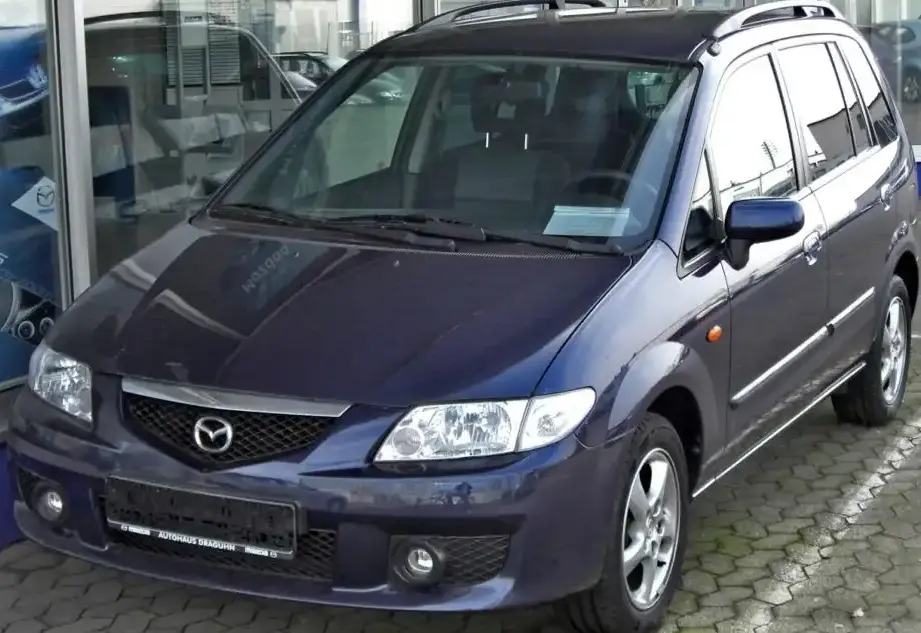
The Mazda Premacy, known as the Mazda5 in North America, is a compact minivan produced by Mazda from 1999 to 2010 across two generations. The CP generation, manufactured between 1999 and 2005, represented Mazda’s entry into the increasingly popular multi-purpose vehicle (MPV) segment, particularly in Europe and Japan. This article focuses on the 2.0 TD variant, equipped with a 101 horsepower turbocharged diesel engine, a configuration offered primarily in European and Asian markets. The 2.0 TD trim occupied a middle ground in the Premacy lineup, offering a balance between fuel efficiency, practicality, and a more accessible price point compared to higher-specification models.
Technical Specifications
| Brand | Mazda |
| Model | Premacy |
| Generation | Premacy (CP) |
| Type (Engine) | 2.0 TD (101 Hp) |
| Start of production | June, 1999 |
| End of production | May, 2005 |
| Powertrain Architecture | Internal Combustion engine |
| Body type | Minivan |
| Seats | 5-7 |
| Doors | 5 |
| Fuel consumption (urban) | 7.8 l/100 km (30.2 US mpg) |
| Fuel consumption (extra urban) | 5.6 l/100 km (42 US mpg) |
| Fuel consumption (combined) | 6.4 l/100 km (36.8 US mpg) |
| Fuel Type | Diesel |
| Acceleration 0 – 100 km/h | 11.6 sec |
| Acceleration 0 – 62 mph | 11.6 sec |
| Acceleration 0 – 60 mph | 11 sec |
| Maximum speed | 170 km/h (105.63 mph) |
| Weight-to-power ratio | 13.7 kg/Hp |
| Weight-to-torque ratio | 6 kg/Nm |
| Power | 101 Hp @ 4000 rpm |
| Torque | 230 Nm @ 2000 rpm (169.64 lb.-ft. @ 2000 rpm) |
| Engine layout | Front, Transverse |
| Engine Model/Code | RF4F |
| Engine displacement | 1998 cm3 (121.93 cu. in.) |
| Number of cylinders | 4 |
| Engine configuration | Inline |
| Cylinder Bore | 86 mm (3.39 in.) |
| Piston Stroke | 86 mm (3.39 in.) |
| Compression ratio | 18.8:1 |
| Number of valves per cylinder | 4 |
| Fuel injection system | Direct injection |
| Engine aspiration | Turbocharger |
| Valvetrain | DOHC |
| Engine oil capacity | 4.7 l (4.97 US qt | 4.14 UK qt) |
| Coolant | 9 l (9.51 US qt | 7.92 UK qt) |
| Kerb Weight | 1380 kg (3042.38 lbs.) |
| Max. weight | 1845 kg (4067.53 lbs.) |
| Max load | 465 kg (1025.15 lbs.) |
| Trunk (boot) space – minimum | 420 l (14.83 cu. ft.) |
| Trunk (boot) space – maximum | 1848 l (65.26 cu. ft.) |
| Fuel tank capacity | 58 l (15.32 US gal | 12.76 UK gal) |
| Length | 4340 mm (170.87 in.) |
| Width | 1710 mm (67.32 in.) |
| Height | 1570 mm (61.81 in.) |
| Wheelbase | 2670 mm (105.12 in.) |
| Front track | 1475 mm (58.07 in.) |
| Rear (Back) track | 1480 mm (58.27 in.) |
| Drivetrain Architecture | Front wheel drive |
| Number of gears | 5 gears, manual transmission |
| Front suspension | Coil spring |
| Rear suspension | Coil spring |
| Front brakes | Ventilated discs |
| Rear brakes | Disc |
| Assisting systems | ABS (Anti-lock braking system) |
| Steering type | Steering rack and pinion |
| Power steering | Hydraulic Steering |
| Tires size | 195/55 R15 |
| Wheel rims size | 15 |
INTRODUCTION
The Mazda Premacy CP, launched in June 1999, was a significant model for Mazda, representing their attempt to capitalize on the growing demand for compact, versatile family vehicles. Built on the 1HX0/A3 platform shared with other Ford and Mazda models, the Premacy offered a practical alternative to larger, more expensive MPVs. The 2.0 TD variant, powered by the RF4F engine, was specifically tailored for European and Asian markets where diesel engines were favored for their fuel efficiency and torque characteristics. This trim level aimed to provide a balance between affordability and functionality, appealing to families and individuals seeking a spacious and economical vehicle.
Powertrain & Engine Architecture
The heart of the Premacy 2.0 TD is the RF4F engine, a 1998cc inline-four cylinder diesel engine. This engine utilized direct fuel injection and a turbocharger to produce 101 horsepower at 4000 rpm and 230 Nm (169.64 lb.-ft.) of torque at 2000 rpm. The direct injection system, a key feature of this engine, allowed for more precise fuel delivery, improving combustion efficiency and reducing emissions. The turbocharger boosted power output by forcing more air into the cylinders. The engine featured a double overhead camshaft (DOHC) valvetrain, optimizing airflow for improved performance. The 2.0 TD was typically paired with a five-speed manual transmission, although an automatic transmission was also available in some markets. The automatic transmission, while offering convenience, generally resulted in slightly reduced fuel economy and acceleration compared to the manual version.
Driving Characteristics
The 2.0 TD variant of the Mazda Premacy offered a comfortable and practical driving experience. While not particularly sporty, the engine provided adequate power for everyday driving, with the 230 Nm of torque being readily available from low engine speeds. This made it well-suited for overtaking and navigating hilly terrain. The five-speed manual transmission allowed drivers to maintain optimal engine speed for efficiency or performance. Compared to the gasoline-powered versions of the Premacy, the 2.0 TD offered significantly better fuel economy. However, it was noticeably slower in acceleration, taking approximately 11.6 seconds to reach 100 km/h (62 mph). The suspension, tuned for comfort, provided a smooth ride, although it could feel somewhat soft during spirited driving. The steering was light and precise, making it easy to maneuver in urban environments.
Equipment & Trim Levels
The 2.0 TD trim of the Mazda Premacy typically included features such as power windows, central locking, and an air conditioning system. Higher-specification models offered additional features like alloy wheels, a CD player, and upgraded interior trim. Interior upholstery was generally cloth, with a functional and durable design. The dashboard layout was straightforward and user-friendly, with clearly labeled controls. Optional extras included a sunroof, rear parking sensors, and a more advanced audio system. The Premacy’s interior was designed with practicality in mind, offering ample storage space and flexible seating arrangements. The rear seats could be folded down or removed completely to create a larger cargo area.
Chassis & Braking
The Mazda Premacy CP featured a front-engine, front-wheel-drive layout. The suspension consisted of coil springs on both the front and rear axles, providing a comfortable ride. The front brakes were ventilated discs, offering good stopping power, while the rear brakes were typically solid discs. Anti-lock Braking System (ABS) was standard equipment, enhancing safety by preventing wheel lockup during hard braking. The chassis was designed to provide a stable and predictable handling experience, although it was not intended for high-performance driving. The steering system utilized a rack and pinion setup with hydraulic power assistance, making it easy to maneuver at low speeds.
Market Reception & Comparison
The Mazda Premacy 2.0 TD was generally well-received by automotive critics for its practicality, fuel efficiency, and comfortable ride. However, some reviewers noted that the engine lacked refinement compared to some of its competitors. Compared to the gasoline-powered versions of the Premacy, the 2.0 TD offered superior fuel economy but slightly slower performance. It also competed with other compact MPVs such as the Renault Scenic and the Citroën Xsara Picasso. The 2.0 TD offered a compelling alternative for buyers prioritizing fuel efficiency and torque, particularly in markets where diesel fuel was readily available and affordable.
Legacy
The Mazda Premacy 2.0 TD has proven to be a relatively reliable vehicle, with the RF4F engine generally considered durable. However, like all diesel engines, it is susceptible to issues related to the fuel injection system and turbocharger. Regular maintenance, including oil changes and filter replacements, is crucial for ensuring long-term reliability. In the used car market, the Premacy 2.0 TD remains a popular choice for budget-conscious buyers seeking a practical and economical family vehicle. Its spacious interior, good fuel economy, and relatively low running costs make it an attractive option for those needing a versatile MPV.
