
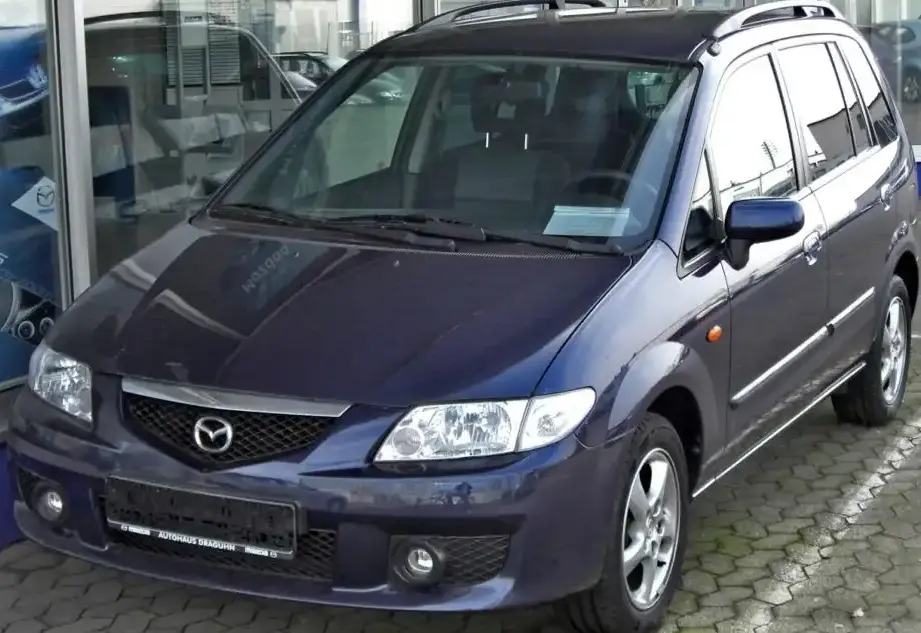
The Mazda Premacy, known as the Mazda Familia Wagon in Japan, was a compact minivan produced by Mazda from 1999 to 2005. The first generation, designated CP, was introduced in 1999 and continued through 2000 in its initial form. This model aimed to provide a practical and affordable family vehicle, particularly in European and Asian markets. The 2.0 TD variant, equipped with a 90 horsepower turbodiesel engine, represented a mid-range offering within the Premacy lineup, balancing fuel efficiency with adequate performance for everyday driving. It was positioned as a step up from the base gasoline models, appealing to buyers prioritizing economy and torque.
Technical Specifications
| Brand | Mazda |
| Model | Premacy |
| Generation | Premacy (CP) |
| Type (Engine) | 2.0 TD (90 Hp) |
| Start of production | 1999 |
| End of production | 2000 |
| Powertrain Architecture | Internal Combustion engine |
| Body type | Minivan |
| Seats | 5 |
| Doors | 5 |
| Fuel consumption (urban) | 7.5 l/100 km (31.4 US mpg) |
| Fuel consumption (extra urban) | 5.5 l/100 km (42.8 US mpg) |
| Fuel consumption (combined) | 6.5 l/100 km (36.2 US mpg) |
| Fuel Type | Diesel |
| Acceleration 0 – 100 km/h | 12 sec |
| Acceleration 0 – 62 mph | 12 sec |
| Acceleration 0 – 60 mph | 11.4 sec |
| Maximum speed | 170 km/h (105.63 mph) |
| Emission standard | Euro 2 |
| Weight-to-power ratio | 14.9 kg/Hp |
| Weight-to-torque ratio | 6.1 kg/Nm |
| Power | 90 Hp @ 4000 rpm |
| Torque | 220 Nm @ 1800 rpm (162.26 lb.-ft. @ 1800 rpm) |
| Engine layout | Front, Transverse |
| Engine Model/Code | RF3F |
| Engine displacement | 1998 cm3 (121.93 cu. in.) |
| Number of cylinders | 4 |
| Engine configuration | Inline |
| Cylinder Bore | 86 mm (3.39 in.) |
| Piston Stroke | 86 mm (3.39 in.) |
| Compression ratio | 18:1 |
| Number of valves per cylinder | 2 |
| Fuel injection system | Diesel Commonrail |
| Engine aspiration | Turbocharger |
| Valvetrain | OHC |
| Engine oil capacity | 4.7 l (4.97 US qt | 4.14 UK qt) |
| Coolant | 9 l (9.51 US qt | 7.92 UK qt) |
| Kerb Weight | 1340 kg (2954.19 lbs.) |
| Max. weight | 1820 kg (4012.41 lbs.) |
| Max load | 480 kg (1058.22 lbs.) |
| Trunk (boot) space – minimum | 420 l (14.83 cu. ft.) |
| Fuel tank capacity | 58 l (15.32 US gal | 12.76 UK gal) |
| Length | 4295 mm (169.09 in.) |
| Width | 1705 mm (67.13 in.) |
| Height | 1600 mm (62.99 in.) |
| Wheelbase | 2670 mm (105.12 in.) |
| Front track | 1475 mm (58.07 in.) |
| Rear (Back) track | 1480 mm (58.27 in.) |
| Drivetrain Architecture | Front wheel drive |
| Number of gears | 5 gears, manual transmission |
| Front suspension | Coil spring |
| Rear suspension | Coil spring |
| Front brakes | Disc |
| Rear brakes | Drum |
| Assisting systems | ABS (Anti-lock braking system) |
| Steering type | Steering rack and pinion |
| Power steering | Hydraulic Steering |
| Tires size | 185/65 R14 |
| Wheel rims size | 14 |
Powertrain & Engine Architecture
The heart of the Premacy 2.0 TD was the RF3F engine, a 1.998-liter inline-four cylinder diesel. This engine utilized a turbocharger and a common rail direct injection system to deliver 90 horsepower at 4000 rpm and 220 Nm (162 lb-ft) of torque at a low 1800 rpm. The common rail system allowed for precise fuel delivery, improving combustion efficiency and reducing emissions. The engine featured an overhead camshaft (OHC) valvetrain with two valves per cylinder. The 5-speed manual transmission was the standard offering for this variant, providing a balance between fuel economy and driver control. The engine’s design prioritized low-end torque, making it well-suited for hauling passengers and cargo, a key requirement for a minivan.
Driving Characteristics
The 2.0 TD Premacy offered a comfortable and practical driving experience. While not particularly sporty, the engine’s torque output provided adequate acceleration for everyday driving situations. The 0-60 mph time of around 11.4 seconds and a top speed of 105.63 mph were respectable for a vehicle of this class. The manual transmission allowed drivers to maximize fuel efficiency and maintain control in various driving conditions. Compared to the gasoline-powered versions, the diesel offered significantly better fuel economy, making it an attractive option for those covering long distances. However, it lacked the responsiveness and higher-revving nature of the petrol engines.
Equipment & Trim Levels
The 2.0 TD trim level typically included features such as power steering, central locking, electric front windows, and an anti-lock braking system (ABS). Interior upholstery was generally cloth, with a functional and durable design. Optional extras could include air conditioning, alloy wheels, and a radio/cassette player. The Premacy’s interior was designed with practicality in mind, offering ample space for passengers and luggage. The rear seats could be folded down to create a larger cargo area, enhancing the vehicle’s versatility.
Chassis & Braking
The Premacy’s chassis featured a coil spring suspension system at both the front and rear, providing a comfortable ride quality. The front brakes were discs, while the rear brakes were drums. This configuration was typical for vehicles in this weight class during the late 1990s. The steering system was a rack and pinion type with hydraulic power assistance, offering precise and responsive steering feel. The vehicle’s relatively modest weight of 1340 kg (2954 lbs) contributed to its manageable handling characteristics.
Market Reception & Comparison
The Mazda Premacy 2.0 TD was generally well-received by critics as a practical and economical family vehicle. Its fuel efficiency and torque output were praised, making it a popular choice for those seeking a versatile and affordable minivan. Compared to other trims in the Premacy lineup, the 2.0 TD offered a compelling balance between performance and economy. While the gasoline engines provided more spirited acceleration, they lacked the fuel efficiency and low-end torque of the diesel. The 2.0 TD also offered a more refined driving experience compared to the base gasoline models.
Legacy
The Mazda Premacy 2.0 TD, while not a performance icon, established itself as a reliable and practical family vehicle. The RF3F engine, when properly maintained, proved to be durable and long-lasting. In the used car market, these models are often sought after for their fuel efficiency and affordability. However, potential buyers should be aware of the typical maintenance requirements for diesel engines, such as regular oil changes and filter replacements. The Premacy’s simple and robust design contributes to its continued appeal as a dependable and economical transportation option.
