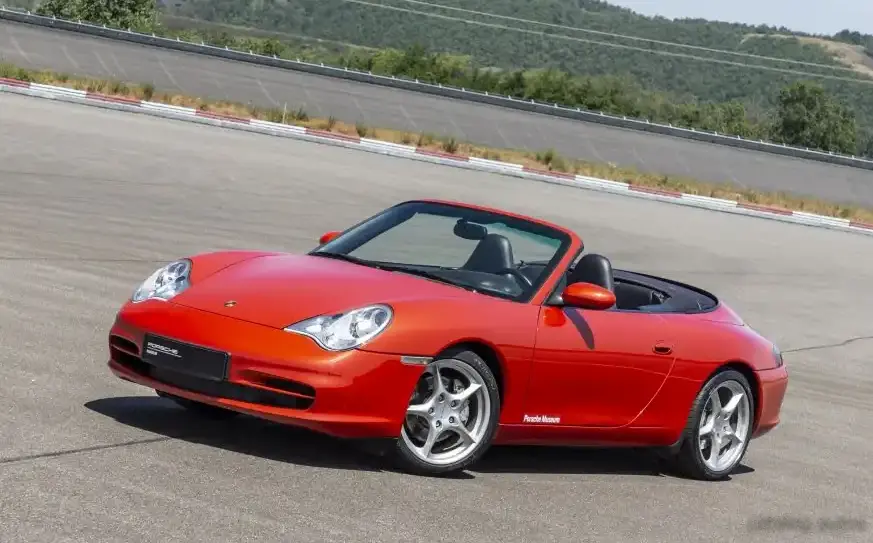
The Porsche 911 Cabriolet (996) facelift Carrera 3.6, produced from 2001 to 2004, represents a significant evolution of Porsche’s iconic sports car. This iteration, part of the 996 generation, benefited from a mid-cycle refresh addressing some criticisms of the earlier 996 models. The Carrera 3.6 occupied a central position in the 911 Cabriolet lineup, offering a compelling blend of performance, luxury, and open-air driving enjoyment. It served as the mainstream offering, positioned above the base Carrera 3.4 and below the more potent Carrera 4S and Turbo models. This variant aimed to deliver a refined Porsche experience accessible to a wider range of buyers while retaining the core 911 driving characteristics.
Technical Specifications
| Brand | Porsche |
| Model | 911 |
| Generation | 911 Cabriolet (996, facelift 2001) |
| Type (Engine) | Carrera 3.6 (320 Hp) |
| Start of production | 2001 |
| End of production | 2004 |
| Powertrain Architecture | Internal Combustion engine |
| Body type | Cabriolet |
| Seats | 4 |
| Doors | 2 |
| Fuel consumption (economy) – urban | 16.1 l/100 km (14.6 US mpg, 17.5 UK mpg, 6.2 km/l) |
| Fuel consumption (economy) – extra urban | 8.1 l/100 km (29 US mpg, 34.9 UK mpg, 12.3 km/l) |
| Fuel consumption (economy) – combined | 11.1 l/100 km (21.2 US mpg, 25.4 UK mpg, 9 km/l) |
| CO2 emissions | 269 g/km |
| Fuel Type | Petrol (Gasoline) |
| Acceleration 0 – 100 km/h | 5.2 sec |
| Acceleration 0 – 62 mph | 5.2 sec |
| Acceleration 0 – 60 mph | 4.9 sec |
| Maximum speed | 285 km/h (177.09 mph) |
| Weight-to-power ratio | 4.5 kg/Hp, 220.7 Hp/tonne |
| Weight-to-torque ratio | 3.9 kg/Nm, 255.2 Nm/tonne |
| Power | 320 Hp @ 6800 rpm |
| Power per litre | 89 Hp/l |
| Torque | 370 Nm @ 4250 rpm (272.9 lb.-ft. @ 4250 rpm) |
| Engine layout | Rear, Longitudinal |
| Engine Model/Code | M96.05 |
| Engine displacement | 3596 cm3 (219.44 cu. in.) |
| Number of cylinders | 6 |
| Engine configuration | Boxer |
| Cylinder Bore | 96 mm (3.78 in.) |
| Piston Stroke | 82.8 mm (3.26 in.) |
| Compression ratio | 11.3:1 |
| Number of valves per cylinder | 4 |
| Fuel injection system | Multi-port manifold injection |
| Engine aspiration | Naturally aspirated engine |
| Valvetrain | DOHC |
| Engine oil capacity | 8.8 l (9.3 US qt, 7.74 UK qt) |
| Coolant | 31 l (32.76 US qt, 27.28 UK qt) |
| Kerb Weight | 1450 kg (3196.7 lbs.) |
| Max. weight | 1855 kg (4089.57 lbs.) |
| Max load | 405 kg (892.87 lbs.) |
| Trunk (boot) space – maximum | 130 l (4.59 cu. ft.) |
| Fuel tank capacity | 64 l (16.91 US gal, 14.08 UK gal) |
| Length | 4430 mm (174.41 in.) |
| Width | 1770 mm (69.69 in.) |
| Height | 1305 mm (51.38 in.) |
| Wheelbase | 2350 mm (92.52 in.) |
| Front track | 1465 mm (57.68 in.) |
| Rear (Back) track | 1500 mm (59.06 in.) |
| Drivetrain Architecture | Rear wheel drive |
| Number of gears and type of gearbox | 6 gears, manual transmission |
| Front suspension | Independent type McPherson |
| Rear suspension | Independent multi-link suspension |
| Front brakes | Ventilated discs |
| Rear brakes | Ventilated discs |
| Assisting systems | ABS (Anti-lock braking system) |
| Steering type | Steering rack and pinion |
| Power steering | Hydraulic Steering |
| Tires size | 205/50 R17; 255/40 R17 |
| Wheel rims size | 7J x 17; 9J x 17 |
Powertrain & Engine Architecture
The heart of the 996 Carrera 3.6 is the M96.05 engine, a 3.6-liter naturally aspirated flat-six (boxer) engine. This engine represented a departure from the air-cooled heritage of earlier 911s, embracing water cooling for improved efficiency and reduced noise. The M96.05 featured a dry sump lubrication system, a hallmark of Porsche engineering, which ensures consistent oil supply even during aggressive cornering. Fuel delivery is managed by a multi-port fuel injection system, providing precise control over the air-fuel mixture. The engine boasts dual overhead camshafts (DOHC) and four valves per cylinder, contributing to its high-revving nature and impressive power output. The 6-speed manual transmission was standard, offering precise shifts and a direct connection to the engine. The engine’s layout, being rear-mounted and longitudinal, is a defining characteristic of the 911, influencing its handling dynamics.
Driving Characteristics
The 996 Carrera 3.6 offered a balanced driving experience. With 320 horsepower and 272 lb-ft of torque, it provided brisk acceleration, reaching 60 mph in around 4.9 seconds. While not as brutally fast as the Turbo models, the Carrera 3.6 delivered ample power for both spirited driving on winding roads and comfortable cruising. The manual transmission’s gear ratios were well-matched to the engine’s powerband, allowing for responsive acceleration in any gear. Compared to the earlier 3.4-liter Carrera, the 3.6 offered a noticeable improvement in performance, particularly in the mid-range. The rear-wheel-drive configuration and the engine’s rearward placement contributed to the 911’s characteristic handling balance, requiring a skilled driver to fully exploit its potential.
Equipment & Trim Levels
The 996 Carrera 3.6 Cabriolet came standard with a generous array of features. Interior appointments included leather upholstery, power-adjustable seats, and an automatic climate control system. Standard exterior features included 17-inch alloy wheels, a power-operated soft top, and a rear spoiler. Optional extras were plentiful, allowing buyers to personalize their vehicles. Popular options included sport seats, a Bose sound system, navigation, and various interior trim packages. The facelifted models (2001-2004) also featured revised headlights and taillights, as well as a more modern interior design compared to the earlier 996s.
Chassis & Braking
The 996 Carrera 3.6 utilized an independent suspension system at all four corners. The front suspension employed McPherson struts, while the rear featured a multi-link setup. This configuration provided a good balance of ride comfort and handling precision. Ventilated disc brakes were standard on all four wheels, providing ample stopping power. An Anti-lock Braking System (ABS) was also standard, enhancing safety and control. The steering system was a rack-and-pinion setup with hydraulic power assistance, offering precise and responsive steering feel.
Market Reception & Comparison
The 996 Carrera 3.6 Cabriolet was generally well-received by automotive critics. It was praised for its performance, handling, and overall refinement. However, the early 996 models were sometimes criticized for their IMS bearing issues (Intermediate Shaft), a potential point of failure in the engine. The facelifted models (2001-2004) addressed some of these concerns. Compared to the base Carrera 3.4, the 3.6 offered a significant performance upgrade. Compared to the more expensive Carrera 4S, the 3.6 provided a more accessible entry point into the 911 world. Fuel economy was reasonable for a sports car of its caliber, averaging around 21 mpg in combined driving.
Legacy
The 996 Carrera 3.6 Cabriolet remains a popular choice among Porsche enthusiasts. While the IMS bearing issue is a concern, many owners have proactively addressed it with preventative maintenance. The 996 generation represents a pivotal moment in 911 history, marking the transition to water cooling and a more modern design. Today, well-maintained 996 Carrera 3.6 Cabriolets are appreciating in value, making them a compelling investment for collectors and enthusiasts alike. The combination of performance, style, and open-air driving enjoyment ensures that the 996 Carrera 3.6 will continue to be cherished for years to come.