
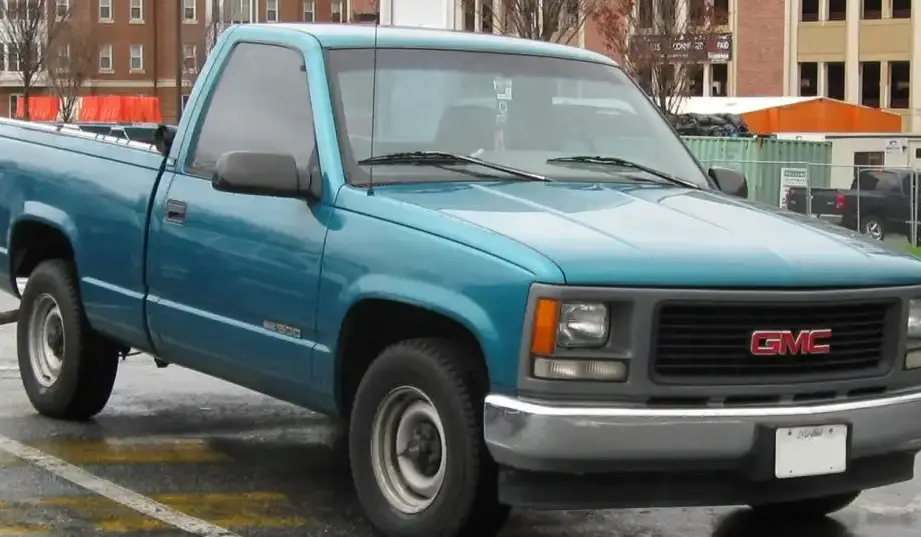
The GMC Sierra 1500, in its first generation (GMT400), marked GMC’s significant entry into the competitive full-size pickup truck market. Produced from 1988 through 1992, this Sierra iteration aimed to deliver a robust and capable work vehicle, while also incorporating a level of comfort and refinement often lacking in its class. The Regular Cab Short Wheelbase (SWB) Wideside configuration, equipped with the 5.7-liter V8 engine and a four-speed automatic transmission, was a common sight on American roads and job sites during this period. This particular variant occupied a middle ground in the Sierra 1500 lineup, balancing affordability and capability, appealing to both individual owners and commercial fleet buyers.
Technical Specifications
| Brand | GMC |
| Model | Sierra 1500 |
| Generation | Sierra 1500 I (GMT400) Regular cab SWB Wideside |
| Type (Engine) | 5.7 V8 (210 Hp) 4WD Automatic |
| Start of production | 1988 |
| End of production | 1992 |
| Powertrain Architecture | Internal Combustion engine |
| Body type | Pick-up |
| Seats | 3 |
| Doors | 2 |
| Fuel Type | Petrol (Gasoline) |
| Power | 210 Hp @ 4000 rpm |
| Torque | 407 Nm @ 2800 rpm / 300.19 lb.-ft. @ 2800 rpm |
| Engine layout | Front, Longitudinal |
| Number of cylinders | 8 |
| Engine configuration | V-engine |
| Cylinder Bore | 101.6 mm / 4 in |
| Piston Stroke | 88.39 mm / 3.48 in |
| Compression ratio | 9.3:1 |
| Fuel injection system | Multi-port manifold injection |
| Engine aspiration | Naturally aspirated engine |
| Max. weight | 2540 kg / 5599.74 lbs |
| Fuel tank capacity | 95 l / 25.1 US gal | 20.9 UK gal |
| Length | 5065 mm / 199.41 in |
| Width | 1951 mm / 76.81 in |
| Height | 1788 mm / 70.39 in |
| Wheelbase | 2985 mm / 117.52 in |
| Front overhang | 886 mm / 34.88 in |
| Rear overhang | 1194 mm / 47.01 in |
| Drivetrain Architecture | The Internal combustion engine (ICE) drives the rear wheels permanently, and the front wheels are driven through an electrically or mechanically operated clutch if necessary. |
| Drive wheel | All wheel drive (4×4) |
| Number of gears and type of gearbox | 4 gears, automatic transmission |
| Front suspension | Independent torsion bar, double wishbone |
| Rear suspension | Rigid axle suspension, Leaf spring |
| Front brakes | Disc |
| Rear brakes | Drum |
| Tires size | 225/75 R16 |
Powertrain & Engine Architecture
The core of this Sierra 1500 variant was the 5.7-liter (350 cubic inch) small-block Chevrolet V8 engine. This engine, designated as the L05, was a mainstay of General Motors’ truck and SUV offerings for many years. It featured a cast iron block and cylinder heads, a 9.3:1 compression ratio, and a multi-port fuel injection system. The multi-port injection, a relatively advanced feature for the time, improved fuel efficiency and throttle response compared to older carbureted designs. The engine produced 210 horsepower at 4,000 rpm and 300 lb-ft of torque at 2,800 rpm. This torque output was particularly crucial for a pickup truck, providing substantial pulling power for towing and hauling tasks. The engine was mounted longitudinally in the chassis, and power was transferred to all four wheels through a four-speed automatic transmission (most likely the 4L60). This transmission was known for its durability and relatively smooth shifting, though it wasn’t particularly fuel-efficient by contemporary standards.
Driving Characteristics
The combination of the 5.7L V8 and automatic transmission delivered a comfortable, though not particularly sporty, driving experience. Acceleration was adequate for everyday driving, but the truck wasn’t engineered for rapid acceleration. The automatic transmission’s gear ratios were optimized for towing and hauling, resulting in a somewhat sluggish feel at higher speeds. The 4WD system, when engaged, provided enhanced traction in challenging conditions, making the Sierra 1500 a capable off-road vehicle. In comparison to the available 6.2-liter diesel engine, the 5.7L V8 offered quicker acceleration but significantly lower fuel economy. Models equipped with a manual transmission, while less common, provided a more engaging driving experience and slightly improved fuel efficiency.
Equipment & Trim Levels
The Regular Cab SWB Wideside trim level generally included basic amenities such as a vinyl bench seat, a straightforward dashboard with analog gauges, and manual windows and locks. Air conditioning was frequently an optional extra, as was an upgraded sound system. The “Wideside” designation indicated the width of the truck bed, offering a larger cargo area compared to the narrower “Narrowside” bed. Higher trim levels, such as the SLX, offered more luxurious features like cloth upholstery, power windows and locks, and a tilt steering wheel. However, the base model prioritized providing a functional and affordable work truck.
Chassis & Braking
The GMT400 chassis utilized a body-on-frame construction, providing a robust and durable platform. The front suspension featured an independent torsion bar setup with double wishbone control arms, offering a relatively comfortable ride. The rear suspension employed a traditional leaf spring setup, well-suited for supporting heavy loads. Braking was handled by disc brakes at the front and drum brakes at the rear. While adequate for the truck’s weight, the braking system wasn’t particularly powerful by modern standards. The 4WD system employed a part-time transfer case, allowing the driver to switch between two-wheel drive and four-wheel drive as needed.
Market Reception & Comparison
The GMC Sierra 1500 GMT400 was generally well-received by both critics and buyers. It was praised for its rugged construction, comfortable ride, and capable powertrain. However, some reviewers noted that the interior was somewhat basic and that the fuel economy wasn’t particularly impressive. Compared to the Ford F-150 and Chevrolet C/K series trucks, the Sierra 1500 offered a comparable level of performance and features. The 5.7L V8 automatic combination was a popular choice, offering a good balance between power, fuel economy, and affordability. The diesel option was favored by those prioritizing fuel efficiency and towing capacity, while the manual transmission appealed to buyers seeking a more engaging driving experience.
Legacy
The GMT400 generation Sierra 1500 established a strong foundation for GMC’s continued success in the full-size pickup truck market. The 5.7L V8 engine proved to be a reliable and durable powerplant, and many examples remain on the road today. While not known for exceptional fuel efficiency, the engine is relatively easy to maintain and repair. In the used car market, these trucks are often sought after by enthusiasts and collectors, particularly those looking for a classic American work truck. The combination of a robust chassis, a capable engine, and a relatively simple design makes the GMT400 Sierra 1500 a lasting icon of the late 1980s and early 1990s.

