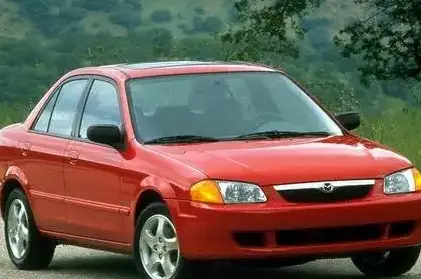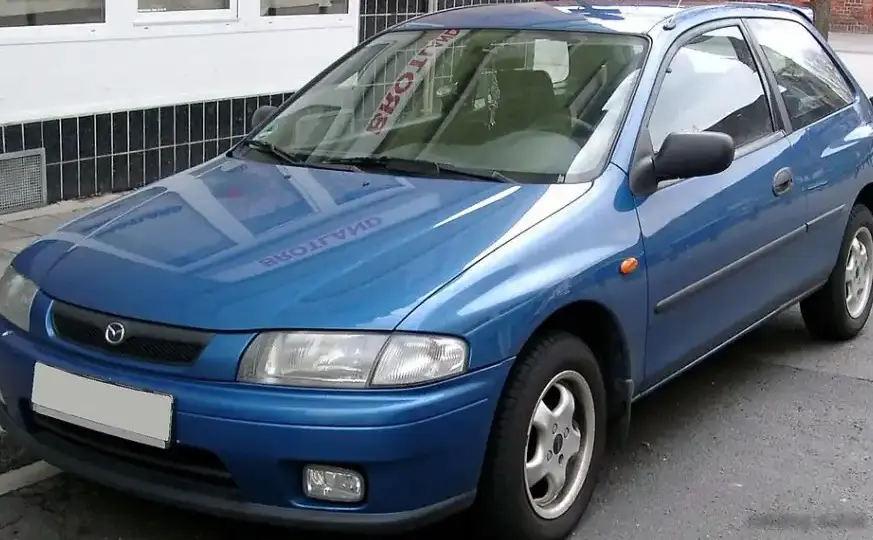
The Mazda Protege Hatchback 1.3i, produced between 1994 and 1998, represented Mazda’s entry-level offering in the compact hatchback segment. This variant, powered by the 1.3-liter B3 engine producing 85 horsepower, was primarily aimed at buyers seeking an economical and practical vehicle for daily commuting. It occupied the base trim level within the Protege hatchback range, positioned below higher-performance and better-equipped models. The 1994-1998 Protege hatchback (known internally as the BG series) was a significant model for Mazda, representing a move towards more modern styling and improved build quality compared to its predecessors. It was sold primarily in Europe, Asia, and Australia, with limited availability in the North American market where the sedan version was more popular.
Technical Specifications
| Brand | Mazda |
| Model | Protege |
| Generation | Protege Hatchback |
| Type (Engine) | 1.3 i (85 Hp) |
| Start of production | 1994 |
| End of production | 1998 |
| Powertrain Architecture | Internal Combustion engine |
| Body type | Hatchback |
| Seats | 5 |
| Doors | 5 |
| Fuel Type | Petrol (Gasoline) |
| Weight-to-power ratio | 15.6 kg/Hp, 64.2 Hp/tonne |
| Weight-to-torque ratio | 12 kg/Nm, 83.1 Nm/tonne |
| Power | 85 Hp @ 6000 rpm |
| Power per litre | 64.2 Hp/l |
| Torque | 110 Nm @ 4000 rpm (81.13 lb.-ft. @ 4000 rpm) |
| Engine layout | Front, Transverse |
| Engine Model/Code | B3 |
| Engine displacement | 1323 cm3 (80.73 cu. in.) |
| Number of cylinders | 4 |
| Engine configuration | Inline |
| Cylinder Bore | 71 mm (2.8 in.) |
| Piston Stroke | 83.6 mm (3.29 in.) |
| Compression ratio | 9:1 |
| Number of valves per cylinder | 4 |
| Fuel injection system | Multi-port manifold injection |
| Engine aspiration | Naturally aspirated engine |
| Valvetrain | DOHC |
| Kerb Weight | 1323 kg (2916.72 lbs.) |
| Fuel tank capacity | 50 l (13.21 US gal | 11 UK gal) |
| Length | 4035 mm (158.86 in.) |
| Width | 1695 mm (66.73 in.) |
| Height | 1170 mm (46.06 in.) |
| Wheelbase | 2505 mm (98.62 in.) |
| Front track | 1460 mm (57.48 in.) |
| Rear (Back) track | 1460 mm (57.48 in.) |
| Drivetrain Architecture | The Internal combustion engine (ICE) drives the front wheels of the vehicle. |
| Drive wheel | Front wheel drive |
| Front brakes | Ventilated discs |
| Rear brakes | Drum |
Powertrain & Engine Architecture
The heart of the 1.3i Protege Hatchback is the Mazda B3 engine, a 1.3-liter inline-four cylinder gasoline engine. This engine utilizes a naturally aspirated configuration and a multi-port fuel injection system, delivering fuel directly to each intake port for improved combustion efficiency. The B3 engine features a double overhead camshaft (DOHC) valvetrain, operating four valves per cylinder. This design enhances volumetric efficiency and contributes to the engine’s ability to produce 85 horsepower at 6000 rpm and 110 Nm (81.13 lb-ft) of torque at 4000 rpm. The engine’s 9:1 compression ratio was a standard figure for the time, balancing performance and fuel economy. The engine was typically paired with a four-speed automatic transmission, although a five-speed manual transmission was also available on some models. The automatic transmission was chosen by many buyers for its ease of use in urban driving conditions.
Driving Characteristics
The 1.3i automatic Protege Hatchback offered a comfortable, if not particularly sporty, driving experience. With 85 horsepower propelling approximately 1323 kg (2916.72 lbs), acceleration was modest. The four-speed automatic transmission, while providing smooth shifts, was geared for economy rather than performance. This resulted in a noticeable delay in downshifts and a relatively slow 0-60 mph time. However, the engine proved to be reasonably responsive in everyday driving situations, particularly at lower speeds. The steering was light and precise, making it easy to maneuver in tight spaces. The suspension, tuned for comfort, absorbed bumps and imperfections in the road well, providing a stable and predictable ride. Compared to the manual transmission version, the automatic offered less driver engagement but greater convenience. Higher-spec Protege models with larger engines, such as the 1.6L or 1.8L variants, offered significantly more performance, but at a higher price point.
Equipment & Trim Levels
The 1.3i Protege Hatchback typically came equipped with a basic but functional set of features. Standard equipment generally included power steering, central locking, and a basic audio system. Interior upholstery was typically cloth, with a simple dashboard layout. Air conditioning was often an optional extra, as were power windows and electric mirrors. The trim level was generally considered the base model, focusing on affordability and practicality. Optional extras could include alloy wheels, a sunroof, and upgraded audio systems. The interior was designed with durability and ease of use in mind, rather than luxury or sophistication.
Chassis & Braking
The Protege Hatchback utilized a front-wheel-drive chassis with independent front suspension and a torsion beam rear suspension. The front suspension featured MacPherson struts, while the rear suspension provided a balance between ride comfort and handling stability. Braking duties were handled by ventilated discs on the front wheels and drum brakes on the rear. This configuration was typical for vehicles in this class during the mid-1990s. The braking system provided adequate stopping power for everyday driving, but lacked the performance of more advanced braking systems found on higher-end vehicles. Stabilizer bars were included to reduce body roll during cornering, improving handling stability.
Market Reception & Comparison
The 1.3i Protege Hatchback was generally well-received as an affordable and reliable compact car. Critics praised its fuel efficiency and practicality, but noted its lack of performance. Compared to other vehicles in its class, such as the Honda Civic or Toyota Corolla, the Protege offered a competitive price point and a decent level of equipment. However, it often lagged behind in terms of performance and refinement. The 1.6L and 1.8L Protege models offered a more compelling driving experience, but came at a higher cost. The 1.3i model was particularly popular with first-time car buyers and those seeking an economical vehicle for commuting.
Legacy
The Mazda Protege Hatchback 1.3i, while not a performance icon, has proven to be a relatively reliable and durable vehicle. The B3 engine, when properly maintained, is known for its longevity. In the used car market, these models are often sought after by buyers looking for an affordable and dependable vehicle. While parts availability may be becoming more challenging due to the vehicle’s age, the B3 engine is relatively simple to work on, making it a popular choice for DIY mechanics. The 1994-1998 Protege Hatchback represents a significant step forward for Mazda in terms of design and build quality, and remains a fondly remembered vehicle for many owners.