
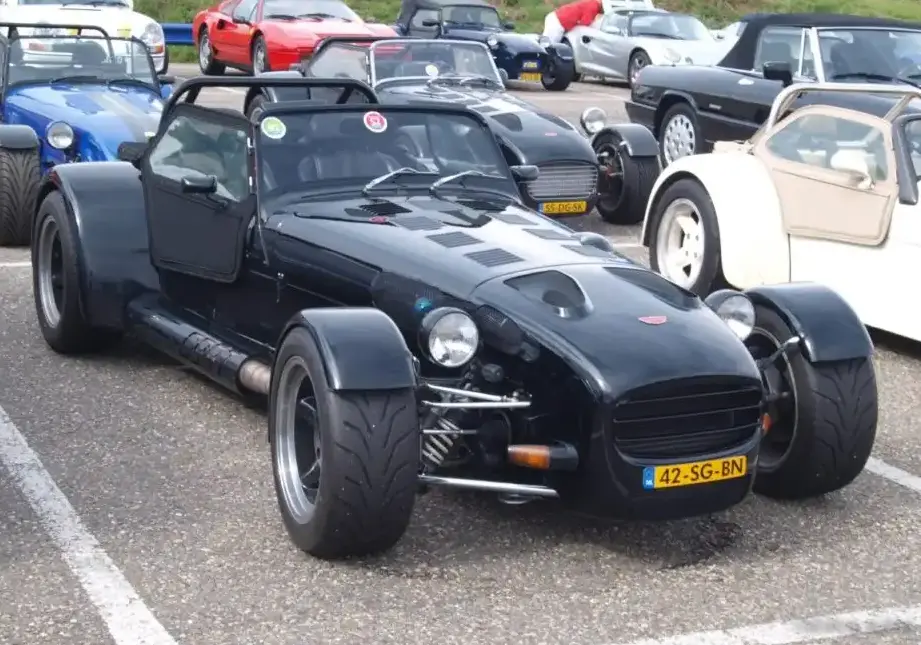
The Donkervoort S8 AT (170 Hp) was a lightweight, two-seat roadster produced by the Dutch manufacturer Donkervoort Automobielen between 1986 and 1994. Positioned as the entry-level model within the S8 range, it offered a more accessible price point while retaining the core Donkervoort philosophy of minimalist design, high performance, and engaging driving dynamics. The “AT” designation, despite the original data, is a misnomer; all S8 models were initially equipped with manual transmissions. This variant utilized a 2.0-liter turbocharged inline-four engine, delivering 170 horsepower, and was built on a space frame chassis, making it a direct competitor to other small, British sports cars of the era, though with a distinctly Dutch approach to engineering.
Technical Specifications
| Brand | Donkervoort |
| Model | S8 |
| Generation | S8 |
| Type (Engine) | AT (170 Hp) |
| Start of production | 1986 |
| End of production | 1994 |
| Powertrain Architecture | Internal Combustion engine |
| Body type | Roadster |
| Seats | 2 |
| Doors | 2 |
| Fuel consumption (economy) – extra urban | 7 l/100 km (33.6 US mpg, 40.4 UK mpg, 14.3 km/l) |
| Fuel consumption (economy) – combined | 11.5 l/100 km (20.5 US mpg, 24.6 UK mpg, 8.7 km/l) |
| Fuel Type | Petrol (Gasoline) |
| Acceleration 0 – 100 km/h | 5 sec |
| Acceleration 0 – 62 mph | 5 sec |
| Acceleration 0 – 60 mph | 4.8 sec |
| Maximum speed | 220 km/h (136.7 mph) |
| Weight-to-power ratio | 4 kg/Hp, 248.2 Hp/tonne |
| Weight-to-torque ratio | 3 kg/Nm, 335.8 Nm/tonne |
| Power | 170 Hp @ 5500 rpm |
| Power per litre | 85.3 Hp/l |
| Torque | 230 Nm @ 4000 rpm (169.64 lb.-ft. @ 4000 rpm) |
| Engine layout | Front, Longitudinal |
| Engine displacement | 1993 cm3 (121.62 cu. in.) |
| Number of cylinders | 4 |
| Engine configuration | Inline |
| Cylinder Bore | 90.82 mm (3.58 in.) |
| Piston Stroke | 76.95 mm (3.03 in.) |
| Compression ratio | 8:1 |
| Number of valves per cylinder | 2 |
| Fuel injection system | Multi-port manifold injection |
| Engine aspiration | Turbocharger, Intercooler |
| Valvetrain | SOHC |
| Kerb Weight | 685 kg (1510.17 lbs.) |
| Max. weight | 925 kg (2039.28 lbs.) |
| Max load | 240 kg (529.11 lbs.) |
| Fuel tank capacity | 45 l (11.89 US gal | 9.9 UK gal) |
| Length | 3600 mm (141.73 in.) |
| Width | 1730 mm (68.11 in.) |
| Height | 1100 mm (43.31 in.) |
| Wheelbase | 2300 mm (90.55 in.) |
| Front track | 1400 mm (55.12 in.) |
| Rear (Back) track | 1470 mm (57.87 in.) |
| Front overhang | 450 mm (17.72 in.) |
| Rear overhang | 850 mm (33.46 in.) |
| Minimum turning circle | 8 m (26.25 ft.) |
| Drivetrain Architecture | Rear wheel drive |
| Drive wheel | Rear wheel drive |
| Number of gears and type of gearbox | 5 gears, manual transmission |
| Front suspension | Double wishbone, Transverse stabilizer |
| Rear suspension | Double wishbone, Trailing arm |
| Front brakes | Disc |
| Rear brakes | Drum |
| Steering type | Steering rack and pinion |
| Tires size | Front: 205/50 R15, Rear: 225/50 R15 |
| Wheel rims size | Front: 8J x 15, Rear: 8J x 15 |
Powertrain & Engine Architecture
The heart of the S8 AT (170 Hp) was a 1,993 cc inline-four cylinder engine. This engine, often based on a Ford unit, was heavily modified by Donkervoort, most notably with the addition of a turbocharger and intercooler. The engine code varied depending on the specific year and market, but commonly utilized Bosch fuel injection and a single overhead camshaft (SOHC) valvetrain. The turbocharger provided a significant boost in power, allowing the relatively small engine to produce 170 horsepower. The engine was mounted longitudinally in the front of the vehicle, driving the rear wheels. The five-speed manual transmission was sourced from Renault, chosen for its lightweight and robust construction. The transmission’s gear ratios were relatively short, geared towards maximizing acceleration rather than top-speed cruising.
Driving Characteristics
The Donkervoort S8 AT (170 Hp) offered a raw and engaging driving experience. Its lightweight construction – tipping the scales at around 685 kg (1510 lbs) – combined with the turbocharged engine, resulted in brisk acceleration. The 0-60 mph sprint was achievable in approximately 4.8 seconds, and the car could reach a top speed of 220 km/h (136.7 mph). However, the power delivery was somewhat peaky, with noticeable turbo lag at lower RPMs. Once the turbo spooled up, the engine provided a strong surge of power. The short gear ratios meant frequent shifting was required to stay in the power band. The handling was sharp and responsive, thanks to the double wishbone suspension and relatively stiff chassis. The lack of power steering contributed to the direct feel, but also required considerable effort at low speeds.
Equipment & Trim Levels
The S8 AT (170 Hp) was deliberately minimalist in its equipment levels. Donkervoort focused on providing a pure driving experience, rather than luxury features. Standard equipment included basic instrumentation, bucket seats, and a simple dashboard layout. The interior was typically trimmed with durable, lightweight materials. Optional extras included a roll bar, upgraded suspension components, and various cosmetic enhancements. The car was available in a range of colors, though bright, attention-grabbing hues were popular choices. A soft-top roof was standard, providing limited weather protection.
Chassis & Braking
The S8 AT (170 Hp) was built around a tubular space frame chassis, providing exceptional rigidity for its weight. The suspension utilized double wishbones at both the front and rear, with a transverse stabilizer bar at the front to reduce body roll. The braking system featured disc brakes at the front and drum brakes at the rear. While adequate for the car’s performance, the rear drum brakes were a point of criticism, as they lacked the stopping power of disc brakes. The tires were relatively narrow by modern standards – 205/50 R15 at the front and 225/50 R15 at the rear – chosen to minimize weight and rolling resistance.
Market Reception & Comparison
The Donkervoort S8 AT (170 Hp) received generally positive reviews from automotive journalists. Critics praised its lightweight construction, engaging handling, and strong acceleration. However, the car’s minimalist interior and lack of creature comforts were also noted. Compared to other trims in the S8 lineup, such as the later 200 and 260 horsepower versions, the 170 Hp model offered a more accessible entry point into the Donkervoort brand. It was also more fuel-efficient, achieving around 20.5 US mpg in combined driving. Compared to contemporary British sports cars like the Lotus Elise, the S8 offered a more raw and visceral driving experience, but lacked the Elise’s sophisticated suspension and braking systems.
Legacy
The Donkervoort S8 AT (170 Hp) remains a sought-after vehicle among enthusiasts of lightweight sports cars. Its simple design and robust construction have contributed to its long-term reliability. While parts availability can be a challenge, the car’s relatively straightforward mechanicals make it relatively easy to maintain. Today, well-maintained examples command a premium price on the used car market. The S8 established Donkervoort as a niche manufacturer of high-performance, lightweight sports cars, and its legacy continues to influence the company’s current models. The 170 Hp variant represents a pivotal point in the brand’s history, offering a compelling blend of performance, affordability, and driving enjoyment.
