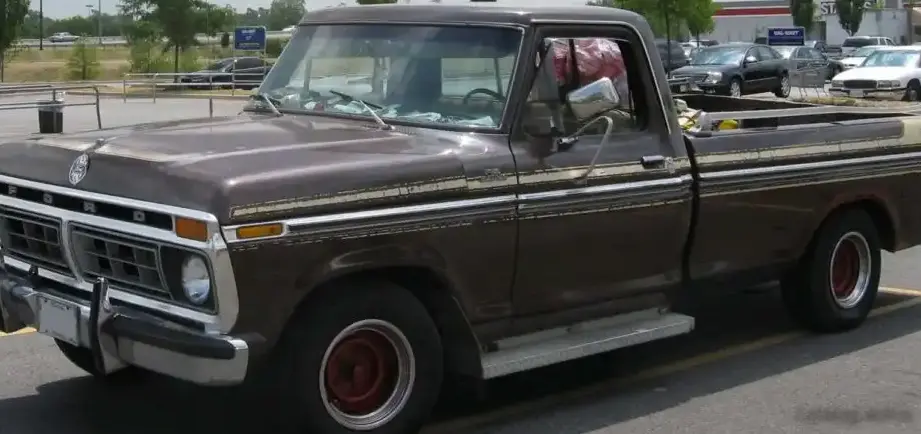
The Ford F-Series F-150 Regular Cab, equipped with the 4.9-liter (300 cubic inch) inline-six engine producing 113 horsepower, represents a cornerstone of American truck design from the mid-1970s. Produced between 1975 and 1979, this configuration occupied the entry-level position within the sixth generation of the F-Series, offering a balance of affordability and capability for a broad range of buyers. It was a workhorse intended for light-duty tasks, fleet applications, and buyers prioritizing simplicity and durability over outright performance. This variant played a significant role in solidifying the F-Series’ dominance in the American pickup truck market.
Technical Specifications
| Brand | Ford |
| Model | F-Series F-100/F-150 |
| Generation | F-Series F-150 VI Regular Cab |
| Type (Engine) | 4.9 300 Six ( 113 Hp) |
| Start of production | 1975 |
| End of production | 1979 |
| Powertrain Architecture | Internal Combustion engine |
| Body type | Pick-up |
| Seats | 3 |
| Doors | 2 |
| Fuel Type | Petrol (Gasoline) |
| Power | 113 Hp |
| Power per litre | 23 Hp/l |
| Engine displacement | 4916 cm3 / 299.99 cu. in. |
| Number of cylinders | 6 |
| Engine configuration | Inline |
| Cylinder Bore | 101.6 mm / 4 in. |
| Piston Stroke | 101.09 mm / 3.98 in. |
| Fuel injection system | Carburettor |
| Engine aspiration | Naturally aspirated engine |
| Max. weight | 2744 kg / 6049.48 lbs. |
| Trunk (boot) space – minimum | 1852-2084 l / 65.4 – 73.6 cu. ft. |
| Length | 5215 mm / 205.31 in. |
| Wheelbase | 3378 mm / 132.99 in. |
| Wading depth | 665 mm / 26.18 in. |
| Drivetrain Architecture | The Internal combustion engine (ICE) drives the rear wheels of the vehicle. |
| Drive wheel | Rear wheel drive |
| Number of gears and type of gearbox | 3 gears, manual transmission |
| Front suspension | Independent coil spring, Transverse stabilizer |
| Rear suspension | Leaf spring |
| Front brakes | Disc |
| Rear brakes | Drum |
| Power steering | Electric Steering |
| Tires size | 215/75 R15; 225/75 R15 |
| Wheel rims size | 7J x 15 |
Powertrain & Engine Architecture
The heart of this F-150 variant was the 4.9-liter (299 cubic inch) inline-six engine, often referred to as the “300 Six.” This engine, a long-stroke design, was renowned for its durability and low-end torque. It utilized a cast-iron block and head, and was fed by a two-barrel carburetor. The valvetrain employed a conventional pushrod configuration. While 113 horsepower wasn’t a groundbreaking figure, the engine produced a respectable 220 lb-ft of torque, making it well-suited for hauling and towing. The engine was longitudinally mounted in the chassis. The standard transmission was a three-speed manual, designed for simplicity and reliability. While an automatic transmission was available as an option, the base model typically came equipped with the manual.
Driving Characteristics
The 113 hp 300 Six-powered F-150 offered a utilitarian driving experience. Acceleration was modest, and highway passing required careful planning. The three-speed manual transmission featured relatively wide gear ratios, prioritizing low-end grunt over quick acceleration. The engine’s torque curve meant that it felt stronger in everyday driving situations than the horsepower figure might suggest. Compared to the optional V8 engines, this configuration was noticeably slower, but it offered better fuel economy. The suspension, consisting of independent coil springs in the front and leaf springs in the rear, provided a comfortable ride for a pickup truck, although it wasn’t particularly sporty. The rear-wheel-drive configuration and relatively simple chassis contributed to a straightforward and predictable handling experience.
Equipment & Trim Levels
The F-150 Regular Cab with the 300 Six engine represented the base trim level. Standard features were minimal, reflecting its focus on affordability. Typically, it included a basic vinyl bench seat, a simple dashboard with essential gauges, and a standard AM radio. Options were available, such as upgraded upholstery, a more comprehensive instrument cluster, and a factory-installed air conditioner. However, these options added to the vehicle’s cost, and many base models were sold with minimal extras. The interior was designed for practicality and ease of cleaning, rather than luxury.
Chassis & Braking
The F-150’s chassis was a traditional body-on-frame construction, providing robust strength and durability. The front suspension utilized independent coil springs with a transverse stabilizer bar, while the rear suspension employed leaf springs. This setup offered a good balance of ride comfort and load-carrying capacity. Braking duties were handled by disc brakes in the front and drum brakes in the rear. Power steering was available, but not standard on all base models. The tires were typically 215/75 R15 or 225/75 R15, providing adequate grip for everyday use. The frame was designed to withstand the rigors of work and hauling.
Market Reception & Comparison
The 113 hp 300 Six-powered F-150 was well-received by buyers seeking a dependable and affordable pickup truck. Critics acknowledged its lack of performance but praised its durability and fuel efficiency compared to the V8 options. It was particularly popular with fleet buyers and individuals who prioritized practicality over speed. Compared to the F-150 models equipped with the 302 or 351 cubic inch V8 engines, this variant offered significantly lower fuel consumption, but also considerably less power. The 300 Six was often seen as a more sensible choice for those who didn’t require the extra power of a V8.
Legacy
The 4.9-liter inline-six engine proved to be exceptionally durable, and many examples are still on the road today. The powertrain, while not particularly sophisticated, is relatively simple to maintain and repair. In the used car market, these F-150s are valued for their simplicity, reliability, and classic American truck aesthetic. While not sought after by collectors in the same way as higher-performance models, they represent a significant piece of automotive history and continue to be appreciated by those who value a rugged and dependable work truck. The 300 Six engine has earned a reputation as one of Ford’s most reliable and long-lasting engines, cementing its place in automotive folklore.