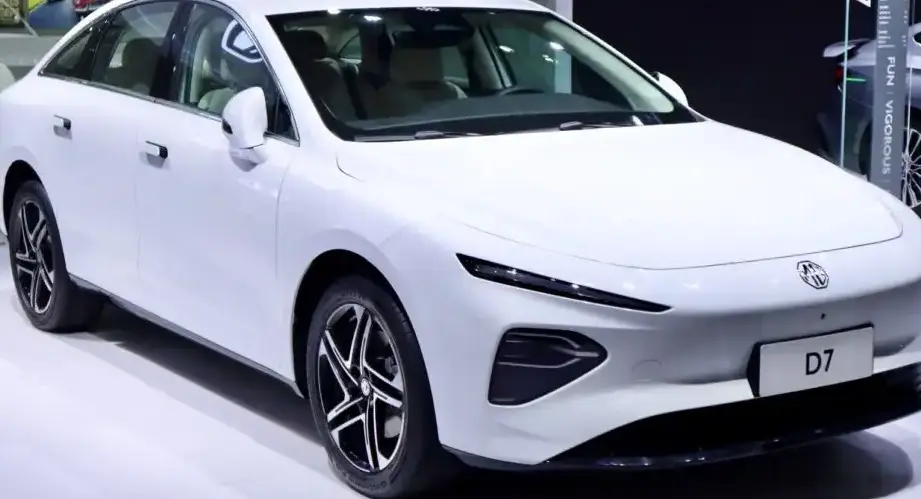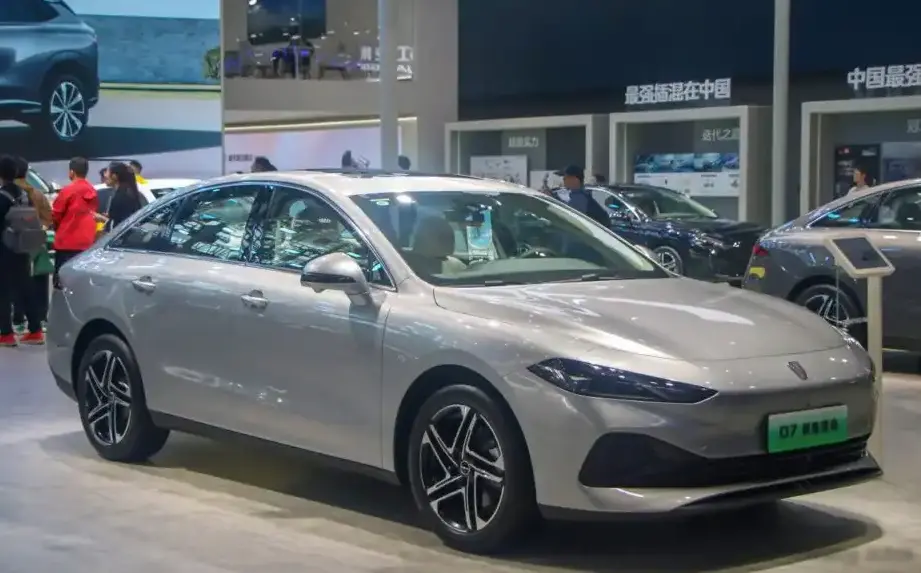
The Roewe D7 DMH 1.5 21.4 kWh (316 Hp) Plug-in Hybrid DHT is a compact sedan produced by the Chinese automaker Roewe, beginning in November 2023. Representing a significant step in Roewe’s development of new energy vehicles, the D7 DMH combines a 1.5-liter gasoline engine with an electric motor and a 21.4 kWh battery pack, offering both all-electric driving capability and extended range through its plug-in hybrid architecture. This variant occupied a mid-to-upper position within the D7 lineup, targeting consumers seeking fuel efficiency, modern technology, and a comfortable driving experience. Production continued through November 2024, marking a relatively short production run for this specific configuration.
Technical Specifications
| Brand | Roewe |
| Model | D7 |
| Generation | D7 |
| Type (Engine) | DMH 1.5 21.4 kWh (316 Hp) Plug-in Hybrid DHT |
| Start of production | November, 2023 |
| End of production | November, 2024 |
| Powertrain Architecture | PHEV (Plug-in Hybrid Electric Vehicle) |
| Body type | Sedan |
| Seats | 5 |
| Doors | 4 |
| Fuel consumption (combined) | 1.02-4.3 l/100 km (230.6 – 54.7 US mpg, 276.9 – 65.7 UK mpg, 98 – 23.3 km/l) |
| Fuel Type | Petrol / electricity |
| Acceleration 0 – 100 km/h | 7.9 sec |
| Acceleration 0 – 62 mph | 7.9 sec |
| Acceleration 0 – 60 mph | 7.5 sec |
| Maximum speed | 185 km/h (114.95 mph) |
| Weight-to-power ratio | 5.4 kg/Hp, 186.4 Hp/tonne |
| Weight-to-torque ratio | 12.6 kg/Nm, 79.6 Nm/tonne |
| Gross battery capacity | 21.4 kWh |
| Battery technology | Lithium iron phosphate (LiFePO4) |
| Battery location | Below the floor |
| All-electric range | 103-125 km (64 – 77.67 mi) |
| Average Energy consumption | 13.9 kWh/100 km (22.37 kWh/100 mi, 151 MPGe, 7.2 km/kWh, 4.5 mi/kWh) |
| Electric motor power | 204 Hp |
| Electric motor Torque | 330 Nm (243.4 lb.-ft.) |
| Electric motor model/code | TZ210XY105 |
| Electric motor location | Integrated into the transmission |
| Electric motor type | Synchronous |
| System power | 316 Hp |
| Engine Power | 112 Hp |
| Engine Torque | 135 Nm (99.57 lb.-ft.) |
| Engine layout | Front, Transverse |
| Engine Model/Code | 15FHC |
| Engine displacement | 1498 cm3 (91.41 cu. in.) |
| Number of cylinders | 4 |
| Engine configuration | Inline |
| Compression ratio | 16:1 |
| Number of valves per cylinder | 4 |
| Fuel injection system | Multi-port manifold injection |
| Engine aspiration | Naturally aspirated engine |
| Valvetrain | DOHC |
| Kerb Weight | 1695 kg (3736.84 lbs.) |
| Max. weight | 2142 kg (4722.3 lbs.) |
| Max load | 447 kg (985.47 lbs.) |
| Trunk (boot) space – minimum | 450 l (15.89 cu. ft.) |
| Trunk (boot) space – maximum | 1695 l (59.86 cu. ft.) |
| Fuel tank capacity | 55 l (14.53 US gal | 12.1 UK gal) |
| Length | 4890 mm (192.52 in.) |
| Width | 1890 mm (74.41 in.) |
| Height | 1510 mm (59.45 in.) |
| Wheelbase | 2810 mm (110.63 in.) |
| Front track | 1600 mm (62.99 in.) |
| Rear (Back) track | 1600 mm (62.99 in.) |
| Drag coefficient (Cd) | 0.26 |
| Minimum turning circle | 11.62 m (38.12 ft.) |
| Front suspension | Independent, type McPherson with coil spring and anti-roll bar |
| Rear suspension | Independent multi-link spring suspension with stabilizer |
| Front brakes | Ventilated discs |
| Rear brakes | Disc |
| Drive wheel | Front wheel drive |
| Number of gears | 1, automatic transmission DHT |
| Tires size | 225/50 R18 |
| Wheel rims size | 18 |
INTRODUCTION
The Roewe D7 DMH 1.5 21.4 kWh represents Roewe’s entry into the competitive plug-in hybrid sedan market. Launched in late 2023, it builds upon the foundation of the broader D7 model range, which is based on Roewe’s modern platform. The “DMH” designation signifies the dual-motor hybrid configuration, combining a gasoline engine with an electric motor for enhanced efficiency and performance. The D7 DMH was designed to appeal to environmentally conscious consumers in China who desire a technologically advanced and comfortable vehicle for daily commuting and longer journeys. It aimed to bridge the gap between traditional gasoline vehicles and fully electric cars, offering the benefits of both worlds.
Powertrain & Engine Architecture
At the heart of the D7 DMH lies a 1.5-liter, naturally aspirated inline-four cylinder gasoline engine (code 15FHC) producing 112 horsepower and 135 Nm (99.57 lb.-ft.) of torque. This engine utilizes multi-port fuel injection and a double overhead camshaft (DOHC) valvetrain. The engine is paired with a 204 horsepower electric motor (TZ210XY105) and a 21.4 kWh lithium iron phosphate (LiFePO4) battery pack. The battery is positioned under the floor of the vehicle, contributing to a lower center of gravity and improved handling. The powertrain utilizes Roewe’s DHT (Dedicated Hybrid Technology) system, a sophisticated arrangement that allows the engine and electric motor to operate independently or in tandem, optimizing efficiency and performance based on driving conditions. The DHT system effectively functions as a continuously variable transmission (CVT), providing smooth and seamless acceleration. The engine also features a Start & Stop system to further reduce fuel consumption during idling.
Driving Characteristics
The D7 DMH delivers a refined and comfortable driving experience. In all-electric mode, the vehicle offers quiet and responsive acceleration, with a range of 103-125 km (64-77.67 miles). When the battery is depleted or requires assistance during demanding acceleration, the gasoline engine seamlessly kicks in, providing additional power. The combined system output of 316 horsepower allows for a 0-100 km/h (0-62 mph) acceleration time of 7.9 seconds. The DHT transmission provides smooth and linear power delivery, eliminating the need for traditional gear changes. Compared to lower-powered D7 variants, the DMH offers significantly improved acceleration and overall performance. While not as sporty as some dedicated performance sedans, the D7 DMH provides ample power for everyday driving and highway cruising.
Equipment & Trim Levels
The D7 DMH typically came well-equipped with standard features including automatic climate control, a touchscreen infotainment system, Bluetooth connectivity, and a suite of advanced driver-assistance systems (ADAS). Interior upholstery consisted of high-quality fabric or leatherette, depending on the specific trim level. Optional extras included a panoramic sunroof, premium audio system, and ventilated front seats. The dashboard layout was modern and minimalist, with a focus on intuitive controls and a clean aesthetic. Higher trim levels often featured additional chrome accents and upgraded interior materials.
Chassis & Braking
The D7 DMH utilizes an independent McPherson strut suspension in the front and an independent multi-link suspension in the rear, providing a comfortable and controlled ride. Stabilizer bars are included on both axles to minimize body roll during cornering. The braking system consists of ventilated discs at the front and solid discs at the rear, providing adequate stopping power. Anti-lock braking system (ABS) is standard. The vehicle’s weight of 1695 kg (3736.84 lbs) is partially offset by the low center of gravity afforded by the underfloor battery pack, contributing to stable handling.
Market Reception & Comparison
The Roewe D7 DMH was generally well-received by Chinese automotive media and consumers. Critics praised its fuel efficiency, comfortable ride, and advanced technology. Compared to other plug-in hybrid sedans in its class, the D7 DMH offered a competitive combination of performance, range, and features. Its fuel economy of 1.02-4.3 l/100 km (230.6 – 54.7 US mpg) was a significant selling point, particularly in urban environments. Compared to non-hybrid D7 variants, the DMH commanded a higher price premium, reflecting the added cost of the hybrid powertrain. However, the long-term fuel savings and environmental benefits often justified the higher initial investment for many buyers.
Legacy
The Roewe D7 DMH 1.5 21.4 kWh represents an important milestone in Roewe’s transition towards electrification. While its production run was relatively short, it established the brand as a serious contender in the plug-in hybrid market. The DHT powertrain technology showcased in the D7 DMH has been further refined and implemented in subsequent Roewe models. On the used car market, the D7 DMH is likely to hold its value reasonably well, particularly among buyers seeking a fuel-efficient and technologically advanced vehicle. The long-term reliability of the powertrain remains to be fully assessed, but the use of proven components and a robust hybrid system suggests a reasonable level of durability.