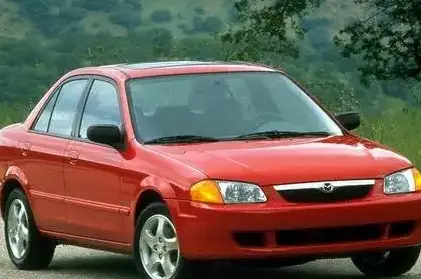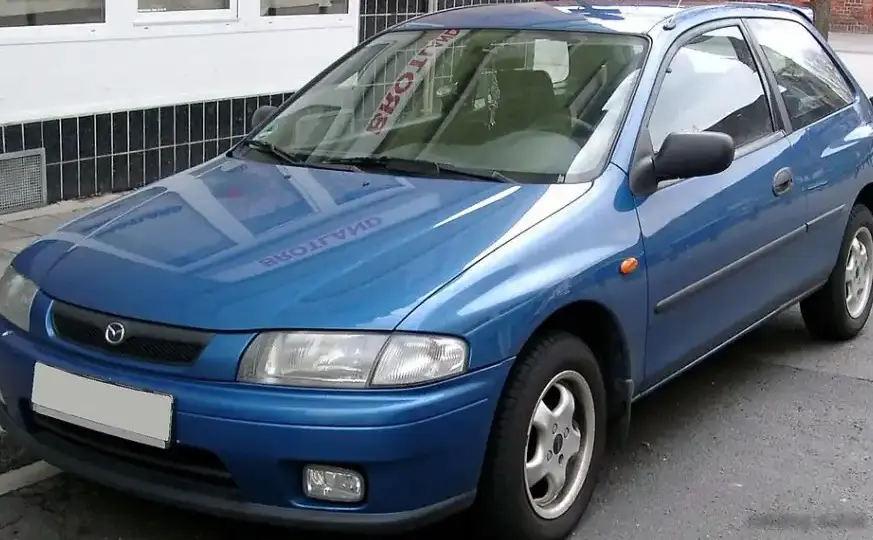
The Mazda Protege Wagon 2.0i, produced between 2002 and 2004, represented Mazda’s entry into the compact wagon segment in North America. Positioned as a practical and affordable alternative to traditional sedans and hatchbacks, the Protege Wagon aimed to provide increased cargo capacity without sacrificing the nimble handling Mazda was becoming known for. This particular 2.0i variant, equipped with the BP-ZE engine, served as the top-tier offering for the wagon body style, providing a balance of performance and fuel efficiency. It was built upon the P platform, shared with other Mazda models of the era, and offered a five-door, five-passenger configuration.
Technical Specifications
| Brand | Mazda |
| Model | Protege |
| Generation | Protege Wagon |
| Type (Engine) | 2.0 i (165 Hp) |
| Start of production | 2002 |
| End of production | 2004 |
| Powertrain Architecture | Internal Combustion engine |
| Body type | Station wagon (estate) |
| Seats | 5 |
| Doors | 5 |
| Fuel Type | Petrol (Gasoline) |
| Power | 165 Hp @ 7000 rpm |
| Power per litre | 89.4 Hp/l |
| Torque | 157 Nm @ 4500 rpm |
| Torque (lb.-ft.) | 115.8 lb.-ft. @ 4500 rpm |
| Engine layout | Front, Transverse |
| Engine Model/Code | BP-ZE |
| Engine displacement | 1845 cm3 |
| Engine displacement (cu. in.) | 112.59 cu. in. |
| Number of cylinders | 4 |
| Engine configuration | Inline |
| Cylinder Bore | 83 mm |
| Cylinder Bore (in.) | 3.27 in. |
| Piston Stroke | 85 mm |
| Piston Stroke (in.) | 3.35 in. |
| Compression ratio | 9:1 |
| Number of valves per cylinder | 4 |
| Fuel injection system | Multi-port manifold injection |
| Engine aspiration | Naturally aspirated engine |
| Valvetrain | DOHC |
| Engine oil capacity | 3.3 l |
| Engine oil capacity (US qt) | 3.49 US qt |
| Engine oil capacity (UK qt) | 2.9 UK qt |
| Max. weight | 1170 kg |
| Max. weight (lbs.) | 2579.41 lbs. |
| Fuel tank capacity | 50 l |
| Fuel tank capacity (US gal) | 13.21 US gal |
| Fuel tank capacity (UK gal) | 11 UK gal |
| Length | 4200 mm |
| Length (in.) | 165.35 in. |
| Width | 1695 mm |
| Width (in.) | 66.73 in. |
| Height | 1420 mm |
| Height (in.) | 55.91 in. |
| Wheelbase | 2610 mm |
| Wheelbase (in.) | 102.76 in. |
| Front track | 1470 mm |
| Front track (in.) | 57.87 in. |
| Rear track | 1470 mm |
| Rear track (in.) | 57.87 in. |
| Drivetrain Architecture | The Internal combustion engine (ICE) drives the front wheels of the vehicle. |
| Drive wheel | Front wheel drive |
| Front brakes | Ventilated discs |
| Rear brakes | Drum |
Powertrain & Engine Architecture
The heart of the Protege Wagon 2.0i was the BP-ZE engine, a 2.0-liter inline-four cylinder powerplant. This engine was a member of Mazda’s BP series, known for its durability and relatively simple design. The BP-ZE featured a 9.0:1 compression ratio and utilized a multi-port fuel injection system for precise fuel delivery. The engine employed a double overhead camshaft (DOHC) valvetrain, contributing to its respectable power output for its displacement. The BP-ZE produced 165 horsepower at 7000 rpm and 157 Nm (115.8 lb-ft) of torque at 4500 rpm. The engine was transversely mounted in the front of the vehicle, driving the front wheels. While a five-speed manual transmission was available on lower trims, the 2.0i was exclusively offered with a four-speed automatic transmission. This automatic, while providing convenience, was sometimes criticized for its relatively conservative gear ratios, prioritizing fuel economy over outright acceleration.
Driving Characteristics
The 2.0i automatic Protege Wagon offered a comfortable and predictable driving experience. The four-speed automatic transmission, while smooth, didn’t offer the responsiveness of a manual gearbox or more modern automatics. Acceleration was adequate for everyday driving, but the engine felt somewhat strained when pushed hard, particularly when fully loaded. The gear ratios were tuned for fuel efficiency, meaning the engine often operated at higher RPMs during highway cruising. Compared to the manual transmission versions, the automatic suffered a slight performance penalty. The suspension, tuned for comfort, provided a reasonably smooth ride, absorbing most road imperfections without excessive body roll. Steering was light and precise, typical of Mazda vehicles of the era.
Equipment & Trim Levels
The 2.0i trim represented the highest level of equipment available for the Protege Wagon. Standard features included air conditioning, power windows and locks, a CD player, and alloy wheels. Interior upholstery consisted of cloth seats, available in a variety of colors. Optional extras included a sunroof, upgraded audio system, and anti-lock brakes (ABS). The dashboard layout was functional and straightforward, with easy-to-read gauges and logically placed controls. The interior, while not luxurious, was well-built and durable.
Chassis & Braking
The Protege Wagon utilized a MacPherson strut front suspension and a torsion beam rear suspension. This setup provided a good balance of ride comfort and handling. The front brakes were ventilated discs, offering adequate stopping power, while the rear brakes were drum brakes, a cost-saving measure common in this class of vehicle. The 2.0i trim typically featured slightly thicker stabilizer bars compared to lower trims, further improving handling stability. The vehicle’s relatively light weight (approximately 1170 kg or 2579 lbs) contributed to its nimble handling characteristics.
Market Reception & Comparison
The Mazda Protege Wagon 2.0i received generally positive reviews from automotive critics. It was praised for its practicality, fuel efficiency, and Mazda’s reputation for reliability. However, the four-speed automatic transmission was often criticized for its lack of responsiveness and its impact on fuel economy compared to the manual transmission. Compared to competitors like the Toyota Matrix and Honda Civic Wagon, the Protege Wagon offered a more engaging driving experience, but lacked the brand recognition of its Japanese rivals. Fuel economy was rated at around 24 mpg city and 30 mpg highway, which was competitive for its class.
Legacy
The Mazda Protege Wagon 2.0i, while not a sales blockbuster, has developed a loyal following among enthusiasts. The BP-ZE engine is known for its durability and relatively simple maintenance requirements. Used examples are still relatively common today, and well-maintained vehicles can provide reliable transportation at an affordable price. The four-speed automatic transmission, while not the most desirable, has proven to be reasonably durable. The Protege Wagon represents a practical and often overlooked alternative in the compact wagon segment, offering a blend of Mazda’s sporty DNA and the versatility of a wagon body style.