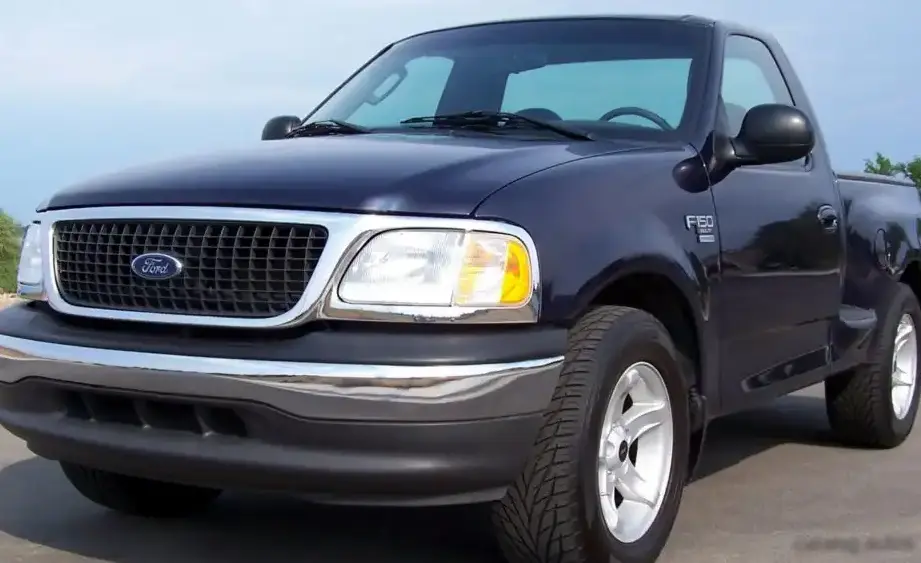
The Ford F-Series F-150 X Regular Cab, equipped with the 4.6-liter V8 Triton engine producing 231 horsepower, represents a significant iteration of Ford’s long-running and immensely popular F-Series pickup truck line. Produced from 1999 to 2004, this variant occupied a middle ground within the tenth generation (1997-2003) F-150 lineup, offering a balance between capability, affordability, and everyday usability. It served as a workhorse for many American consumers, appealing to those needing a robust truck without the expense or complexity of higher trim levels or larger engines. This configuration was particularly popular in regions where heavy-duty towing wasn’t a primary concern, but reliable transportation and moderate hauling capacity were essential.
Technical Specifications
| Brand | Ford |
| Model | F-Series F-150 |
| Generation | F-Series F-150 X Regular Cab |
| Type (Engine) | 4.6 V8 Triton (231 Hp) |
| Start of production | 1999 |
| End of production | 2004 |
| Powertrain Architecture | Internal Combustion engine |
| Body type | Pick-up |
| Seats | 3 |
| Doors | 2 |
| Fuel Type | Petrol (Gasoline) |
| Power | 231 Hp @ 4750 rpm |
| Power per litre | 50.2 Hp/l |
| Torque | 397 Nm @ 3500 rpm / 292.81 lb.-ft. @ 3500 rpm |
| Engine layout | Front, Longitudinal |
| Engine displacement | 4605 cm3 / 281.01 cu. in. |
| Number of cylinders | 8 |
| Engine configuration | V-engine |
| Cylinder Bore | 90.17 mm / 3.55 in. |
| Piston Stroke | 89.92 mm / 3.54 in. |
| Compression ratio | 9.3:1 |
| Number of valves per cylinder | 2 |
| Fuel injection system | Multi-port manifold injection |
| Engine aspiration | Naturally aspirated engine |
| Valvetrain | SOHC |
| Engine oil capacity | 5.7 l / 6.02 US qt | 5.02 UK qt |
| Coolant | 19.5 l / 20.61 US qt | 17.16 UK qt |
| Max. weight | 2994 kg / 6600.64 lbs. |
| Trunk (boot) space – minimum | 1422 l / 50.22 cu. ft. |
| Trunk (boot) space – maximum | 2056 l / 72.61 cu. ft. |
| Fuel tank capacity | 95-114 l / 25.1 – 30.12 US gal | 20.9 – 25.08 UK gal |
| Permitted trailer load with brakes (12%) | 1588 kg / 3500.94 lbs. |
| Length | 5255-5728 mm / 206.89 – 225.51 in. |
| Width | 2014 mm / 79.29 in. |
| Height | 1864 mm / 73.39 in. |
| Wheelbase | 3045-3518 mm / 119.88 – 138.5 in. |
| Front overhang | 983 mm / 38.7 in. |
| Rear overhang | 1227 mm / 48.31 in. |
| Ride height (ground clearance) | 203 mm / 7.99 in. |
| Approach angle | 18.5° |
| Departure angle | 16.2° |
| Ramp-over (brakeover) angle | 17.4° |
| Wading depth | 843 mm / 33.19 in. |
| Drivetrain Architecture | The Internal combustion engine (ICE) drives the rear wheels of the vehicle. |
| Drive wheel | Rear wheel drive |
| Number of gears and type of gearbox | 5 gears, manual transmission |
| Front suspension | Independent coil spring, Transverse stabilizer |
| Rear suspension | Leaf spring |
| Front brakes | Ventilated discs, 308 mm |
| Rear brakes | Ventilated discs, 335 mm |
| Assisting systems | ABS (Anti-lock braking system) |
| Steering type | Cone worm with recirculation balls |
| Power steering | Electric Steering |
| Tires size | 235/70 R16 |
| Wheel rims size | 16 |
Powertrain & Engine Architecture
The heart of this F-150 variant is the 4.6-liter Triton V8 engine. This engine, part of Ford’s modular engine family, utilizes a single overhead camshaft (SOHC) design with two valves per cylinder. The engine code varied slightly depending on the specific year, but generally falls within the range of engines produced during this period. The multi-port fuel injection system delivers fuel directly to each cylinder, optimizing combustion efficiency. The 9.3:1 compression ratio was a compromise between performance and the ability to run on readily available 87-octane gasoline. The 5-speed manual transmission was the standard offering, providing a direct connection between the engine and the rear wheels. The transmission’s gear ratios were tuned for a balance of acceleration and fuel economy, prioritizing usability over outright performance.
Driving Characteristics
The 231 horsepower and 293 lb-ft of torque provided by the 4.6L Triton engine, coupled with the 5-speed manual transmission, resulted in adequate, but not exceptional, performance. Acceleration was respectable for everyday driving, but it wasn’t designed for rapid acceleration or competitive performance. The manual transmission allowed for greater driver control and engagement compared to the optional automatic, and contributed to slightly improved fuel economy. The truck felt capable when hauling moderate loads, but its limitations became apparent when approaching its maximum towing capacity. The rear-wheel-drive configuration provided a traditional truck driving experience, with a focus on durability and simplicity.
Equipment & Trim Levels
The F-150 X Regular Cab, in this configuration, represented a fairly basic trim level. Standard features typically included a vinyl bench seat, air conditioning, and an AM/FM radio. Power windows and locks were often optional extras. The interior was designed for functionality and durability, with hard-wearing materials used throughout. Optional packages could add features like a CD player, upgraded upholstery, and cruise control. The exterior typically featured black plastic bumpers and side moldings, with minimal chrome accents. The focus was on providing a practical and affordable work truck.
Chassis & Braking
The F-150 X Regular Cab utilized a body-on-frame construction, providing a robust and durable platform. The front suspension consisted of independent coil springs with a transverse stabilizer bar, while the rear suspension employed leaf springs. This setup prioritized load-carrying capacity and durability over refined ride quality. Braking duties were handled by ventilated disc brakes on all four wheels, with ABS (Anti-lock Braking System) as a standard safety feature. The braking system was adequate for the truck’s weight and performance, but it wasn’t particularly powerful or sophisticated.
Market Reception & Comparison
The 4.6L V8-equipped F-150 X Regular Cab was generally well-received by consumers seeking a reliable and affordable pickup truck. Critics noted its adequate performance and good fuel economy for a full-size truck. Compared to the larger 5.4L V8 engine option, the 4.6L offered a more economical choice, albeit with less power. Compared to the diesel options available in other full-size trucks, the 4.6L Triton lacked the torque necessary for heavy-duty towing, but it was significantly less expensive to purchase and maintain. The manual transmission was praised for its driver engagement and fuel efficiency, but some buyers preferred the convenience of an automatic transmission.
Legacy
The 4.6L Triton engine, while not without its issues (such as potential timing chain guide failures in later years), proved to be a relatively durable and reliable powerplant when properly maintained. The F-150 X Regular Cab with this engine remains a popular choice in the used truck market today, particularly among those seeking an affordable and capable work truck. Parts availability is generally good, and the truck’s simple design makes it relatively easy to repair. While it may not offer the refinement or features of newer trucks, the 1999-2004 F-150 X Regular Cab with the 4.6L V8 remains a testament to Ford’s long-standing tradition of building tough and dependable trucks.