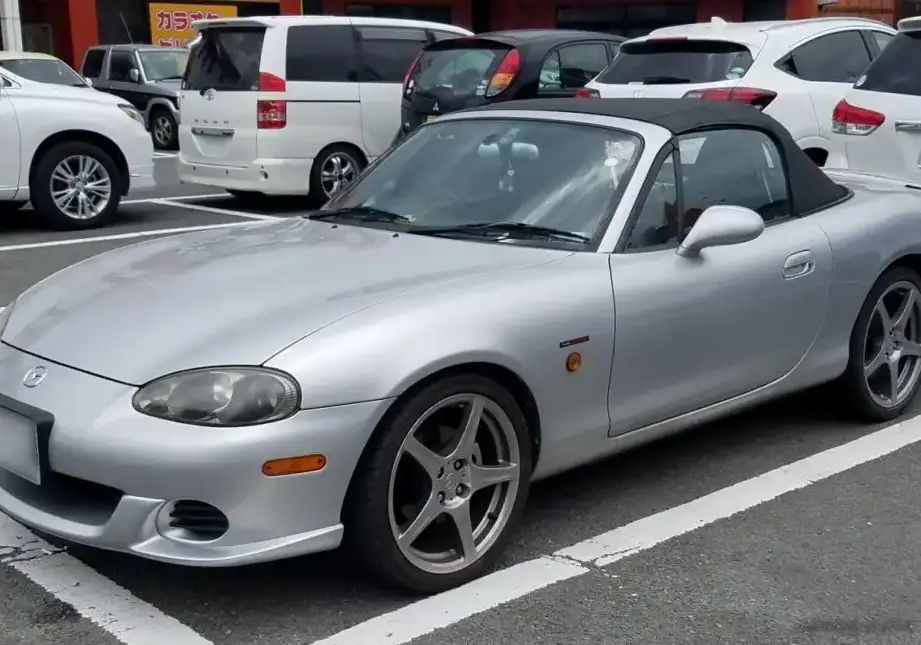
Technical Specifications
| Brand | Mazda |
| Model | Roadster |
| Generation | Roadster (NB) |
| Type (Engine) | 1.8 i (146 Hp) |
| Start of production | 1998 |
| End of production | 2005 |
| Powertrain Architecture | Internal Combustion engine |
| Body type | Roadster |
| Seats | 2 |
| Doors | 2 |
| Fuel Type | Petrol (Gasoline) |
| Weight-to-power ratio | 6.9 kg/Hp, 144.6 Hp/tonne |
| Weight-to-torque ratio | 6 kg/Nm, 166.3 Nm/tonne |
| Power | 146 Hp @ 7000 rpm |
| Power per litre | 79.3 Hp/l |
| Torque | 168 Nm @ 5000 rpm (123.91 lb.-ft. @ 5000 rpm) |
| Engine layout | Front, Longitudinal |
| Engine displacement | 1840 cm3 (112.28 cu. in.) |
| Number of cylinders | 4 |
| Engine configuration | Inline |
| Cylinder Bore | 83 mm (3.27 in.) |
| Piston Stroke | 85 mm (3.35 in.) |
| Compression ratio | 10:1 |
| Number of valves per cylinder | 4 |
| Fuel injection system | Multi-port manifold injection |
| Engine aspiration | Naturally aspirated engine |
| Valvetrain | DOHC |
| Kerb Weight | 1010 kg (2226.67 lbs.) |
| Fuel tank capacity | 48 l (12.68 US gal | 10.56 UK gal) |
| Length | 3955 mm (155.71 in.) |
| Width | 1680 mm (66.14 in.) |
| Height | 1235 mm (48.62 in.) |
| Wheelbase | 2265 mm (89.17 in.) |
| Front track | 1405 mm (55.31 in.) |
| Rear (Back) track | 1430 mm (56.3 in.) |
| Drivetrain Architecture | Rear wheel drive |
| Drive wheel | Rear wheel drive |
| Number of gears and type of gearbox | 5 gears, manual transmission |
| Front brakes | Ventilated discs |
| Rear brakes | Disc |
| Tires size | 185/60 R14 |
| Wheel rims size | 14 |
The NB Mazda Roadster, launched in 1998, represented a significant redesign of the original NA model. While retaining the fundamental rear-wheel-drive, lightweight roadster formula, the NB featured a more contemporary exterior design, improved interior refinement, and enhanced safety features. The 1.8 i variant, introduced later in the NB’s production run, became a popular choice for enthusiasts seeking a balance of performance and affordability. It was built on the 1HX0 platform, shared with other Mazda models of the era, and quickly gained a reputation for its engaging driving dynamics and reliability. This model was primarily aimed at the North American and European markets, where the demand for affordable, sporty roadsters was high.
Powertrain & Engine Architecture
The heart of the 1.8 i Roadster is the BP-4C engine, a 1.8-liter inline-four cylinder powerplant. This engine utilized a naturally aspirated configuration with multi-port fuel injection and a double overhead camshaft (DOHC) valvetrain. The BP-4C engine benefited from improvements over the earlier 1.6L engines, including larger intake and exhaust ports, a revised intake manifold, and a higher compression ratio (10:1). These changes contributed to the increased horsepower and torque output. The engine’s longitudinal front-engine layout, coupled with rear-wheel drive, provided excellent weight distribution and handling characteristics. The standard transmission was a 5-speed manual, known for its precise shift feel and relatively short ratios. A 4-speed automatic transmission was also offered, though it was less favored by enthusiasts due to its slower shift times and less direct connection to the engine. The automatic was geared more towards comfort and ease of use, appealing to a broader demographic.
Driving Characteristics
The 1.8 i Roadster offered a distinctly engaging driving experience. While not overwhelmingly powerful, the combination of the 146 hp engine and the lightweight chassis (approximately 2227 lbs) resulted in a lively and responsive feel. The 5-speed manual transmission allowed drivers to fully exploit the engine’s powerband, with quick shifts and a satisfying mechanical connection. The rear-wheel-drive configuration provided excellent balance and predictable handling, making it a joy to drive on winding roads. Compared to the earlier 1.6L models, the 1.8 i offered noticeably more torque, particularly in the mid-range, making it more tractable in everyday driving situations. The automatic transmission, while convenient, noticeably dulled the driving experience, with slower acceleration and a less connected feel. Gear ratios in the manual transmission were relatively short, prioritizing acceleration over top-end speed.
Equipment & Trim Levels
The 1.8 i Roadster typically came equipped with a range of standard features, including power windows, power steering, and a basic audio system. Interior upholstery was typically cloth, with options for leather available. Dashboard configuration was relatively simple and functional, prioritizing driver information. Popular optional extras included air conditioning, a limited-slip differential, and upgraded audio systems. Later models often featured a Targa top as standard, offering open-air driving enjoyment with added security compared to a fully removable soft top. Trim levels varied depending on the market; in the US, the “LS” trim was a common base model, while the “SE” offered more features. Special editions, like the “Shinsenmiata” in Japan, added unique cosmetic enhancements.
Chassis & Braking
The NB Roadster retained the double-wishbone suspension setup of the NA model, providing excellent handling and ride quality. The 1.8 i variant typically featured a slightly stiffer suspension tuning compared to the earlier 1.6L models, to better manage the increased power output. Braking duties were handled by ventilated discs at the front and solid discs at the rear. The braking system was generally considered adequate for the car’s performance, providing good stopping power and pedal feel. Anti-lock brakes (ABS) were available as an option, enhancing safety in slippery conditions. The relatively low curb weight of the vehicle contributed to its nimble handling and efficient braking performance. Stabilizer bars were standard front and rear, further enhancing handling stability.
Market Reception & Comparison
The 1.8 i Roadster was generally well-received by automotive critics, who praised its engaging driving dynamics, responsive engine, and affordable price point. It was often compared favorably to other small roadsters, such as the BMW Z3 and the Honda S2000. While the Z3 offered more luxury and refinement, the Roadster provided a more raw and visceral driving experience. The S2000, with its high-revving engine, offered even greater performance, but at a significantly higher price. In terms of fuel economy, the 1.8 i Roadster performed respectably, achieving around 25-30 mpg in mixed driving conditions. Reliability was generally good, with the BP-4C engine proving to be a durable and long-lasting powerplant. Some critics noted the interior plastics felt somewhat cheap compared to competitors.
Legacy
The NB Mazda Roadster, particularly the 1.8 i variant, has become a popular choice among enthusiasts and collectors. Its combination of affordability, reliability, and engaging driving dynamics has ensured its continued popularity in the used car market. The BP-4C engine is known for its durability and relatively simple maintenance requirements. While some NB Roadsters have succumbed to rust or neglect, well-maintained examples continue to provide years of driving enjoyment. The NB Roadster represents a high point in the evolution of the Mazda Roadster, solidifying its reputation as one of the most iconic and beloved sports cars of all time. Today, it remains a popular platform for modification and restoration, with a thriving aftermarket support network. The 1.8L engine, in particular, is considered a sweet spot for reliability and performance, making it a desirable choice for those seeking a classic roadster experience.