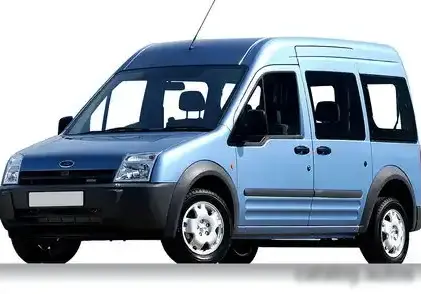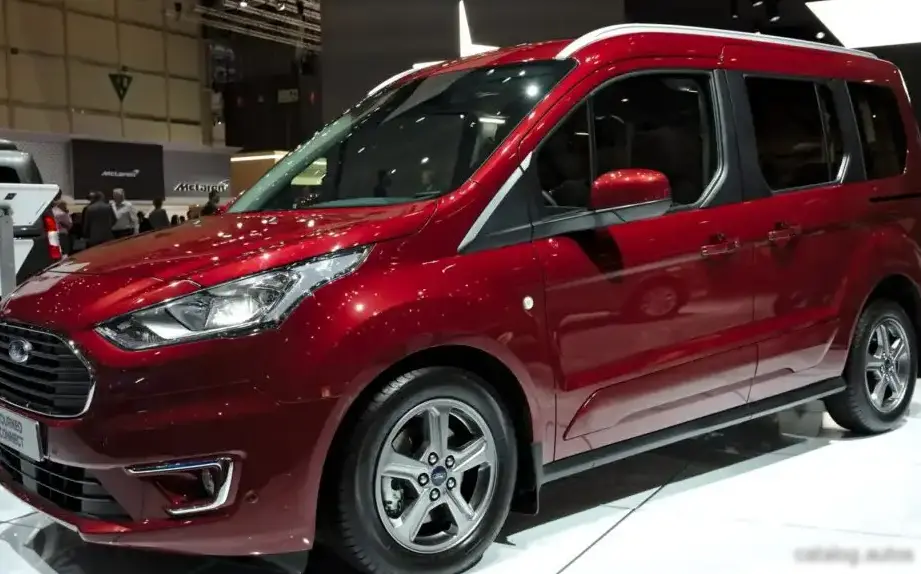
The Ford Tourneo Connect II 1.6 Duratorq TDCi, producing 95 horsepower, was a key variant in the second generation of Ford’s compact leisure activity vehicle (LAV) line. Introduced in 2014 and continuing through 2015, this model occupied the entry-level position within the Tourneo Connect II range, appealing to buyers prioritizing fuel efficiency and practicality over outright performance. Built upon the global Ford C-Max/Focus platform, the Tourneo Connect II aimed to provide a versatile and affordable option for families and commercial users alike, particularly in European markets. This specific 1.6-liter diesel configuration was designed to balance running costs with acceptable usability for everyday driving.
Technical Specifications
| Brand | Ford |
| Model | Tourneo Connect |
| Generation | Tourneo Connect II |
| Type (Engine) | 1.6 Duratorq TDCi (95 Hp) |
| Start of production | 2014 |
| End of production | 2015 |
| Powertrain Architecture | Internal Combustion engine |
| Body type | Minivan |
| Seats | 5 |
| Doors | 5 |
| Fuel consumption (urban) | 5.6 l/100 km (42 US mpg, 50.4 UK mpg, 17.9 km/l) |
| Fuel consumption (extra urban) | 4.6 l/100 km (51.1 US mpg, 61.4 UK mpg, 21.7 km/l) |
| Fuel consumption (combined) | 5 l/100 km (47 US mpg, 56.5 UK mpg, 20 km/l) |
| CO2 emissions | 130 g/km |
| Fuel Type | Diesel |
| Acceleration 0 – 100 km/h | 14.7 sec |
| Acceleration 0 – 62 mph | 14.7 sec |
| Acceleration 0 – 60 mph | 14 sec |
| Maximum speed | 160 km/h (99.42 mph) |
| Emission standard | Euro 5 |
| Weight-to-power ratio | 15.3 kg/Hp, 65.2 Hp/tonne |
| Weight-to-torque ratio | 6.3 kg/Nm, 157.8 Nm/tonne |
| Power | 95 Hp @ 3600 rpm |
| Power per litre | 60.9 Hp/l |
| Torque | 230 Nm @ 1500-2000 rpm (169.64 lb.-ft. @ 1500-2000 rpm) |
| Engine layout | Front, Transverse |
| Engine Model/Code | TZGA, TZGB |
| Engine displacement | 1560 cm3 (95.2 cu. in.) |
| Number of cylinders | 4 |
| Engine configuration | Inline |
| Cylinder Bore | 75 mm (2.95 in.) |
| Piston Stroke | 88.3 mm (3.48 in.) |
| Compression ratio | 16:1 |
| Number of valves per cylinder | 2 |
| Fuel injection system | Diesel Commonrail |
| Engine aspiration | Turbocharger, Intercooler |
| Valvetrain | SOHC |
| Engine oil capacity | 6.2 l (6.55 US qt | 5.46 UK qt) |
| Coolant | 7.3 l (7.71 US qt | 6.42 UK qt) |
| Kerb Weight | 1458 kg (3214.34 lbs.) |
| Max. weight | 2045 kg (4508.45 lbs.) |
| Max load | 587 kg (1294.11 lbs.) |
| Trunk (boot) space – minimum | 1029 l (36.34 cu. ft.) |
| Trunk (boot) space – maximum | 2410 l (85.11 cu. ft.) |
| Length | 4418 mm (173.94 in.) |
| Width | 2137 mm (84.13 in.) |
| Height | 1852 mm (72.91 in.) |
| Wheelbase | 2662 mm (104.8 in.) |
| Front track | 1568 mm (61.73 in.) |
| Rear (Back) track | 1584 mm (62.36 in.) |
| Minimum turning circle | 11.7 m (38.39 ft.) |
| Drivetrain Architecture | Front wheel drive |
| Number of gears | 5 |
| Gearbox type | Manual transmission |
| Front suspension | Independent, McPherson with coil spring and anti-roll bar |
| Rear suspension | Semi-dependent beam with stabilizer |
| Front brakes | Ventilated discs |
| Rear brakes | Disc |
| Assisting systems | ABS (Anti-lock braking system) |
| Steering type | Steering rack and pinion |
| Tires size | 205/60 R16 |
| Wheel rims size | 6.5J x 16 |
INTRODUCTION
The Ford Tourneo Connect II, launched in 2014, represented Ford’s entry into the compact leisure activity vehicle segment, sharing its underpinnings with the similarly-structured Ford Transit Connect van. The 1.6 Duratorq TDCi 95 hp variant served as the base engine option, targeting budget-conscious buyers and those prioritizing fuel economy. This version was primarily sold in Europe, where smaller, more efficient vehicles are highly valued. It offered a practical and versatile solution for families and small businesses needing a flexible vehicle for both passenger and light cargo duties. The Tourneo Connect II aimed to bridge the gap between a traditional minivan and a compact MPV, offering a more car-like driving experience than larger vans.
Powertrain & Engine Architecture
The heart of this Tourneo Connect variant is the 1.6-liter Duratorq TDCi diesel engine, specifically the TZGA or TZGB engine code depending on the specific market and production date. This engine is a four-cylinder, inline configuration, utilizing a common-rail direct fuel injection system to optimize combustion and efficiency. The engine features a single overhead camshaft (SOHC) valvetrain operating two valves per cylinder. A turbocharger with an intercooler is employed to boost power output and improve torque delivery. The 95 horsepower peak is achieved at 3600 rpm, while the 230 Nm (169.64 lb.-ft.) of torque is available between 1500 and 2000 rpm, providing reasonable low-end grunt for everyday driving. This engine is paired with a five-speed manual transmission, chosen for its simplicity and contribution to fuel efficiency. The transmission’s gear ratios are geared towards maximizing fuel economy rather than providing rapid acceleration.
Driving Characteristics
The 1.6 Duratorq TDCi 95 hp Tourneo Connect II delivers a driving experience focused on practicality and economy. Acceleration is modest, with a 0-60 mph time of around 14 seconds. The engine feels strained when pushed hard, particularly when fully loaded. However, for typical urban and highway driving, the engine provides sufficient power. The five-speed manual transmission is smooth and easy to operate, but the relatively long gearing emphasizes fuel efficiency over spirited performance. The suspension setup, featuring McPherson struts at the front and a semi-dependent beam at the rear, provides a comfortable ride, absorbing bumps and imperfections in the road reasonably well. Compared to higher-powered versions of the Tourneo Connect II, such as those equipped with the 1.0 EcoBoost petrol engine, this diesel variant feels noticeably slower and less refined.
Equipment & Trim Levels
The 1.6 Duratorq TDCi 95 hp variant typically represented the base trim level of the Tourneo Connect II. Standard equipment generally included power steering, central locking, electric front windows, and an adjustable steering column. Safety features such as ABS and driver/passenger airbags were also standard. Interior upholstery was typically cloth, and the dashboard featured a functional but basic design. Optional extras included air conditioning, alloy wheels, a CD/radio system, and parking sensors. Higher trim levels added features like upgraded upholstery, cruise control, and a more sophisticated infotainment system.
Chassis & Braking
The Tourneo Connect II utilizes a front-wheel-drive layout. The front suspension consists of independent McPherson struts with coil springs and an anti-roll bar, providing decent handling and stability. The rear suspension employs a semi-dependent beam with a stabilizer, which contributes to a comfortable ride but limits handling precision. The braking system features ventilated discs at the front and solid discs at the rear, providing adequate stopping power for the vehicle’s weight and performance. ABS (Anti-lock Braking System) is standard, enhancing safety during emergency braking situations.
Market Reception & Comparison
The Ford Tourneo Connect II 1.6 Duratorq TDCi 95 hp was generally well-received by critics as a practical and economical vehicle. However, its performance was often criticized as being underwhelming, particularly when compared to more powerful engine options. Fuel economy was a major selling point, with the vehicle achieving around 47 US mpg on the combined cycle. In terms of reliability, the Duratorq engine is generally considered to be robust and durable, although regular maintenance is essential. Compared to the 1.0 EcoBoost petrol variant, the diesel offered better fuel economy but less overall refinement and performance. The diesel also tended to be more expensive to maintain due to the complexity of the diesel particulate filter (DPF) system.
Legacy
The Ford Tourneo Connect II 1.6 Duratorq TDCi 95 hp remains a relatively common sight on used car markets, particularly in Europe. Its reputation for reliability and fuel efficiency makes it an attractive option for budget-conscious buyers. While not known for its performance, the powertrain is generally considered durable and capable of handling high mileage with proper maintenance. The DPF system can be a potential source of issues if not properly maintained, requiring periodic regeneration or eventual replacement. Overall, this variant represents a sensible and practical choice for those seeking a versatile and economical compact leisure activity vehicle.