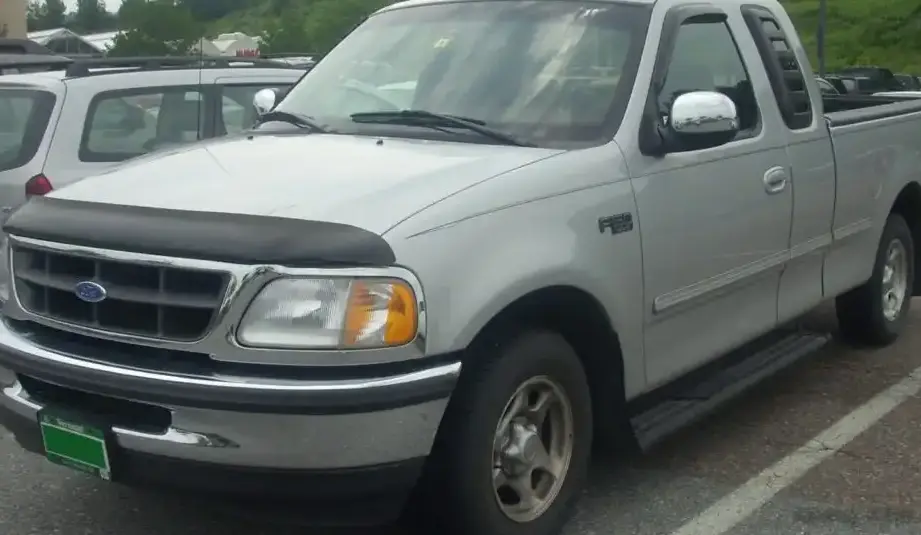
The Ford F-Series F-150 X SuperCab, equipped with the 4.2-liter V6 engine producing 202 horsepower, was a mainstay of Ford’s full-size pickup truck lineup from 1997 through 2004. This variant occupied a middle ground within the F-150 range, offering a balance between affordability, capability, and interior space. It represented Ford’s attempt to cater to buyers who needed more than a standard cab but didn’t require the full size of a crew cab. The SuperCab configuration, combined with the 4.2L engine, was a popular choice for both personal use and light-duty commercial applications.
Technical Specifications
| Brand | Ford |
| Model | F-Series F-100/F-150 |
| Generation | F-Series F-150 X SuperCab |
| Type (Engine) | 4.2 V6 (202 Hp) |
| Start of production | 1997 |
| End of production | 2004 |
| Powertrain Architecture | Internal Combustion engine |
| Body type | Pick-up |
| Seats | 5-6 |
| Doors | 2 |
| Fuel Type | Petrol (Gasoline) |
| Power | 202 Hp @ 4800 rpm |
| Power per litre | 48.2 Hp/l |
| Torque | 342 Nm @ 3400 rpm |
| Torque (lb-ft) | 252.25 lb.-ft. @ 3400 rpm |
| Engine layout | Front, Longitudinal |
| Engine displacement | 4195 cm3 |
| Engine displacement (cu. in.) | 255.99 cu. in. |
| Number of cylinders | 6 |
| Engine configuration | V-engine |
| Cylinder Bore | 96.77 mm |
| Cylinder Bore (in.) | 3.81 in. |
| Piston Stroke | 95 mm |
| Piston Stroke (in.) | 3.74 in. |
| Compression ratio | 9.2:1 |
| Number of valves per cylinder | 2 |
| Fuel injection system | Multi-port manifold injection |
| Engine aspiration | Naturally aspirated engine |
| Valvetrain | OHV |
| Engine oil capacity | 5.7 l |
| Engine oil capacity (US qt) | 6.02 US qt |
| Engine oil capacity (UK qt) | 5.02 UK qt |
| Coolant | 19 l |
| Coolant (US qt) | 20.08 US qt |
| Coolant (UK qt) | 16.72 UK qt |
| Max. weight | 2744 kg |
| Max. weight (lbs) | 6049.48 lbs |
| Trunk (boot) space – minimum | 1422 l |
| Trunk (boot) space – minimum (cu. ft.) | 50.22 cu. ft. |
| Trunk (boot) space – maximum | 1659 l |
| Trunk (boot) space – maximum (cu. ft.) | 58.59 cu. ft. |
| Fuel tank capacity | 95 l |
| Fuel tank capacity (US gal) | 25.1 US gal |
| Fuel tank capacity (UK gal) | 20.9 UK gal |
| Permitted trailer load with brakes (12%) | 1497 kg |
| Permitted trailer load with brakes (12%) (lbs) | 3300.32 lbs |
| Length | 5728 mm |
| Length (in.) | 225.51 in. |
| Width | 2014 mm |
| Width (in.) | 79.29 in. |
| Height | 1849 mm |
| Height (in.) | 72.8 in. |
| Wheelbase | 3518 mm |
| Wheelbase (in.) | 138.5 in. |
| Front overhang | 983 mm |
| Front overhang (in.) | 38.7 in. |
| Rear overhang | 1227 mm |
| Rear overhang (in.) | 48.31 in. |
| Ride height (ground clearance) | 185 mm |
| Ride height (ground clearance) (in.) | 7.28 in. |
| Approach angle | 18.1° |
| Departure angle | 16.1° |
| Ramp-over (brakeover) angle | 14.7° |
| Wading depth | 820 mm |
| Wading depth (in.) | 32.28 in. |
| Drivetrain Architecture | The Internal combustion engine (ICE) drives the rear wheels of the vehicle. |
| Drive wheel | Rear wheel drive |
| Number of gears and type of gearbox | 5 gears, manual transmission |
| Front suspension | Independent coil spring, Transverse stabilizer |
| Rear suspension | Leaf spring |
| Front brakes | Ventilated discs, 308 mm |
| Rear brakes | Ventilated discs, 335 mm |
| Assisting systems | ABS (Anti-lock braking system) |
| Steering type | Cone worm with recirculation balls |
| Power steering | Electric Steering |
| Tires size | 235/70 R16 |
| Wheel rims size | 16 |
Introduction
The Ford F-150 X SuperCab with the 4.2-liter V6 engine, produced between 1997 and 2004, was part of the tenth generation of the Ford F-Series. This generation (1997-2003, with minor updates through 2004) marked a significant departure from previous F-Series trucks, introducing a more aerodynamic design and a greater emphasis on interior comfort and refinement. The SuperCab body style offered extended rear doors and a small rear seat area, providing occasional passenger accommodation. The 4.2-liter V6 was positioned as the base engine option, offering a more affordable entry point into the F-150 lineup compared to the larger V8 engines.
Powertrain & Engine Architecture
The 4.2-liter V6 engine, designated as the engine code E4TE, was a 90-degree V6 featuring overhead valve (OHV) valvetrain. It utilized a cast iron block and aluminum cylinder heads. The engine employed multi-port fuel injection, delivering fuel directly to each intake port. This engine was a significant departure from Ford’s traditional inline-six engines, offering a smoother and more refined driving experience. The 4.2L V6 produced 202 horsepower at 4800 rpm and 342 Nm (252.25 lb-ft) of torque at 3400 rpm. The standard transmission for this variant was a 5-speed manual transmission, although a 4-speed automatic transmission was also available as an option. The automatic transmission was a Ford 4R70W, known for its durability and relatively smooth shifting characteristics.
Driving Characteristics
The F-150 SuperCab with the 4.2-liter V6 and manual transmission offered adequate performance for everyday driving and light-duty tasks. Acceleration was not particularly brisk, but the engine provided sufficient torque for hauling moderate loads. The automatic transmission, while offering convenience, slightly diminished the truck’s responsiveness. The gear ratios were optimized for fuel economy and towing, rather than outright acceleration. Compared to the larger V8 engines available in the F-150 lineup, the 4.2-liter V6 felt less powerful, especially when fully loaded or towing a trailer. However, it offered a noticeable improvement in fuel economy compared to the V8 options.
Equipment & Trim Levels
The F-150 X SuperCab 4.2L V6 typically came standard with features such as air conditioning, an AM/FM radio, and cloth upholstery. The “X” trim level represented a base level of equipment. Optional extras included power windows and locks, cruise control, a CD player, and upgraded interior trim. The SuperCab configuration offered a small rear seat, capable of accommodating two passengers for short trips. The interior design was functional and durable, with a focus on practicality rather than luxury. The dashboard layout was straightforward and easy to use.
Chassis & Braking
The F-150 SuperCab 4.2L V6 utilized a body-on-frame construction, providing a robust and durable platform. The front suspension consisted of independent coil springs with a transverse stabilizer bar, while the rear suspension employed leaf springs. This suspension setup provided a comfortable ride quality, even when carrying a load. The braking system featured ventilated disc brakes on all four wheels, with ABS (Anti-lock Braking System) as standard equipment. The braking performance was adequate for the truck’s weight and intended use. The rear leaf springs were tuned to handle the expected payload capacity of the vehicle.
Market Reception & Comparison
The F-150 SuperCab 4.2L V6 was generally well-received by critics as a practical and affordable pickup truck. It was praised for its comfortable ride, spacious interior (for a SuperCab), and relatively good fuel economy. However, some critics noted that the 4.2-liter V6 engine lacked the power and refinement of the larger V8 engines. Compared to the F-150 with the 4.6-liter or 5.4-liter V8 engines, the 4.2-liter V6 offered lower performance but also a lower price point. The 4.2L engine was also often compared to similar V6 offerings from Chevrolet and Dodge, generally holding its own in terms of reliability and fuel efficiency.
Legacy
The 4.2-liter V6 engine proved to be a relatively reliable powertrain, although it was not without its issues. Common problems included oil leaks and occasional issues with the intake manifold. However, with proper maintenance, these engines could provide many years of service. Today, the F-150 SuperCab 4.2L V6 is a popular choice among used truck buyers looking for an affordable and dependable work truck. Its relatively simple design and readily available parts make it a relatively easy vehicle to maintain and repair. While it may not offer the same level of performance or luxury as newer trucks, it remains a capable and practical vehicle for a variety of tasks.