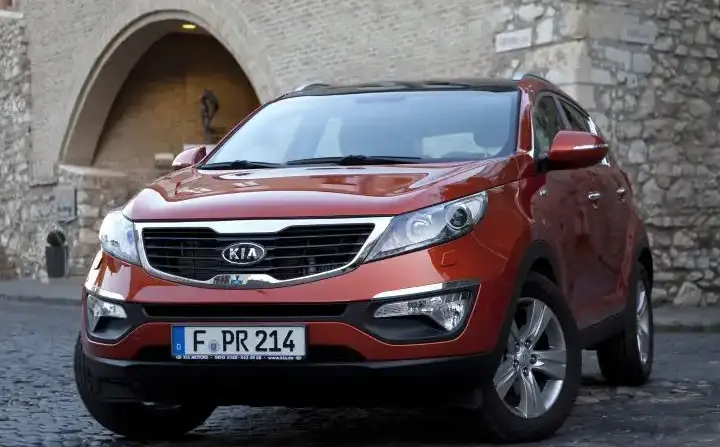
The Kia Sportage III, produced between 2010 and 2014, represented a significant step forward for the South Korean automaker in the competitive compact SUV segment. The 1.6 16V variant, generating 135 horsepower, was positioned as an entry-level offering within the Sportage III lineup, aimed at buyers prioritizing fuel efficiency and affordability. This model, designated internally with the G4FD engine code, played a crucial role in expanding the Sportage’s market reach, particularly in Europe and other regions where smaller displacement engines were favored. It was built on the platform shared with the Hyundai ix35, offering a blend of practicality, style, and value.
Technical Specifications
| Brand | Kia |
| Model | Sportage |
| Generation | Sportage III |
| Type (Engine) | 1.6 16V (135 Hp) |
| Start of production | 2010 |
| End of production | 2014 |
| Powertrain Architecture | Internal Combustion engine |
| Body type | SUV |
| Seats | 5 |
| Doors | 5 |
| Fuel consumption (urban) | 8.2 l/100 km (28.7 US mpg) |
| Fuel consumption (extra urban) | 6 l/100 km (39.2 US mpg) |
| Fuel consumption (combined) | 6.8 l/100 km (34.6 US mpg) |
| Fuel Type | Petrol (Gasoline) |
| Acceleration 0 – 100 km/h | 11.1 sec |
| Acceleration 0 – 62 mph | 11.1 sec |
| Acceleration 0 – 60 mph | 10.5 sec |
| Maximum speed | 178 km/h (110.6 mph) |
| Emission standard | Euro 5 |
| Weight-to-power ratio | 10 kg/Hp |
| Weight-to-torque ratio | 8.2 kg/Nm |
| Power | 135 Hp @ 6300 rpm |
| Torque | 165 Nm @ 4850 rpm (121.7 lb.-ft. @ 4850 rpm) |
| Engine layout | Front, Transverse |
| Engine Model/Code | G4FD |
| Engine displacement | 1591 cm3 (97.09 cu. in.) |
| Number of cylinders | 4 |
| Engine configuration | Inline |
| Number of valves per cylinder | 4 |
| Fuel injection system | Multi-port manifold injection |
| Engine aspiration | Naturally aspirated engine |
| Valvetrain | DOHC |
| Engine oil capacity | 3.3 l (3.49 US qt | 2.9 UK qt) |
| Coolant capacity | 6.6 l (6.97 US qt | 5.81 UK qt) |
| Kerb Weight | 1350 kg (2976.24 lbs.) |
| Max. weight | 1830 kg (4034.46 lbs.) |
| Max load | 480 kg (1058.22 lbs.) |
| Trunk (boot) space – minimum | 564 l (19.92 cu. ft.) |
| Trunk (boot) space – maximum | 1353 l (47.78 cu. ft.) |
| Fuel tank capacity | 58 l (15.32 US gal | 12.76 UK gal) |
| Length | 4440 mm (174.8 in.) |
| Width | 1855 mm (73.03 in.) |
| Height | 1685 mm (66.34 in.) |
| Wheelbase | 2640 mm (103.94 in.) |
| Minimum turning circle | 10.58 m (34.71 ft.) |
| Drivetrain Architecture | Front wheel drive |
| Number of gears | 6 gears, manual transmission |
| Assisting systems | ABS (Anti-lock braking system) |
| Steering type | Steering rack and pinion |
| Tires size | 225/60 R17 |
| Wheel rims size | 17 |
Powertrain & Engine Architecture
The heart of the Sportage 1.6 is the Kia-developed G4FD engine, a 1.6-liter inline-four cylinder gasoline engine. This engine utilizes a multi-point fuel injection system and a double overhead camshaft (DOHC) valvetrain with four valves per cylinder. The G4FD is a naturally aspirated engine, meaning it doesn’t employ turbocharging or supercharging. This design prioritizes simplicity and reliability. The 135 horsepower output is achieved at 6,300 rpm, while peak torque of 165 Nm (121.7 lb-ft) arrives at 4,850 rpm. Paired with this engine was typically a six-speed manual transmission, although a six-speed automatic was also offered as an option. The automatic transmission was designed to provide smooth shifts and contribute to the vehicle’s overall fuel efficiency. The engine’s architecture was relatively conventional for the time, focusing on maximizing efficiency within the constraints of naturally aspirated operation.
Driving Characteristics
The 1.6-liter Sportage offered a comfortable, if not particularly exhilarating, driving experience. With 135 hp, acceleration was adequate for everyday driving, but overtaking maneuvers required planning. The 0-60 mph time of around 10.5 seconds reflects this. The six-speed manual transmission allowed drivers to keep the engine in its optimal power band, but the engine lacked the low-end grunt of larger displacement alternatives. The automatic transmission, while smooth, could sometimes feel hesitant during quick acceleration. Compared to the more powerful 2.0-liter gasoline or diesel variants, the 1.6 felt noticeably less responsive. However, the lighter engine weight contributed to slightly improved handling and a more nimble feel in urban environments. The gear ratios were tuned for fuel economy, prioritizing efficiency over outright performance.
Equipment & Trim Levels
The 1.6-liter Sportage typically came with a reasonable level of standard equipment. Base models included air conditioning, power windows, central locking, and an audio system with USB connectivity. Safety features such as ABS (Anti-lock Braking System) and multiple airbags were standard across the range. Higher trim levels, such as the LS and EX, added features like alloy wheels, a sunroof, leather upholstery, and a more advanced audio system. Optional extras included a rear parking sensor, cruise control, and heated seats. Interior upholstery was typically cloth on the base models, with leather available on higher trims. The dashboard layout was functional and straightforward, with a focus on ease of use.
Chassis & Braking
The Sportage III utilized a front-wheel-drive chassis with independent suspension at the front and a multi-link rear suspension. This setup provided a comfortable ride quality, absorbing bumps and imperfections in the road surface effectively. The front brakes were typically ventilated discs, while the rear brakes were often drum brakes on the base 1.6L models, with disc brakes available on higher trims. The steering was a rack and pinion system, providing reasonably precise control. Stabilizer bars were fitted to both the front and rear axles to reduce body roll during cornering. The suspension tuning was geared towards comfort rather than sporty handling.
Market Reception & Comparison
The Kia Sportage 1.6 16V was generally well-received as an affordable and practical SUV. Critics praised its fuel efficiency and value for money, but noted its lack of outright performance. Compared to the more powerful engine options within the Sportage lineup, the 1.6 offered lower running costs but a less engaging driving experience. The 2.0-liter gasoline and diesel variants provided significantly more power and torque, but at a higher price point and with increased fuel consumption. The 1.6L model appealed to buyers who prioritized economy and practicality over performance, making it a popular choice for urban commuters and families.
Legacy
The G4FD engine, while not known for being particularly groundbreaking, proved to be a relatively reliable unit. Long-term reliability reports suggest that the engine is generally durable, provided it receives regular maintenance. In the used car market, the Sportage 1.6 remains an affordable option, appealing to buyers seeking a budget-friendly SUV. However, potential buyers should be aware of the engine’s limitations in terms of performance and consider whether it meets their driving needs. The Sportage III, as a whole, helped establish Kia as a serious contender in the compact SUV segment, paving the way for future models that would further enhance the brand’s reputation for quality and value.