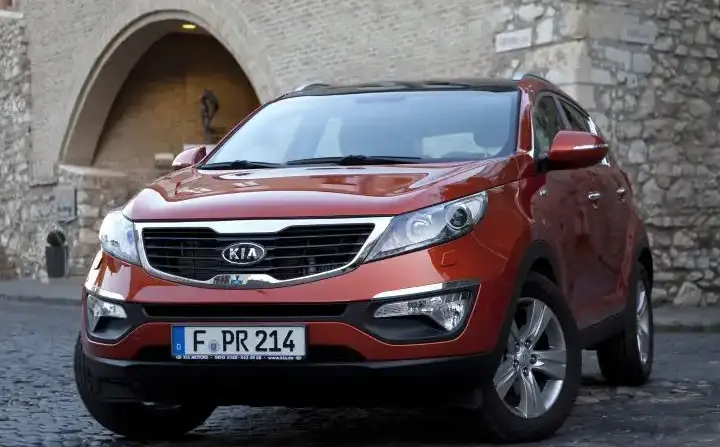
The Kia Sportage III, produced between 2010 and 2014, represented a significant step forward for the South Korean automaker in the competitive compact SUV segment. This generation, known internally as the SL, aimed to broaden Kia’s appeal with a more refined design and improved features. The 2.0-liter 16V (163 horsepower) variant, while not the top performer in the Sportage III lineup, served as a popular and accessible entry point for many buyers, particularly in markets where fuel efficiency and affordability were key considerations. This model occupied a mid-range position, offering a balance between price, performance, and features, slotting below the more powerful 2.4-liter engine option.
Technical Specifications
| Brand | Kia |
| Model | Sportage |
| Generation | Sportage III |
| Type (Engine) | 2.0 16V (163 Hp) |
| Start of production | 2010 |
| End of production | 2014 |
| Powertrain Architecture | Internal Combustion engine |
| Body type | SUV |
| Seats | 5 |
| Doors | 5 |
| Fuel consumption (urban) | 9.8 l/100 km (24 US mpg) |
| Fuel consumption (extra urban) | 6.3 l/100 km (37.3 US mpg) |
| Fuel consumption (combined) | 7.6 l/100 km (30.9 US mpg) |
| Fuel Type | Petrol (Gasoline) |
| Acceleration 0 – 100 km/h | 10.7 sec |
| Acceleration 0 – 62 mph | 10.7 sec |
| Acceleration 0 – 60 mph | 10.2 sec |
| Maximum speed | 182 km/h (113.09 mph) |
| Emission standard | Euro 5 |
| Weight-to-power ratio | 9.4 kg/Hp |
| Weight-to-torque ratio | 7.8 kg/Nm |
| Power | 163 Hp @ 6200 rpm |
| Torque | 195 Nm @ 4600 rpm (143.82 lb.-ft. @ 4600 rpm) |
| Engine layout | Front, Transverse |
| Engine Model/Code | G4KD |
| Engine displacement | 1998 cm3 (121.93 cu. in.) |
| Number of cylinders | 4 |
| Engine configuration | Inline |
| Number of valves per cylinder | 4 |
| Fuel injection system | Multi-port manifold injection |
| Engine aspiration | Naturally aspirated engine |
| Valvetrain | DOHC |
| Engine oil capacity | 5.8 l (6.13 US qt | 5.1 UK qt) |
| Coolant capacity | 6.7 l (7.08 US qt | 5.9 UK qt) |
| Kerb Weight | 1525 kg (3362.05 lbs.) |
| Max. weight | 2030 kg (4475.38 lbs.) |
| Max load | 505 kg (1113.33 lbs.) |
| Trunk (boot) space – minimum | 564 l (19.92 cu. ft.) |
| Trunk (boot) space – maximum | 1353 l (47.78 cu. ft.) |
| Fuel tank capacity | 58 l (15.32 US gal | 12.76 UK gal) |
| Length | 4440 mm (174.8 in.) |
| Width | 1855 mm (73.03 in.) |
| Height | 1685 mm (66.34 in.) |
| Wheelbase | 2640 mm (103.94 in.) |
| Minimum turning circle | 10.58 m (34.71 ft.) |
| Drivetrain Architecture | Front wheel drive |
| Number of gears | 5 |
| Gearbox type | Manual transmission |
| Front brakes | Ventilated discs |
| Rear brakes | Disc |
| Assisting systems | ABS (Anti-lock braking system) |
| Steering type | Steering rack and pinion |
| Tires size | 225/60 R17 |
| Wheel rims size | 17 |
Powertrain & Engine Architecture
The heart of this Sportage variant is the G4KD 2.0-liter inline-four cylinder engine. This engine utilizes a dual overhead camshaft (DOHC) valvetrain with four valves per cylinder, contributing to its respectable power output for its displacement. Fuel delivery is managed by a multi-port fuel injection system, a common setup for engines of this era. The G4KD engine is known for its relatively simple design, which aids in reliability and ease of maintenance. The engine produces 163 horsepower at 6200 rpm and 195 Nm (143.82 lb-ft) of torque at 4600 rpm. This power is then sent to the front wheels through a five-speed manual transmission. While an automatic transmission was available, the manual offered a more engaging driving experience and slightly improved fuel economy.
Driving Characteristics
The 2.0-liter Sportage delivers adequate performance for everyday driving. Acceleration from 0 to 60 mph takes around 10.2 seconds, which is competitive within its class, but noticeably slower than the 2.4-liter models. The five-speed manual transmission provides a reasonable spread of gears, allowing the engine to operate efficiently at highway speeds. However, the engine can feel strained when climbing hills or during quick overtaking maneuvers. The gear ratios are tuned for fuel economy rather than outright performance. Compared to the more powerful engine options, the 2.0-liter Sportage prioritizes fuel efficiency and a smoother, less aggressive driving experience.
Equipment & Trim Levels
The 2.0-liter Sportage typically came equipped with a standard set of features, including air conditioning, power windows and locks, a basic audio system, and ABS brakes. Higher trim levels added features such as alloy wheels, a sunroof, upgraded audio systems, and leather upholstery. Interior materials were generally durable and functional, though not particularly luxurious. The dashboard layout was straightforward and easy to use, with clearly labeled controls. Optional extras included a rearview camera, parking sensors, and a navigation system.
Chassis & Braking
The Sportage III utilizes a front-wheel-drive platform with independent suspension in the front and a multi-link suspension in the rear. This setup provides a comfortable ride quality, absorbing bumps and imperfections in the road effectively. The front brakes are ventilated discs, providing good stopping power, while the rear brakes are solid discs. The steering is a rack-and-pinion system, offering precise and responsive handling. The standard tire size is 225/60 R17, providing a good balance between grip and ride comfort.
Market Reception & Comparison
The 2.0-liter Sportage was generally well-received by critics as a practical and affordable compact SUV. It was praised for its comfortable ride, spacious interior, and good fuel economy. However, some reviewers noted that the engine lacked the power of its competitors and could feel underpowered when fully loaded. Compared to the 2.4-liter Sportage, the 2.0-liter model offered a lower price point but sacrificed some performance. In terms of reliability, the G4KD engine has proven to be relatively robust, with few major issues reported. Fuel economy figures averaged around 30.9 US mpg combined, making it an attractive option for budget-conscious buyers.
Legacy
The Kia Sportage III 2.0 16V (163 Hp) remains a popular choice in the used car market due to its affordability, reliability, and practicality. The G4KD engine is known for its longevity, and parts are readily available. While it may not offer the same level of performance as some of its rivals, it provides a comfortable and dependable driving experience. This variant helped establish Kia as a serious contender in the compact SUV segment, paving the way for the brand’s continued success in the years that followed. Today, well-maintained examples can still provide years of reliable service, making it a sensible and economical choice for those seeking a used SUV.