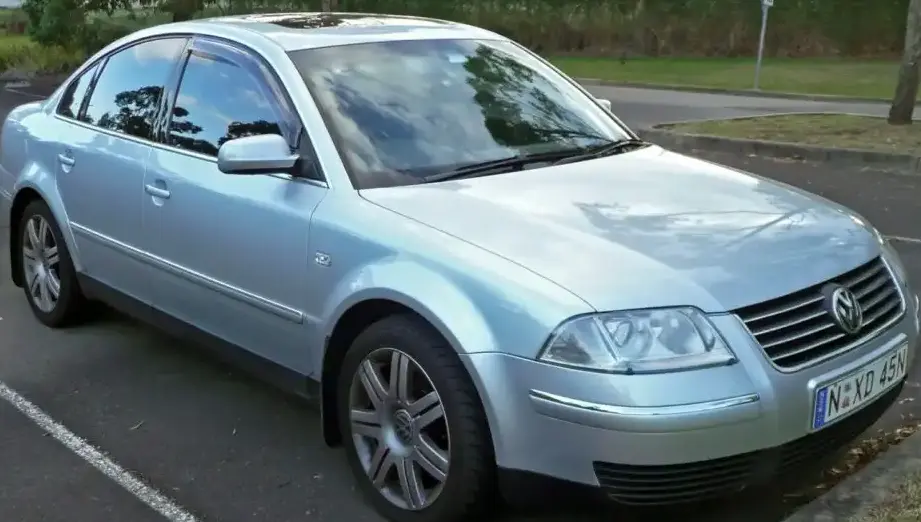
The Volkswagen Passat B5.5 2.0 20V, producing 130 horsepower, represents a significant refinement of the popular mid-size sedan. Produced from 2002 to 2004, this variant occupied a middle ground within the B5.5 range, offering a balance between performance and affordability. It was positioned as a step up from the base 1.8T models, while remaining more accessible than the flagship W8 or performance-oriented VR6 versions. The B5.5 designation refers to a substantial facelift of the B5 Passat, introducing revised styling, improved interior materials, and updated technology.
Technical Specifications
| Brand | Volkswagen |
| Model | Passat |
| Generation | Passat (B5.5) |
| Type (Engine) | 2.0 20V (130 Hp) |
| Start of production | 2002 |
| End of production | 2004 |
| Powertrain Architecture | Internal Combustion engine |
| Body type | Sedan |
| Seats | 5 |
| Doors | 4 |
| Fuel consumption (economy) – urban (NEDC) | 11.6 l/100 km (20.3 US mpg, 24.4 UK mpg, 8.6 km/l) |
| Fuel consumption (economy) – extra urban (NEDC) | 6.1 l/100 km (38.6 US mpg, 46.3 UK mpg, 16.4 km/l) |
| Fuel consumption (economy) – combined (NEDC) | 8.1 l/100 km (29 US mpg, 34.9 UK mpg, 12.3 km/l) |
| CO2 emissions (NEDC) | 194 g/km |
| Fuel Type | Petrol (Gasoline) |
| Acceleration 0 – 100 km/h | 9.9 sec |
| Acceleration 0 – 62 mph | 9.9 sec |
| Acceleration 0 – 60 mph | 9.4 sec |
| Maximum speed | 209 km/h (129.87 mph) |
| Emission standard | Euro 4 |
| Weight-to-power ratio | 11.2 kg/Hp, 89.3 Hp/tonne |
| Weight-to-torque ratio | 7.5 kg/Nm, 134 Nm/tonne |
| Power | 130 Hp @ 5700 rpm |
| Power per litre | 65.5 Hp/l |
| Torque | 195 Nm @ 3300 rpm (143.82 lb.-ft. @ 3300 rpm) |
| Engine layout | Front, Longitudinal |
| Engine Model/Code | ALT |
| Engine displacement | 1984 cm3 (121.07 cu. in.) |
| Number of cylinders | 4 |
| Engine configuration | Inline |
| Cylinder Bore | 82.5 mm (3.25 in.) |
| Piston Stroke | 92.8 mm (3.65 in.) |
| Compression ratio | 10.3:1 |
| Number of valves per cylinder | 5 |
| Fuel injection system | Multi-port manifold injection |
| Engine aspiration | Naturally aspirated engine |
| Valvetrain | DOHC |
| Engine oil capacity | 4.2 l (4.44 US qt | 3.7 UK qt) |
| Coolant | 7 l (7.4 US qt | 6.16 UK qt) |
| Kerb Weight | 1455 kg (3207.73 lbs.) |
| Max. weight | 1930 kg (4254.92 lbs.) |
| Max load | 475 kg (1047.2 lbs.) |
| Trunk (boot) space – minimum | 475 l (16.77 cu. ft.) |
| Trunk (boot) space – maximum | 800 l (28.25 cu. ft.) |
| Fuel tank capacity | 62 l (16.38 US gal | 13.64 UK gal) |
| Max. roof load | 100 kg (220.46 lbs.) |
| Permitted trailer load with brakes (12%) | 1400 kg (3086.47 lbs.) |
| Permitted trailer load without brakes | 650 kg (1433 lbs.) |
| Permitted towbar download | 75 kg (165.35 lbs.) |
| Length | 4703 mm (185.16 in.) |
| Width | 1746 mm (68.74 in.) |
| Height | 1462 mm (57.56 in.) |
| Wheelbase | 2703 mm (106.42 in.) |
| Front track | 1515 mm (59.65 in.) |
| Rear (Back) track | 1515 mm (59.65 in.) |
| Minimum turning circle (turning diameter) | 11.4 m (37.4 ft.) |
| Drivetrain Architecture | The Internal combustion engine (ICE) drives the front wheels of the vehicle. |
| Drive wheel | Front wheel drive |
| Number of gears and type of gearbox | 5 gears, manual transmission |
| Front suspension | Independent multi-link suspension, Transverse stabilizer |
| Rear suspension | Trailing arm, Torsion |
| Front brakes | Ventilated discs |
| Rear brakes | Disc |
| Assisting systems | ABS (Anti-lock braking system) |
| Steering type | Steering rack and pinion |
| Power steering | Hydraulic Steering |
| Tires size | 195/65 R15 |
| Wheel rims size | 6J x 15 |
INTRODUCTION
The Volkswagen Passat B5.5 2.0 20V (130 hp) was a key model in Volkswagen’s lineup during its production run. Building upon the success of the B5 generation, the B5.5 brought a more refined and modern aesthetic, along with improvements to the interior and mechanical components. This particular variant, powered by the 1984cc 20-valve inline-four engine, was aimed at buyers seeking a comfortable and reliable family sedan with adequate performance for everyday driving. It was a popular choice in Europe and other markets where fuel efficiency and practicality were highly valued.
Powertrain & Engine Architecture
The heart of the Passat 2.0 20V is the ALT engine code, a naturally aspirated 1.984-liter inline-four cylinder engine. This engine features a dual overhead camshaft (DOHC) design with five valves per cylinder (20 valves total), contributing to improved breathing and power delivery. Fuel delivery is managed by a multi-port fuel injection system, providing precise fuel metering for optimal combustion. The engine’s 10.3:1 compression ratio further enhances efficiency and performance. The engine is longitudinally mounted, a characteristic of many Volkswagen and Audi models, and drives the front wheels. The 5-speed manual transmission was standard, offering a balance between fuel economy and driver engagement.
Driving Characteristics
The 130 horsepower and 195 Nm (144 lb-ft) of torque produced by the 2.0 20V engine provided adequate, though not exhilarating, performance. Acceleration from 0 to 60 mph took approximately 9.4 seconds, and the top speed was around 129.87 mph. The engine felt responsive in the mid-range, making it suitable for highway cruising and overtaking maneuvers. Compared to the more powerful VR6 variant, the 2.0 20V offered a more economical driving experience, but lacked the VR6’s outright acceleration. The 5-speed manual transmission allowed for precise gear selection, while the gear ratios were tuned for a balance of fuel efficiency and performance. The engine’s power delivery was linear and predictable, making it easy to drive in various conditions.
Equipment & Trim Levels
The Passat B5.5 2.0 20V typically came equipped with a respectable level of standard features. These included power windows, power locks, air conditioning, and an AM/FM radio with CD player. Higher trim levels offered options such as leather upholstery, sunroof, automatic climate control, and upgraded audio systems. Interior upholstery was typically cloth, with options for leather available. The dashboard layout was clean and functional, with easy-to-read gauges and intuitive controls. Safety features included ABS brakes, front airbags, and side airbags.
Chassis & Braking
The Passat B5.5 featured an independent multi-link front suspension and a trailing arm rear suspension, providing a comfortable and controlled ride. A transverse stabilizer bar was fitted to the front suspension to reduce body roll during cornering. The braking system consisted of ventilated discs at the front and solid discs at the rear, providing adequate stopping power. ABS (Anti-lock Braking System) was standard, enhancing safety and stability during emergency braking situations. The suspension was tuned for a balance of comfort and handling, making it suitable for both city driving and highway cruising.
Market Reception & Comparison
The Passat B5.5 2.0 20V was generally well-received by automotive critics. It was praised for its comfortable ride, spacious interior, and refined styling. However, some critics noted that the engine lacked the punch of the VR6 variant. Fuel economy was considered to be good for its class, with combined fuel consumption of around 29 US mpg. Compared to the 1.8T models, the 2.0 20V offered slightly more power and torque, but at a higher price point. The 2.0 20V was often seen as a sensible choice for buyers who prioritized reliability and practicality over outright performance.
Legacy
The Volkswagen Passat B5.5 2.0 20V has proven to be a relatively reliable and durable vehicle. The ALT engine is known for its longevity, provided it is properly maintained. Common issues include oil leaks and occasional sensor failures. Today, these Passats can be found on the used car market at affordable prices. They remain a popular choice for budget-conscious buyers seeking a comfortable and reliable family sedan. The B5.5 generation Passat, and particularly the 2.0 20V variant, holds a respected place in Volkswagen’s history as a well-rounded and practical vehicle.