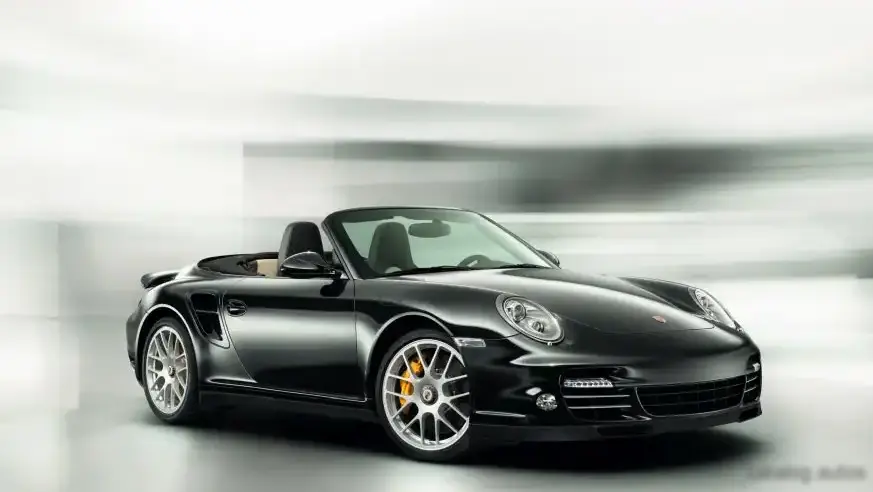
The Porsche 911 Turbo Cabriolet, specifically the 997 generation facelift model produced from 2009 to 2011, represents a pinnacle of open-top performance engineering. This variant, powered by a 3.8-liter twin-turbocharged flat-six engine producing 500 horsepower, combined that power with Porsche’s innovative PDK (Porsche Doppelkupplung) seven-speed dual-clutch transmission. Positioned as the flagship convertible within the 997.2 lineup, it offered a unique blend of exhilarating performance, luxurious appointments, and open-air driving enjoyment. It built upon the already successful 997 platform, introducing significant engine upgrades and refined styling compared to the earlier 997.1 models.
Technical Specifications
| Brand | Porsche |
| Model | 911 |
| Generation | 911 Cabriolet (997, facelift 2008) |
| Type (Engine) | Turbo 3.8 (500 Hp) PDK |
| Start of production | 2009 |
| End of production | 2011 |
| Powertrain Architecture | Internal Combustion engine |
| Body type | Cabriolet |
| Seats | 4 |
| Doors | 2 |
| Fuel consumption (economy) – urban | 16.7 l/100 km (14.1 US mpg, 16.9 UK mpg, 6 km/l) |
| Fuel consumption (economy) – extra urban | 8.2 l/100 km (28.7 US mpg, 34.4 UK mpg, 12.2 km/l) |
| Fuel consumption (economy) – combined | 11.5 l/100 km (20.5 US mpg, 24.6 UK mpg, 8.7 km/l) |
| CO2 emissions | 270 g/km |
| Fuel Type | Petrol (Gasoline) |
| Acceleration 0 – 100 km/h | 3.5-3.7 sec |
| Acceleration 0 – 62 mph | 3.5-3.7 sec |
| Acceleration 0 – 60 mph | 3.3 sec |
| Maximum speed | 312 km/h (193.87 mph) |
| Emission standard | Euro 5 |
| Weight-to-power ratio | 3.3 kg/Hp, 299.4 Hp/tonne |
| Weight-to-torque ratio | 2.6 kg/Nm, 389.2 Nm/tonne |
| Power | 500 Hp @ 6000-6500 rpm |
| Power per litre | 131.6 Hp/l |
| Torque | 650 Nm @ 1950-5000 rpm (479.42 lb.-ft. @ 1950-5000 rpm) |
| Engine layout | Rear, Longitudinal |
| Engine Model/Code | MA1.70 |
| Engine displacement | 3800 cm3 (231.89 cu. in.) |
| Number of cylinders | 6 |
| Engine configuration | Boxer |
| Compression ratio | 9.8:1 |
| Fuel injection system | Direct injection |
| Engine aspiration | Turbocharger, Intercooler |
| Engine oil capacity | 8 l (8.45 US qt | 7.04 UK qt) |
| Coolant | 29 l (30.64 US qt | 25.52 UK qt) |
| Kerb Weight | 1670 kg (3681.72 lbs) |
| Max. weight | 2020 kg (4453.34 lbs) |
| Max load | 350 kg (771.62 lbs) |
| Trunk (boot) space – maximum | 105 l (3.71 cu. ft.) |
| Fuel tank capacity | 67 l (17.7 US gal | 14.74 UK gal) |
| Length | 4450 mm (175.2 in) |
| Width | 1852 mm (72.91 in) |
| Width including mirrors | 1952 mm (76.85 in) |
| Height | 1300 mm (51.18 in) |
| Wheelbase | 2350 mm (92.52 in) |
| Drag coefficient (Cd) | 0.32 |
| Minimum turning circle | 10.9 m (35.76 ft) |
| Drive wheel | All wheel drive (4×4) |
| Number of gears and type of gearbox | 7 gears, automatic transmission PDK |
| Front suspension | Independent type McPherson |
| Rear suspension | Independent multi-link suspension |
| Front brakes | Ventilated discs |
| Rear brakes | Ventilated discs |
| Assisting systems | ABS (Anti-lock braking system) |
| Steering type | Steering rack and pinion |
| Power steering | Hydraulic Steering |
| Tires size | 235/35 ZR19; 305/30 ZR19 |
| Wheel rims size | 8.5J x 19; 11J x 19 |
Powertrain & Engine Architecture
At the heart of the 997.2 Turbo Cabriolet lies the MA1.70 engine, a 3.8-liter twin-turbocharged flat-six. This engine represented a significant upgrade over the previous generation, featuring direct fuel injection (DFI) and revised turbochargers. The DFI system allowed for more precise fuel delivery, improving both power and efficiency. The engine’s flat-six configuration, also known as a boxer engine, contributes to a lower center of gravity, enhancing handling characteristics. The twin turbochargers, with variable turbine geometry (VTG), minimized turbo lag and provided a broad, flat torque curve. The PDK transmission, a seven-speed dual-clutch automated manual, offered incredibly fast and smooth gear changes, contributing to the car’s blistering acceleration. Unlike a traditional automatic, the PDK utilizes two separate clutches for odd and even gears, pre-selecting the next gear for near-instantaneous shifts.
Driving Characteristics
The 997.2 Turbo Cabriolet with the PDK transmission delivers a driving experience that is both visceral and refined. The 500 horsepower and 650 Nm (479 lb-ft) of torque are readily available, providing effortless acceleration in any gear. The PDK transmission’s quick shifts and intelligent programming contribute to a 0-60 mph time of around 3.3 seconds. While the PDK offers a fully automatic mode, drivers can also take control with paddle shifters, allowing for precise gear selection. Compared to the standard Carrera Cabriolet or even the Carrera S, the Turbo offers a significantly more potent and engaging driving experience. The increased power and all-wheel-drive system provide exceptional grip and stability, even in challenging conditions. The open-top configuration adds another dimension to the driving experience, allowing occupants to fully enjoy the engine’s sound and the surrounding environment.
Equipment & Trim Levels
The 997.2 Turbo Cabriolet came standard with a comprehensive list of features, reflecting its position as the range-topping convertible. Standard equipment included leather upholstery, heated front seats, a Bose audio system, navigation, and Porsche’s Active Suspension Management (PASM) system, which adjusts the dampers in real-time to optimize ride comfort and handling. Optional extras were plentiful, allowing buyers to personalize their vehicles. Popular options included sport seats, carbon fiber interior trim, a sport exhaust system, and various exterior customization options. The interior design was typically Porsche – functional, driver-focused, and built with high-quality materials.
Chassis & Braking
The 997.2 Turbo Cabriolet features a robust chassis designed to handle the immense power of the engine. The suspension system utilizes independent McPherson struts at the front and a multi-link setup at the rear. The standard PASM system allows drivers to adjust the suspension stiffness to suit their preferences. Braking duties are handled by ventilated discs on all four wheels, providing exceptional stopping power. The braking system is further enhanced by Porsche’s Ceramic Composite Brakes (PCCB) as an optional upgrade, offering even greater fade resistance and performance. The all-wheel-drive system distributes power to all four wheels, maximizing traction and stability.
Market Reception & Comparison
The 997.2 Turbo Cabriolet was widely praised by automotive critics for its exceptional performance, handling, and refinement. It was often lauded as one of the most capable and enjoyable open-top sports cars available. Compared to other high-performance convertibles of the time, such as the Ferrari California or the Mercedes-Benz SL63 AMG, the 911 Turbo Cabriolet offered a unique blend of performance and practicality. While the Ferrari offered more exotic styling and a more emotional driving experience, the Porsche provided a more usable and reliable everyday car. Fuel economy, while not a primary concern for buyers in this segment, was respectable for a car of this performance level, averaging around 20.5 US mpg in combined driving.
Legacy
The 997.2 Turbo Cabriolet has proven to be a remarkably reliable and durable sports car. The MA1.70 engine, while complex, is generally considered to be robust and well-engineered. The PDK transmission has also proven to be highly reliable, with many examples exceeding six figures in mileage without issue. Today, the 997.2 Turbo Cabriolet is a highly sought-after vehicle in the used car market, commanding premium prices. Its combination of performance, luxury, and open-air driving enjoyment continues to appeal to enthusiasts and collectors alike. It represents a sweet spot in the 911 lineage, offering a compelling blend of classic Porsche characteristics and modern technology.