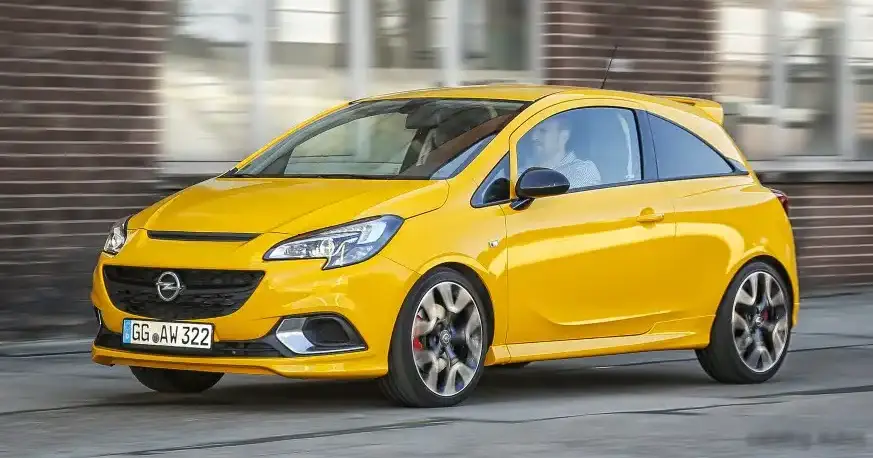
The Opel Corsa E 3-door 1.4 Turbo ECOTEC (150 hp) start/stop was a performance-oriented variant of the fifth-generation Opel Corsa, produced between April 2015 and April 2018. Positioned as a mid-range offering within the Corsa E lineup, it aimed to provide a balance between fuel efficiency and spirited driving. This model was primarily marketed in Europe, where the Corsa was a consistently popular supermini. It represented a step up from the base 1.0-liter engine options, offering significantly more power and torque for drivers seeking a more engaging experience.
Technical Specifications
| Brand | Opel |
| Model | Corsa |
| Generation | Corsa E 3-door |
| Type (Engine) | 1.4 Turbo ECOTEC (150 Hp) start/stop |
| Start of production | April, 2015 |
| End of production | April, 2018 |
| Powertrain Architecture | Internal Combustion engine |
| Body type | Hatchback |
| Seats | 5 |
| Doors | 3 |
| Fuel consumption (urban) | 7.4-6.8 l/100 km (31.8 – 34.6 US mpg) |
| Fuel consumption (extra urban) | 4.8 l/100 km (49 US mpg) |
| Fuel consumption (combined) | 5.7 l/100 km (41.3 US mpg) |
| CO2 emissions | 132 g/km |
| Fuel Type | Petrol (Gasoline) |
| Acceleration 0 – 100 km/h | 8.9 sec |
| Acceleration 0 – 62 mph | 8.9 sec |
| Acceleration 0 – 60 mph | 8.5 sec |
| Maximum speed | 207 km/h (128.62 mph) |
| Emission standard | Euro 6 |
| Weight-to-power ratio | 7.6 kg/Hp |
| Weight-to-torque ratio | 5.2 kg/Nm |
| Power | 150 Hp @ 5000 rpm |
| Torque | 220 Nm @ 3000-4500 rpm (162.26 lb.-ft. @ 3000-4500 rpm) |
| Engine layout | Front, Transverse |
| Engine Model/Code | B14NEH |
| Engine displacement | 1364 cm3 (83.24 cu. in.) |
| Number of cylinders | 4 |
| Engine configuration | Inline |
| Cylinder Bore | 72.5 mm (2.85 in.) |
| Piston Stroke | 82.6 mm (3.25 in.) |
| Compression ratio | 9.5:1 |
| Number of valves per cylinder | 4 |
| Fuel injection system | Multi-port manifold injection |
| Engine aspiration | Turbocharger, Intercooler |
| Engine oil capacity | 4 l (4.23 US qt | 3.52 UK qt) |
| Coolant | 5.1 l (5.39 US qt | 4.49 UK qt) |
| Kerb Weight | 1139 kg (2511.07 lbs.) |
| Max. weight | 1690 kg (3725.81 lbs.) |
| Max load | 551 kg (1214.75 lbs.) |
| Trunk (boot) space – minimum | 285 l (10.06 cu. ft.) |
| Trunk (boot) space – maximum | 1090 l (38.49 cu. ft.) |
| Fuel tank capacity | 45 l (11.89 US gal | 9.9 UK gal) |
| Max. roof load | 75 kg (165.35 lbs.) |
| Permitted trailer load with brakes (12%) | 1200 kg (2645.55 lbs.) |
| Permitted trailer load without brakes | 580 kg (1278.68 lbs.) |
| Length | 4021 mm (158.31 in.) |
| Width | 1736 mm (68.35 in.) |
| Width including mirrors | 1944 mm (76.54 in.) |
| Height | 1479 mm (58.23 in.) |
| Wheelbase | 2510 mm (98.82 in.) |
| Front track | 1472 mm (57.95 in.) |
| Rear (Back) track | 1464 mm (57.64 in.) |
| Minimum turning circle | 11.00 m (36.09 ft.) |
| Drivetrain Architecture | Front wheel drive |
| Number of gears and type of gearbox | 6 gears, manual transmission |
| Front suspension | Independent type McPherson |
| Rear suspension | Semi-independent, coil spring |
| Front brakes | Disc |
| Rear brakes | Disc |
| Assisting systems | ABS (Anti-lock braking system) |
| Steering type | Steering rack and pinion |
| Tires size | 185/65 R15 88H; 185/70 R14 88T |
| Wheel rims size | 6.0J x 15; 5.5J x 14 |
Powertrain & Engine Architecture
The heart of the Corsa E 1.4 Turbo ECOTEC was the B14NEH engine, a 1.4-liter inline-four cylinder gasoline engine. This engine featured a single-scroll turbocharger with an intercooler, boosting power output to 150 hp at 5000 rpm and 220 Nm (162 lb-ft) of torque between 3000 and 4500 rpm. The engine utilized multi-port fuel injection and a compression ratio of 9.5:1. The ‘ECOTEC’ designation signified Opel’s focus on efficiency, incorporating features like start/stop technology to reduce fuel consumption in urban driving. The engine was transversely mounted at the front of the vehicle, driving the front wheels. The standard transmission for this variant was a six-speed manual gearbox, although an automatic transmission was also available as an option, albeit less common.
Driving Characteristics
The 1.4 Turbo ECOTEC offered a noticeable improvement in performance over the lower-powered Corsa E models. The 0-60 mph sprint took approximately 8.5 seconds, and the car had a top speed of 128.62 mph. The turbocharger provided a good surge of power in the mid-range, making overtaking and highway cruising more comfortable. While not a sports car, the 150 hp engine provided a lively and engaging driving experience for a supermini. The six-speed manual transmission allowed drivers to keep the engine in its optimal power band, while the optional automatic transmission offered convenience, though at the expense of some responsiveness. Compared to the base 1.0-liter models, the 1.4 Turbo felt significantly more capable, but it didn’t quite match the performance of larger, more expensive hot hatches.
Equipment & Trim Levels
The Corsa E 1.4 Turbo ECOTEC typically came with a reasonable level of standard equipment. This included air conditioning, power windows, central locking, and a basic audio system. Higher trim levels added features such as alloy wheels, a touchscreen infotainment system with Bluetooth connectivity, cruise control, and parking sensors. Interior upholstery was typically cloth, with options for upgraded materials. The 3-door configuration emphasized a sportier aesthetic, appealing to younger buyers. Optional extras included a panoramic sunroof, heated seats, and a more advanced navigation system.
Chassis & Braking
The Corsa E utilized a McPherson strut front suspension and a semi-independent torsion beam rear suspension. This setup provided a good balance between ride comfort and handling. The steering was light and precise, making the car easy to maneuver in urban environments. Braking was handled by disc brakes on all four wheels, providing adequate stopping power. ABS (Anti-lock Braking System) was standard. The weight distribution was fairly balanced, contributing to the car’s predictable handling characteristics. Stabilizer bars were fitted to both the front and rear axles to reduce body roll during cornering.
Market Reception & Comparison
The Opel Corsa E 1.4 Turbo ECOTEC was generally well-received by automotive critics. It was praised for its punchy engine, decent fuel economy, and comfortable ride. However, some reviewers noted that the interior quality wasn’t quite as refined as some of its rivals, such as the Volkswagen Polo or Ford Fiesta. Compared to the 1.0-liter Corsa E models, the 1.4 Turbo offered a significant performance upgrade, but it came at a higher price point. The diesel-powered Corsa E variants (e.g., 1.3 CDTi) offered even better fuel economy, but lacked the responsiveness of the 1.4 Turbo. The 1.4 Turbo appealed to buyers who wanted a fun-to-drive supermini without sacrificing practicality or efficiency.
Legacy
The B14NEH engine proved to be a relatively reliable unit, although like any turbocharged engine, it required regular maintenance and quality oil changes. Common issues included occasional turbocharger problems and potential issues with the direct injection system. In the used car market, the Corsa E 1.4 Turbo ECOTEC remains a popular choice for buyers seeking an affordable and well-equipped supermini. Its combination of performance, fuel economy, and practicality makes it a compelling option. However, potential buyers should carefully inspect the car’s service history and check for any signs of previous issues.