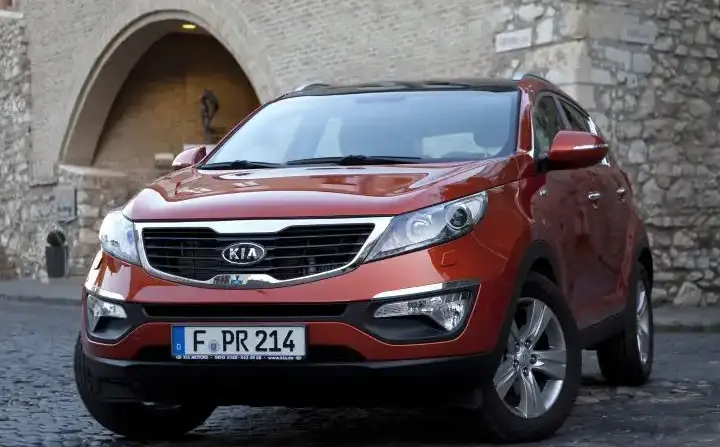
The Kia Sportage III, produced between 2010 and 2013, represented a significant step forward for the South Korean automaker in the competitive compact SUV segment. The 2.4-liter Dual-CVVT (Continuously Variable Valve Timing) engine paired with an automatic transmission and all-wheel drive (AWD) was a popular configuration, positioned as a mid-range offering within the Sportage lineup. This variant aimed to balance performance, fuel efficiency, and all-weather capability for a broad range of buyers. It was a key model for Kia as they sought to establish a stronger foothold in the North American and European markets, offering a compelling alternative to established Japanese and European competitors.
Technical Specifications
| Brand | Kia |
| Model | Sportage |
| Generation | Sportage III |
| Type (Engine) | 2.4 Dual-CVVT (176 Hp) AWD Automatic |
| Start of production | 2010 |
| End of production | 2013 |
| Powertrain Architecture | Internal Combustion engine |
| Body type | SUV |
| Seats | 5 |
| Doors | 5 |
| Fuel consumption (urban) | 12.5 l/100 km (18.8 US mpg) |
| Fuel consumption (extra urban) | 7.3 l/100 km (32.2 US mpg) |
| Fuel consumption (combined) | 9.2 l/100 km (25.6 US mpg) |
| CO2 emissions | 221 g/km |
| Fuel Type | Petrol (Gasoline) |
| Weight-to-power ratio | 8.2 kg/Hp |
| Weight-to-torque ratio | 6.4 kg/Nm |
| Power | 176 Hp @ 6000 rpm |
| Power per litre | 74.6 Hp/l |
| Torque | 227 Nm @ 4000 rpm (167.43 lb.-ft. @ 4000 rpm) |
| Engine layout | Front, Transverse |
| Engine Model/Code | G4KE |
| Engine displacement | 2359 cm3 (143.96 cu. in.) |
| Number of cylinders | 4 |
| Engine configuration | Inline |
| Cylinder Bore | 88 mm (3.46 in.) |
| Piston Stroke | 97 mm (3.82 in.) |
| Compression ratio | 10.5:1 |
| Number of valves per cylinder | 4 |
| Fuel injection system | Multi-port manifold injection |
| Engine aspiration | Naturally aspirated engine |
| Valvetrain | DOHC |
| Engine oil capacity | 4.6 l (4.86 US qt | 4.05 UK qt) |
| Coolant capacity | 6.7 l (7.08 US qt | 5.9 UK qt) |
| Kerb Weight | 1445-1582 kg (3185.68 – 3487.71 lbs.) |
| Trunk (boot) space – minimum | 740 l (26.13 cu. ft.) |
| Trunk (boot) space – maximum | 1547 l (54.63 cu. ft.) |
| Fuel tank capacity | 55 l (14.53 US gal | 12.1 UK gal) |
| Permitted trailer load with brakes (12%) | 907 kg (1999.59 lbs.) |
| Length | 4440 mm (174.8 in.) |
| Width | 1855 mm (73.03 in.) |
| Height | 1645 mm (64.76 in.) |
| Wheelbase | 2640 mm (103.94 in.) |
| Front track | 1614 mm (63.54 in.) |
| Rear track | 1615 mm (63.58 in.) |
| Front overhang | 890 mm (35.04 in.) |
| Rear overhang | 910 mm (35.83 in.) |
| Ride height (ground clearance) | 172 mm (6.77 in.) |
| Drag coefficient (Cd) | 0.37 |
| Approach angle | 28.1° |
| Departure angle | 28.2° |
| Drivetrain Architecture | All wheel drive (4×4) |
| Number of gears | 6 |
| Type of gearbox | automatic transmission |
| Front suspension | Independent type McPherson |
| Rear suspension | Independent multi-link suspension |
| Front brakes | Ventilated discs, 300 mm |
| Rear brakes | Disc, 284 mm |
| Assisting systems | ABS (Anti-lock braking system) |
| Tires size | 215/70 R16; 225/60 R17; 235/55 R18 |
| Wheel rims size | 6.5J x 16; 6.5J x 17; 7J x 18 |
Powertrain & Engine Architecture
The heart of this Sportage variant is the G4KE 2.4-liter inline-four cylinder engine. This engine utilizes Kia’s Dual-CVVT technology, which independently controls the timing of both intake and exhaust valves. This system optimizes engine performance across the rev range, improving both power output and fuel efficiency. The G4KE is a naturally aspirated engine, relying on conventional fuel injection rather than forced induction. The engine’s architecture is relatively straightforward, contributing to its generally good reliability. The six-speed automatic transmission, sourced from Hyundai (Kia’s parent company), was designed to provide smooth shifts and efficient power delivery. It features a torque converter for smooth engagement and a range of gear ratios optimized for both city and highway driving. The AWD system is primarily front-wheel drive, engaging the rear wheels automatically when slip is detected, providing enhanced traction in adverse conditions.
Driving Characteristics
The 176 horsepower and 167 lb-ft of torque produced by the 2.4L engine and automatic transmission combination provided adequate, but not exhilarating, performance. Acceleration from 0 to 60 mph was typically in the 9-10 second range. Compared to the manual transmission version of the same engine, the automatic resulted in a slight performance decrease due to drivetrain losses. The automatic transmission’s gear ratios were tuned for comfort and fuel economy, rather than aggressive acceleration. In real-world driving, the Sportage felt competent and capable, particularly on the highway. The AWD system provided confident handling in slippery conditions, but it wasn’t designed for serious off-roading. The automatic transmission generally offered smooth and predictable shifts, although it could sometimes feel hesitant during quick overtaking maneuvers.
Equipment & Trim Levels
The 2.4L AWD Automatic Sportage typically came standard with features such as air conditioning, power windows and locks, a basic audio system with CD player and auxiliary input, and alloy wheels. Higher trim levels added features like a sunroof, leather upholstery, heated front seats, a more advanced audio system with navigation, and automatic climate control. Safety features included ABS, front airbags, and side curtain airbags. Optional extras included a rearview camera, parking sensors, and a premium sound system. The interior design was functional and modern for its time, with a focus on practicality and durability. Upholstery options ranged from cloth to leather, depending on the trim level.
Chassis & Braking
The Sportage III utilized a McPherson strut front suspension and a multi-link rear suspension, providing a comfortable ride and reasonably controlled handling. Stabilizer bars were fitted to both the front and rear axles to reduce body roll during cornering. Braking duties were handled by ventilated discs at the front and solid discs at the rear. ABS (Anti-lock Braking System) was standard, enhancing braking performance and stability. The suspension tuning was geared towards comfort, prioritizing ride quality over sporty handling. The chassis was designed to provide a good balance between rigidity and weight, contributing to the vehicle’s overall stability.
Market Reception & Comparison
The Kia Sportage III 2.4L AWD Automatic was generally well-received by automotive critics. It was praised for its spacious interior, comfortable ride, and competitive price. However, some reviewers noted that the engine lacked the punch of some of its rivals, and the automatic transmission could feel sluggish at times. Compared to other trims in the Sportage lineup, the 2.4L Automatic offered a good balance between performance and fuel economy. The base 2.0L engine was less powerful, while the more expensive V6 offered significantly more performance but at the cost of fuel efficiency. In terms of reliability, the G4KE engine and the six-speed automatic transmission proved to be generally reliable, although some owners reported minor issues with the fuel pump and the transmission’s control module.
Legacy
The Kia Sportage III, particularly the 2.4L AWD Automatic variant, played a crucial role in establishing Kia as a serious contender in the compact SUV market. The powertrain, while not groundbreaking, proved to be durable and relatively trouble-free. On the used car market today, these Sportages represent a good value proposition, offering a lot of features and space for the price. Maintenance costs are generally reasonable, and parts availability is good. However, potential buyers should be aware of the potential for minor issues with the fuel pump and transmission control module, and it’s always advisable to have a pre-purchase inspection performed by a qualified mechanic.