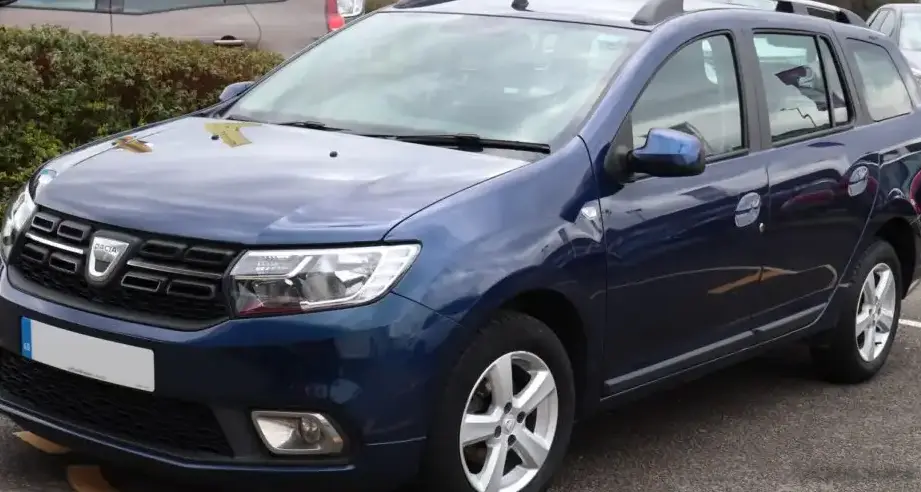
The Dacia Logan II MCV (facelift 2017) 1.0 SCe (75 hp) represents an entry-level variant of the second-generation Logan MCV, a practical and affordable station wagon aimed primarily at the European market. Introduced with the 2017 facelift, this version offered a budget-friendly option for families and those needing a spacious vehicle for work or leisure. It sat at the base of the Logan MCV lineup, positioned below higher-trim levels with larger engines and more features. Production of this specific configuration ran from 2017 to 2018.
Technical Specifications
| Brand | Dacia |
| Model | Logan |
| Generation | Logan II MCV (facelift 2017) |
| Type (Engine) | 1.0 SCe (75 Hp) |
| Start of production | 2017 |
| End of production | 2018 |
| Powertrain Architecture | Internal Combustion engine |
| Body type | Station wagon (estate) |
| Seats | 5 |
| Doors | 5 |
| Fuel consumption (urban) | 6.6 l/100 km (35.6 US mpg, 42.8 UK mpg, 15.2 km/l) |
| Fuel consumption (extra urban) | 4.6 l/100 km (51.1 US mpg, 61.4 UK mpg, 21.7 km/l) |
| Fuel consumption (combined) | 5.4 l/100 km (43.6 US mpg, 52.3 UK mpg, 18.5 km/l) |
| CO2 emissions | 120 g/km |
| Fuel Type | Petrol (Gasoline) |
| Acceleration 0 – 100 km/h | 14.7 sec |
| Acceleration 0 – 62 mph | 14.7 sec |
| Acceleration 0 – 60 mph | 14 sec |
| Maximum speed | 158 km/h (98.18 mph) |
| Emission standard | Euro 6 |
| Weight-to-power ratio | 13.1 kg/Hp, 76.5 Hp/tonne |
| Weight-to-torque ratio | 10.1 kg/Nm, 99 Nm/tonne |
| Power | 75 Hp @ 6300 rpm |
| Power per litre | 75.2 Hp/l |
| Torque | 97 Nm @ 3500 rpm (71.54 lb.-ft. @ 3500 rpm) |
| Engine layout | Front, Transverse |
| Engine Model/Code | B4D 411 |
| Engine displacement | 998 cm3 (60.9 cu. in.) |
| Number of cylinders | 3 |
| Engine configuration | Inline |
| Number of valves per cylinder | 4 |
| Fuel injection system | Multi-port manifold injection |
| Engine aspiration | Naturally aspirated engine |
| Valvetrain | DOHC |
| Engine oil capacity | 3 l (3.17 US qt | 2.64 UK qt) |
| Coolant capacity | 4.5 l (4.76 US qt | 3.96 UK qt) |
| Kerb Weight | 980 kg (2160.53 lbs.) |
| Max. weight | 1555 kg (3428.19 lbs.) |
| Max load | 575 kg (1267.66 lbs.) |
| Trunk (boot) space – minimum | 573 l (20.24 cu. ft.) |
| Trunk (boot) space – maximum | 1518 l (53.61 cu. ft.) |
| Fuel tank capacity | 50 l (13.21 US gal | 11 UK gal) |
| Permitted trailer load with brakes (12%) | 1110 kg (2447.13 lbs.) |
| Permitted trailer load without brakes | 525 kg (1157.43 lbs.) |
| Length | 4501 mm (177.2 in.) |
| Width | 1733 mm (68.23 in.) |
| Width including mirrors | 1994 mm (78.5 in.) |
| Height | 1552 mm (61.1 in.) |
| Wheelbase | 2635 mm (103.74 in.) |
| Front track | 1497 mm (58.94 in.) |
| Rear (Back) track | 1486 mm (58.5 in.) |
| Front overhang | 827 mm (32.56 in.) |
| Rear overhang | 1039 mm (40.91 in.) |
| Ride height (ground clearance) | 128 mm (5.04 in.) |
| Minimum turning circle | 10.82 m (35.5 ft.) |
| Drivetrain Architecture | Front wheel drive |
| Number of gears and type of gearbox | 5 gears, manual transmission |
| Front suspension | Independent type McPherson |
| Rear suspension | independent torsion suspension |
| Front brakes | Ventilated discs |
| Rear brakes | Drum |
| Assisting systems | ABS (Anti-lock braking system) |
| Steering type | Steering rack and pinion |
| Power steering | Electric Steering |
| Tires size | 185/65 R15 |
| Wheel rims size | 6.0J x 15 |
INTRODUCTION
The Dacia Logan II MCV, particularly in its facelifted 2017 form, continued Dacia’s mission of providing affordable, no-frills transportation. The “MCV” designation stands for “Multi Capacity Vehicle,” highlighting the estate’s focus on practicality and cargo space. The 1.0 SCe 75 hp variant was specifically targeted at buyers prioritizing economy and low running costs over outright performance. This engine, a three-cylinder unit, was a relatively new addition to the Dacia lineup, designed to meet increasingly stringent emissions standards. It represented the entry point into the Logan MCV range, appealing to first-time car buyers, families on a budget, and those seeking a dependable workhorse.
Powertrain & Engine Architecture
The heart of this Logan MCV is the B4D 411 engine, a 998cc three-cylinder petrol engine. This engine utilizes multi-point fuel injection and a double overhead camshaft (DOHC) valvetrain. The three-cylinder configuration inherently offers reduced friction compared to four-cylinder engines, contributing to improved fuel efficiency. The 1.0 SCe engine is naturally aspirated, meaning it doesn’t employ a turbocharger or supercharger. This simplicity contributes to its reliability and lower maintenance costs. The engine produces 75 horsepower at 6300 rpm and 97 Nm (71.54 lb-ft) of torque at 3500 rpm. The engine is paired with a five-speed manual transmission, chosen for its cost-effectiveness and simplicity. The transmission’s gear ratios are tuned for fuel economy rather than spirited acceleration.
Driving Characteristics
The 1.0 SCe engine in the Logan MCV delivers modest performance. Acceleration from 0-100 km/h (0-62 mph) takes approximately 14.7 seconds, and the top speed is around 158 km/h (98 mph). In real-world driving, the engine feels adequate for everyday commuting and urban driving, but struggles when fully loaded or attempting to overtake at higher speeds. The five-speed gearbox requires frequent shifting to maintain momentum, especially on inclines. Compared to the more powerful 0.9 TCe engine option available in the Logan MCV range, the 1.0 SCe feels significantly less responsive. However, the 1.0 SCe offers a smoother and more linear power delivery than the diesel options, making it easier to drive in stop-and-go traffic.
Equipment & Trim Levels
The 1.0 SCe trim level of the Logan MCV was typically quite basic, focusing on essential features. Standard equipment generally included power steering, ABS brakes, front airbags, and a basic audio system. Interior upholstery was typically cloth, and the dashboard featured a functional but unadorned design. Optional extras, such as air conditioning, electric windows, and a more advanced audio system, were available but added to the vehicle’s cost. The emphasis was on providing a practical and affordable vehicle, rather than luxury or advanced technology.
Chassis & Braking
The Logan MCV utilizes a McPherson strut front suspension and a torsion beam rear suspension. This setup provides a comfortable ride quality, prioritizing practicality over sporty handling. The front brakes are ventilated discs, while the rear brakes are drums. This configuration is typical for vehicles in this price segment, balancing cost and performance. The electric power steering provides light and easy steering, making it maneuverable in urban environments. The relatively lightweight construction of the Logan MCV helps to compensate for the engine’s modest power output.
Market Reception & Comparison
The Dacia Logan II MCV 1.0 SCe was generally well-received by critics as a value-for-money proposition. It was praised for its spacious interior, large boot capacity, and low running costs. However, the engine’s lack of power was a common criticism. Compared to other trims in the Logan MCV lineup, the 1.0 SCe offered the lowest price point but also the least amount of performance. Fuel economy was a strong point, with combined fuel consumption figures around 5.4 l/100 km (43.6 US mpg). Reliability was also considered to be good, thanks to the engine’s simple design and robust construction.
Legacy
The 1.0 SCe engine, while not known for its performance, proved to be a reliable and economical powerplant. In the used car market, Logan MCV 1.0 SCe models are often sought after by buyers looking for a cheap and practical vehicle. Maintenance costs are generally low, and parts are readily available. While not a particularly exciting car to drive, the Logan MCV 1.0 SCe remains a sensible choice for those prioritizing affordability, practicality, and low running costs. Its enduring appeal lies in its ability to provide basic transportation without breaking the bank.