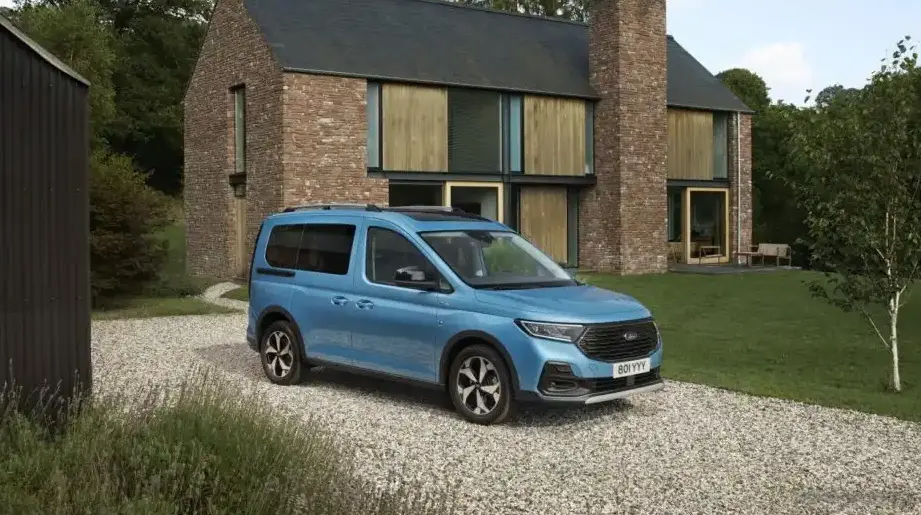
The Ford Tourneo Connect III 2.0 EcoBlue (110 Hp) represents a significant iteration in Ford’s compact people carrier lineup, launched in 2022. Built upon the shared platform with the Fiat Doblò and Opel Combo, the Tourneo Connect III aimed to provide a practical and efficient transportation solution for families and commercial users alike. This particular variant, powered by the 2.0 EcoBlue diesel engine producing 110 horsepower, occupied a middle ground within the Tourneo Connect range, offering a balance between fuel economy, performance, and affordability. It was positioned as a versatile option for those needing more than basic transport but not requiring the higher performance of the more powerful engine options.
Technical Specifications
| Brand | Ford |
| Model | Tourneo Connect |
| Generation | Tourneo Connect III |
| Type (Engine) | 2.0 EcoBlue (110 Hp) |
| Start of production | 2022 |
| Powertrain Architecture | Internal Combustion engine |
| Body type | MPV |
| Seats | 5-7 |
| Doors | 5 |
| Fuel consumption at Low speed (WLTP) | 7-5.9 l/100 km (33.6 – 39.9 US mpg, 40.4 – 47.9 UK mpg, 14.3 – 16.9 km/l) |
| Fuel consumption at Medium speed (WLTP) | 5.7-4.5 l/100 km (41.3 – 52.3 US mpg, 49.6 – 62.8 UK mpg, 17.5 – 22.2 km/l) |
| Fuel consumption at high speed (WLTP) | 5.7-4.1 l/100 km (41.3 – 57.4 US mpg, 49.6 – 68.9 UK mpg, 17.5 – 24.4 km/l) |
| Fuel consumption at very high speed (WLTP) | 6.2-5.1 l/100 km (37.9 – 46.1 US mpg, 45.6 – 55.4 UK mpg, 16.1 – 19.6 km/l) |
| Combined fuel consumption (WLTP) | 5.7-4.8 l/100 km (41.3 – 49 US mpg, 49.6 – 58.9 UK mpg, 17.5 – 20.8 km/l) |
| CO2 emissions (WLTP) | 126-150 g/km |
| Fuel Type | Diesel |
| Maximum speed | 180 km/h (111.85 mph) |
| Emission standard | Euro 6d-ISC-FCM |
| Weight-to-power ratio | 13.9 kg/Hp, 71.8 Hp/tonne |
| Weight-to-torque ratio | 5.1 kg/Nm, 196 Nm/tonne |
| Power | 110 Hp |
| Power per litre | 55.9 Hp/l |
| Torque | 300 Nm (221.27 lb.-ft.) |
| Engine layout | Front, Transverse |
| Engine Model/Code | CRVD |
| Engine displacement | 1968 cm3 (120.09 cu. in.) |
| Number of cylinders | 4 |
| Engine configuration | Inline |
| Cylinder Bore | 81 mm (3.19 in.) |
| Piston Stroke | 95.5 mm (3.76 in.) |
| Number of valves per cylinder | 4 |
| Fuel injection system | Diesel Commonrail |
| Engine aspiration | Turbocharger, Intercooler |
| Valvetrain | DOHC |
| Kerb Weight | 1531-1550 kg (3375.28 – 3417.17 lbs.) |
| Max. weight | 2350 kg (5180.86 lbs.) |
| Max load | 800-819 kg (1763.7 – 1805.59 lbs.) |
| Trunk (boot) space – minimum | 248 l (8.76 cu. ft.) |
| Trunk (boot) space – maximum | 2556 l (90.26 cu. ft.) |
| Fuel tank capacity | 50 l (13.21 US gal | 11 UK gal) |
| AdBlue tank | 15 l (3.96 US gal | 3.3 UK gal) |
| Max. roof load | 100 kg (220.46 lbs.) |
| Permitted trailer load with brakes (12%) | 1500 kg (3306.93 lbs.) |
| Permitted trailer load without brakes | 750 kg (1653.47 lbs.) |
| Permitted towbar download | 75 kg (165.35 lbs.) |
| Length | 4515 mm (177.76 in.) |
| Width | 1855 mm (73.03 in.) |
| Width including mirrors | 2100 mm (82.68 in.) |
| Height | 1833 mm (72.17 in.) |
| Wheelbase | 2755 mm (108.46 in.) |
| Front track | 1565-1572 mm (61.61 – 61.89 in.) |
| Rear (Back) track | 1603-1606 mm (63.11 – 63.23 in.) |
| Ride height (ground clearance) | 153 mm (6.02 in.) |
| Minimum turning circle (turning diameter) | 11.4 m (37.4 ft.) |
| Drivetrain Architecture | The Internal combustion engine (ICE) drives the front wheels of the vehicle. |
| Drive wheel | Front wheel drive |
| Number of gears and type of gearbox | 6 gears, manual transmission |
| Front suspension | Independent, type McPherson with coil spring and anti-roll bar |
| Rear suspension | Rigid axle suspension, Trailing arm, Coil spring |
| Front brakes | Ventilated discs, 288-312 mm |
| Rear brakes | Disc, 272-300 mm |
| Assisting systems | ABS (Anti-lock braking system) |
| Steering type | Steering rack and pinion |
| Power steering | Electric Steering |
| Tires size | 205/65 R15; 205/60 R16 |
| Wheel rims size | 6.0J x 15; 6.5J x 16 |
Powertrain & Engine Architecture
The heart of the Tourneo Connect III 2.0 EcoBlue (110 Hp) is the Ford EcoBlue 2.0-liter turbocharged diesel engine, identified by the CRVD engine code. This engine is part of Ford’s EcoBlue family, designed for improved efficiency and reduced emissions. It features a cast iron block and aluminum cylinder head, incorporating a common-rail direct fuel injection system operating at pressures up to 2,000 bar. This high-pressure injection ensures fine atomization of the fuel, leading to more complete combustion. The engine utilizes a variable geometry turbocharger (VGT) and an intercooler to optimize boost pressure and intake air temperature. The valvetrain employs a double overhead camshaft (DOHC) configuration with four valves per cylinder, enhancing volumetric efficiency. The 110 horsepower variant was typically paired with a six-speed manual transmission, delivering power to the front wheels. While an automatic transmission was offered on other EcoBlue variants, it was less common with the 110 hp engine.
Driving Characteristics
The 110 horsepower EcoBlue engine in the Tourneo Connect III provides adequate, though not exhilarating, performance. Acceleration is best described as steady, with a 0-60 mph time estimated around 12-13 seconds. The engine delivers its peak torque of 300 Nm (221 lb-ft) relatively low in the rev range, providing good responsiveness for everyday driving situations. The six-speed manual transmission is well-matched to the engine’s characteristics, allowing drivers to keep the engine in its optimal power band. Compared to the higher-output 120 hp or 150 hp versions, the 110 hp model feels less strained when fully loaded or tackling inclines. However, it requires more frequent gear changes to maintain momentum. The gear ratios are tuned for fuel efficiency rather than outright performance.
Equipment & Trim Levels
The Tourneo Connect III 2.0 EcoBlue (110 Hp) was typically offered in mid-range trim levels, such as Trend or Limited, depending on the specific market. Standard equipment generally included air conditioning, a basic infotainment system with Bluetooth connectivity, power windows and mirrors, and a driver’s airbag. Higher trim levels added features like alloy wheels, a more advanced infotainment system with touchscreen display, rear parking sensors, cruise control, and additional safety features. Interior upholstery was typically cloth, with options for upgraded materials on higher trims. The flexible seating configuration, with options for five or seven seats, was a key selling point.
Chassis & Braking
The Tourneo Connect III utilizes a McPherson strut front suspension and a semi-independent trailing arm rear suspension. This setup provides a reasonable balance between ride comfort and handling. The front suspension incorporates a stabilizer bar to reduce body roll during cornering. Braking duties are handled by ventilated discs at the front and solid discs at the rear. Anti-lock Braking System (ABS) is standard. The steering is electrically assisted, providing light and precise control. The vehicle’s weight-to-power ratio of 13.9 kg/Hp contributes to its moderate handling characteristics.
Market Reception & Comparison
The Ford Tourneo Connect III 2.0 EcoBlue (110 Hp) was generally well-received by critics as a practical and fuel-efficient MPV. It was praised for its spacious interior, versatile seating configuration, and competitive fuel economy. Compared to the more powerful EcoBlue variants, the 110 hp model offered a lower purchase price and slightly better fuel efficiency, making it an attractive option for budget-conscious buyers. However, some reviewers noted that the engine could feel underpowered when the vehicle was fully loaded or traveling at highway speeds. Compared to rivals like the Volkswagen Caddy and Citroën Berlingo, the Tourneo Connect offered a compelling combination of practicality, value, and fuel efficiency.
Legacy
The Ford Tourneo Connect III 2.0 EcoBlue (110 Hp) has proven to be a relatively reliable powertrain. The EcoBlue engine, while complex, has demonstrated good durability when properly maintained. Common issues reported include diesel particulate filter (DPF) clogging, particularly with frequent short trips, and occasional problems with the turbocharger. On the used car market, this variant represents a good value proposition, offering a practical and economical transportation solution. Its fuel efficiency and relatively low running costs make it an appealing choice for families and small businesses. The availability of spare parts and a widespread dealer network further contribute to its long-term appeal.