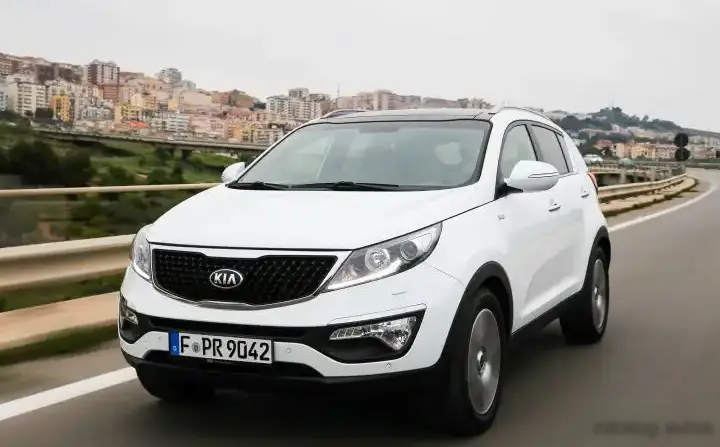
The Kia Sportage III, specifically the facelifted model introduced in 2014, represented a significant step forward for the South Korean automaker in the competitive compact SUV segment. Produced from 2014 to 2016, the 1.6 GDI (Gasoline Direct Injection) variant, generating 135 horsepower, was positioned as an entry-level to mid-range offering within the Sportage lineup. This model aimed to balance affordability with modern features and Kia’s improving build quality. It was primarily marketed in Europe and other regions outside of North America, where the Sportage was gaining traction as a value-oriented alternative to established Japanese and European rivals.
Technical Specifications
| Brand | Kia |
| Model | Sportage |
| Generation | Sportage III (facelift, 2014) |
| Type (Engine) | 1.6 GDI (135 Hp) |
| Start of production | 2014 |
| End of production | 2016 |
| Powertrain Architecture | Internal Combustion engine |
| Body type | SUV |
| Seats | 5 |
| Doors | 5 |
| Fuel consumption (urban) | 8.2 l/100 km (28.7 US mpg) |
| Fuel consumption (extra urban) | 6 l/100 km (39.2 US mpg) |
| Fuel consumption (combined) | 6.8 l/100 km (34.6 US mpg) |
| CO2 emissions | 158 g/km |
| Fuel Type | Petrol (Gasoline) |
| Acceleration 0 – 100 km/h | 11.5 sec |
| Acceleration 0 – 62 mph | 11.5 sec |
| Acceleration 0 – 60 mph | 10.9 sec |
| Maximum speed | 178 km/h (110.6 mph) |
| Emission standard | Euro 5 |
| Weight-to-power ratio | 10.2 kg/Hp |
| Weight-to-torque ratio | 8.4 kg/Nm |
| Power | 135 Hp @ 6300 rpm |
| Torque | 165 Nm @ 4850 rpm (121.7 lb.-ft. @ 4850 rpm) |
| Engine layout | Front, Transverse |
| Engine Model/Code | G4FD |
| Engine displacement | 1591 cm3 (97.09 cu. in.) |
| Number of cylinders | 4 |
| Engine configuration | Inline |
| Cylinder Bore | 77 mm (3.03 in.) |
| Piston Stroke | 85.4 mm (3.36 in.) |
| Compression ratio | 11:1 |
| Number of valves per cylinder | 4 |
| Fuel injection system | Direct injection |
| Engine aspiration | Naturally aspirated engine |
| Valvetrain | DOHC |
| Engine oil capacity | 3.3 l (3.49 US qt | 2.9 UK qt) |
| Coolant capacity | 6.6 l (6.97 US qt | 5.81 UK qt) |
| Kerb Weight | 1380 kg (3042.38 lbs.) |
| Max. weight | 1830 kg (4034.46 lbs.) |
| Max load | 450 kg (992.08 lbs.) |
| Trunk (boot) space – minimum | 564 l (19.92 cu. ft.) |
| Trunk (boot) space – maximum | 1353 l (47.78 cu. ft.) |
| Fuel tank capacity | 58 l (15.32 US gal | 12.76 UK gal) |
| Permitted trailer load with brakes (12%) | 1200 kg (2645.55 lbs.) |
| Permitted trailer load without brakes | 750 kg (1653.47 lbs.) |
| Length | 4440 mm (174.8 in.) |
| Width | 1855 mm (73.03 in.) |
| Height | 1635 mm (64.37 in.) |
| Wheelbase | 2640 mm (103.94 in.) |
| Front track | 1618 mm (63.7 in.) |
| Rear (Back) track | 1619 mm (63.74 in.) |
| Ride height (ground clearance) | 172 mm (6.77 in.) |
| Drag coefficient (Cd) | 0.37 |
| Minimum turning circle (turning diameter) | 10.58 m (34.71 ft.) |
| Approach angle | 22.7° |
| Departure angle | 28.2° |
| Ramp-over (brakeover) angle | 17.7° |
| Drivetrain Architecture | Front wheel drive |
| Drive wheel | Front wheel drive |
| Number of gears and type of gearbox | 6 gears, manual transmission |
| Front brakes | Ventilated discs |
| Rear brakes | Disc |
| Assisting systems | ABS (Anti-lock braking system) |
| Steering type | Steering rack and pinion |
| Power steering | Electric Steering |
| Tires size | 215/70 R16 |
| Wheel rims size | 16 |
Powertrain & Engine Architecture
The heart of the Sportage 1.6 GDI is the G4FD engine, a 1.6-liter inline-four cylinder gasoline engine. This engine utilizes Gasoline Direct Injection (GDI) technology, where fuel is injected directly into the combustion chamber, improving efficiency and power output compared to traditional port fuel injection. The G4FD features a double overhead camshaft (DOHC) valvetrain with four valves per cylinder, contributing to its relatively high specific output. The engine’s 11:1 compression ratio is typical for a GDI engine, balancing performance and fuel economy. The 135 horsepower and 165 Nm (121.7 lb-ft) of torque are delivered at 6300 rpm and 4850 rpm respectively. This particular variant was typically paired with a six-speed manual transmission, although a six-speed automatic transmission was also available as an option. The automatic transmission was designed to provide smooth shifts and enhance the vehicle’s usability in urban environments.
Driving Characteristics
The 1.6 GDI engine, while adequate for everyday driving, wasn’t known for its blistering performance. Acceleration from 0 to 60 mph took around 10.9 seconds, and the top speed was approximately 110.6 mph. Compared to higher-powered Sportage variants, such as those equipped with the 2.0-liter petrol or diesel engines, the 1.6 GDI felt noticeably less responsive, particularly when fully loaded or tackling steep inclines. The six-speed manual transmission offered a more engaging driving experience, allowing drivers to maximize the engine’s limited power band. The automatic transmission, while convenient, could sometimes feel sluggish, especially during downshifts. The gear ratios were tuned for fuel efficiency rather than outright performance.
Equipment & Trim Levels
The 1.6 GDI Sportage typically came with a reasonable level of standard equipment. This included air conditioning, power windows, central locking, and a basic audio system with USB connectivity. Higher trim levels added features such as alloy wheels, a touchscreen infotainment system, rear parking sensors, and cruise control. Interior upholstery was generally cloth, with leather options available on higher-spec models. Safety features included ABS, airbags, and stability control. The specific trim levels and available options varied depending on the market.
Chassis & Braking
The Sportage III utilized a front-wheel-drive platform with independent suspension at the front and a multi-link suspension at the rear. This setup provided a comfortable ride quality, although it wasn’t particularly sporty. The front brakes were ventilated discs, while the rear brakes were solid discs. ABS (Anti-lock Braking System) was standard, enhancing braking performance and safety. The steering was electrically assisted, providing light and easy steering feel.
Market Reception & Comparison
The 1.6 GDI Sportage was generally well-received as a practical and affordable compact SUV. Critics praised its fuel efficiency and comfortable ride, but noted its lack of outright performance. Compared to the more powerful Sportage variants, the 1.6 GDI offered a lower price point, making it an attractive option for budget-conscious buyers. The diesel variants, particularly the 1.7 CRDi, were often favored by those prioritizing fuel economy and torque. The 1.6 GDI offered a good balance for those who didn’t require the extra power of the larger engines.
Legacy
The G4FD engine, while generally reliable, has been known to exhibit some issues with carbon buildup on the intake valves, a common problem with direct injection engines. Regular maintenance, including the use of high-quality fuel and occasional intake valve cleaning, can help mitigate this issue. The Sportage III 1.6 GDI remains a popular choice in the used car market, offering a good value proposition for buyers seeking a practical and affordable compact SUV. Its relatively simple mechanical design and readily available parts contribute to its ongoing appeal.