
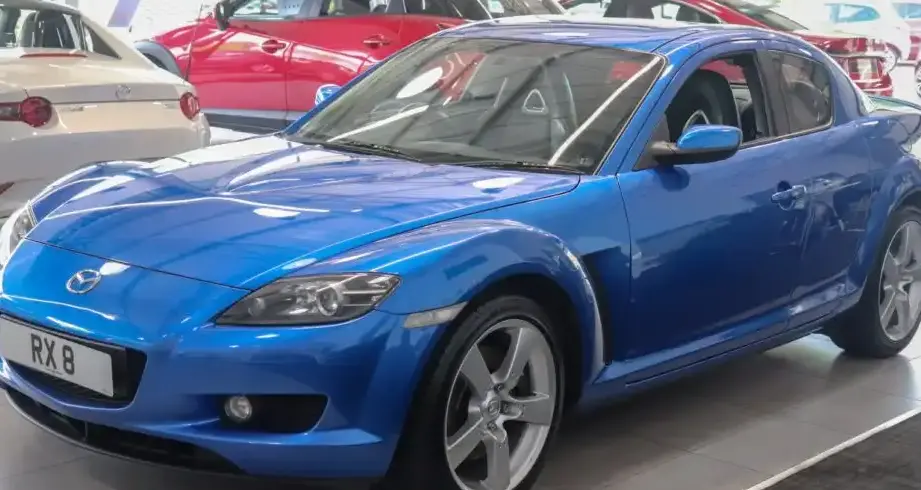
The Mazda RX-8, launched in 2003 and produced through 2009, represented a unique offering in the sports coupe market. Distinguished by its rotary engine, the RX-8 aimed to blend sporty handling with reasonable practicality thanks to its four-seat configuration and rear “freestyle” doors. This article focuses specifically on the 1.3 Wankel engine variant producing 192 horsepower, a configuration sold primarily in select markets outside of North America. It occupied a middle ground in the RX-8 lineup, offering a balance between performance and affordability compared to the higher-output versions.
Technical Specifications
| Brand | Mazda |
| Model | RX-8 |
| Generation | RX-8 |
| Type (Engine) | 1.3 Wankel (192 Hp) |
| Start of production | 2003 |
| End of production | 2009 |
| Powertrain Architecture | Internal Combustion engine |
| Body type | Coupe |
| Seats | 4 |
| Doors | 4 |
| Fuel consumption (economy) – urban | 14.9 l/100 km (15.8 US mpg, 19 UK mpg, 6.7 km/l) |
| Fuel consumption (economy) – extra urban | 8.1 l/100 km (29 US mpg, 34.9 UK mpg, 12.3 km/l) |
| Fuel consumption (economy) – combined | 10.6 l/100 km (22.2 US mpg, 26.6 UK mpg, 9.4 km/l) |
| CO2 emissions | 267 g/km |
| Fuel Type | Petrol (Gasoline) |
| Acceleration 0 – 100 km/h | 7.2 sec |
| Acceleration 0 – 62 mph | 7.2 sec |
| Acceleration 0 – 60 mph | 6.8 sec |
| Maximum speed | 222 km/h (137.94 mph) |
| Weight-to-power ratio | 7.2 kg/Hp, 139.8 Hp/tonne |
| Weight-to-torque ratio | 6.4 kg/Nm, 157.3 Nm/tonne |
| Power | 192 Hp @ 7000 rpm |
| Power per litre | 146.8 Hp/l |
| Torque | 216 Nm @ 2500 rpm (159.31 lb.-ft. @ 2500 rpm) |
| Maximum engine speed | 7500 rpm |
| Engine layout | Front, Longitudinal |
| Engine Model/Code | 13B-MSP |
| Engine displacement | 1308 cm3 (79.82 cu. in.) |
| Number of cylinders | 2 |
| Engine configuration | Rotary (Wankel) |
| Compression ratio | 10:1 |
| Fuel injection system | Multi-port manifold injection |
| Engine aspiration | Naturally aspirated engine |
| Engine oil capacity | 4.4 l (4.65 US qt | 3.87 UK qt) |
| Coolant | 10 l (10.57 US qt | 8.8 UK qt) |
| Kerb Weight | 1373 kg (3026.95 lbs) |
| Max. weight | 1820 kg (4012.41 lbs) |
| Max load | 447 kg (985.47 lbs) |
| Trunk (boot) space – minimum | 290 l (10.24 cu. ft.) |
| Fuel tank capacity | 61 l (16.11 US gal | 13.42 UK gal) |
| Max. roof load | 75 kg (165.35 lbs) |
| Permitted trailer load with brakes (12%) | 1200 kg (2645.55 lbs) |
| Permitted trailer load without brakes | 695 kg (1532.21 lbs) |
| Length | 4430 mm (174.41 in) |
| Width | 1770 mm (69.69 in) |
| Width including mirrors | 1846 mm (72.68 in) |
| Height | 1340 mm (52.76 in) |
| Wheelbase | 2700 mm (106.3 in) |
| Front track | 1500 mm (59.06 in) |
| Rear (Back) track | 1505 mm (59.25 in) |
| Ride height (ground clearance) | 140 mm (5.51 in) |
| Drag coefficient (Cd) | 0.30 |
| Minimum turning circle (turning diameter) | 10.6 m (34.78 ft) |
| Drivetrain Architecture | The Internal combustion engine (ICE) drives the rear wheels of the vehicle. |
| Drive wheel | Rear wheel drive |
| Number of gears and type of gearbox | 5 gears, manual transmission |
| Front suspension | Spring Strut |
| Rear suspension | Coil spring |
| Front brakes | Ventilated discs, 323 mm |
| Rear brakes | Ventilated discs, 302 mm |
| Assisting systems | ABS (Anti-lock braking system) |
| Steering type | Steering rack and pinion |
| Power steering | Hydraulic Steering |
| Tires size | Front wheel tires: 225/45 R18Rear wheel tires: 225/45 R18 |
| Wheel rims size | Front wheel rims: 8J x 18Rear wheel rims: 8J x 18 |
Powertrain & Engine Architecture
The heart of the RX-8 1.3 was the 13B-MSP rotary engine. Unlike traditional piston engines, the 13B-MSP utilizes a triangular rotor spinning within a specially shaped housing to generate power. This design allows for a remarkably smooth and high-revving engine, but also presents unique challenges in terms of fuel efficiency and emissions. The 13B-MSP featured side intake and exhaust ports, a Renesis design, which improved breathing and contributed to the 192 horsepower output at 7,000 rpm and 216 Nm (159.31 lb-ft) of torque at 2500 rpm. Fuel delivery was handled by a multi-port fuel injection system. The engine’s 10:1 compression ratio was relatively moderate for a rotary, balancing performance with reliability. The engine was mounted longitudinally in the front of the vehicle. The 5-speed manual transmission was the standard offering, providing a direct connection to the rear wheels.
Driving Characteristics
The RX-8 1.3, while offering a spirited driving experience, differed noticeably from its higher-powered siblings. The 192 hp engine required more frequent downshifts to maintain momentum, particularly when overtaking or climbing hills. The power delivery was linear and predictable, but lacked the punch of the later, more powerful versions. The 5-speed manual transmission was well-matched to the engine’s characteristics, offering precise shifts. The rear-wheel-drive layout contributed to balanced handling, and the relatively lightweight construction of the RX-8 made it feel nimble and responsive. However, the engine’s torque peak at 2500 rpm meant that it needed to be revved to extract its full potential, which could become tiring on long journeys.
Equipment & Trim Levels
The 1.3-liter RX-8 typically came with a reasonable level of standard equipment. Interior features generally included cloth upholstery, air conditioning, power windows and locks, and a basic audio system. Optional extras could include leather seats, a sunroof, and upgraded audio systems. The trim level often dictated the availability of features like alloy wheels and fog lights. The focus of this variant was on providing an accessible entry point into the RX-8 range, prioritizing affordability over luxury.
Chassis & Braking
The RX-8 featured a MacPherson strut front suspension and a multi-link rear suspension, providing a good balance of ride comfort and handling precision. The chassis was designed to be lightweight and rigid, contributing to the car’s agility. Braking duties were handled by ventilated discs on all four wheels, providing adequate stopping power. Anti-lock braking system (ABS) was standard. The rear brakes were slightly smaller in diameter than the front, reflecting the weight distribution of the vehicle.
Market Reception & Comparison
The RX-8 1.3 was generally well-received by automotive critics, who praised its unique engine, engaging handling, and distinctive styling. However, the engine’s fuel consumption and the need for frequent oil top-ups were often cited as drawbacks. Compared to the higher-output RX-8 variants, the 1.3 offered a more affordable entry point but sacrificed some performance. It also provided better fuel economy than the more powerful versions, but still remained relatively thirsty compared to conventional piston-engine sports coupes. The 1.3 was often seen as a good option for drivers who prioritized handling and driving enjoyment over outright speed.
Legacy
The Mazda RX-8, including the 1.3-liter variant, has developed a loyal following among enthusiasts. The rotary engine, while complex, is admired for its unique characteristics and smooth power delivery. However, the engine’s inherent weaknesses, such as apex seal wear, mean that regular maintenance and careful driving are essential. Today, well-maintained RX-8s are sought after by collectors and enthusiasts, and the 1.3-liter version represents a relatively affordable way to experience the joys of rotary power. Finding parts can sometimes be a challenge, but a dedicated aftermarket support network exists to keep these cars on the road.
