
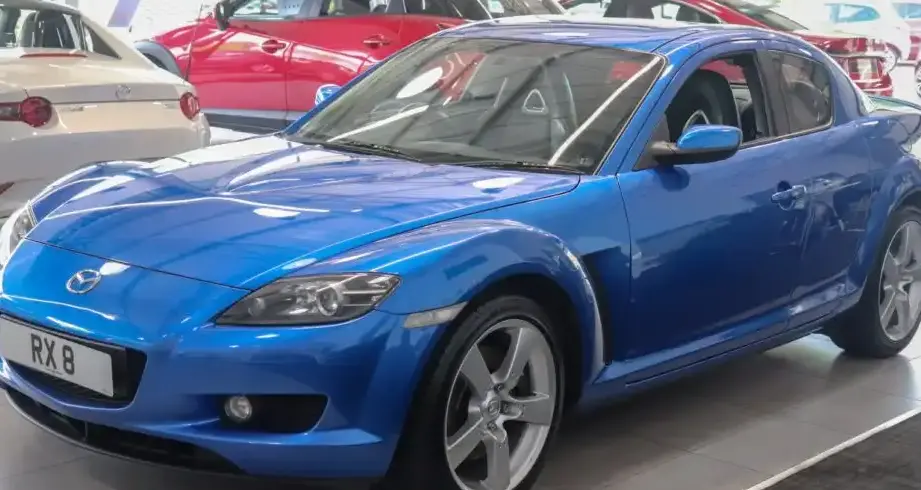
The Mazda RX-8, produced from February 2003 to June 2012, represented a unique offering in the sports coupe market. Distinguished by its rotary engine, the RX-8 aimed to blend sporty handling with reasonable practicality, offering seating for four. This article focuses on the 1.3 Wankel engine variant producing 231 horsepower, which was the primary configuration offered in many markets, including North America. The RX-8 was built on Mazda’s RX-8 platform, internally designated as the SE3P, and was intended as a successor to the RX-7, though it carved its own niche with a focus on accessibility and everyday usability.
Technical Specifications
| Brand | Mazda |
| Model | RX-8 |
| Generation | RX-8 |
| Type (Engine) | 1.3 Wankel (231 Hp) |
| Start of production | February, 2003 |
| End of production | June, 2012 |
| Body type | Coupe |
| Seats | 4 |
| Doors | 2 |
| Fuel consumption (urban) | 15.6 l/100 km (15.1 US mpg, 18.1 UK mpg, 6.4 km/l) |
| Fuel consumption (extra urban) | 8.7 l/100 km (27 US mpg, 32.5 UK mpg, 11.5 km/l) |
| Fuel consumption (combined) | 11.2 l/100 km (21 US mpg, 25.2 UK mpg, 8.9 km/l) |
| CO2 emissions | 284 g/km |
| Fuel Type | Petrol (Gasoline) |
| Acceleration 0 – 100 km/h | 6.4 sec |
| Acceleration 0 – 62 mph | 6.4 sec |
| Acceleration 0 – 60 mph | 6.1 sec |
| Maximum speed | 234 km/h (145.4 mph) |
| Weight-to-power ratio | 6 kg/Hp, 167.5 Hp/tonne |
| Weight-to-torque ratio | 6.5 kg/Nm, 153 Nm/tonne |
| Power | 231 Hp @ 8200 rpm |
| Power per litre | 176.6 Hp/l |
| Torque | 211 Nm @ 5500 rpm (155.63 lb.-ft. @ 5500 rpm) |
| Maximum engine speed | 9000 rpm |
| Engine layout | Front, Longitudinal |
| Engine Model/Code | 13B-MSP |
| Engine displacement | 1308 cm3 (79.82 cu. in.) |
| Number of cylinders | 2 |
| Engine configuration | Rotary (Wankel) |
| Compression ratio | 10:1 |
| Fuel injection system | Multi-port manifold injection |
| Engine oil capacity | 4.4 l (4.65 US qt | 3.87 UK qt) |
| Coolant capacity | 10 l (10.57 US qt | 8.8 UK qt) |
| Kerb Weight | 1379 kg (3040.17 lbs) |
| Max. weight | 1815 kg (4001.39 lbs) |
| Max load | 436 kg (961.22 lbs) |
| Trunk (boot) space – minimum | 290 l (10.24 cu. ft.) |
| Fuel tank capacity | 61 l (16.11 US gal | 13.42 UK gal) |
| Max. roof load | 75 kg (165.35 lbs) |
| Permitted trailer load with brakes (12%) | 1200 kg (2645.55 lbs) |
| Permitted trailer load without brakes | 695 kg (1532.21 lbs) |
| Length | 4430 mm (174.41 in) |
| Width | 1770 mm (69.69 in) |
| Width including mirrors | 1846 mm (72.68 in) |
| Height | 1340 mm (52.76 in) |
| Wheelbase | 2700 mm (106.3 in) |
| Front track | 1500 mm (59.06 in) |
| Rear (Back) track | 1505 mm (59.25 in) |
| Ride height (ground clearance) | 140 mm (5.51 in) |
| Drag coefficient (Cd) | 0.30 |
| Minimum turning circle (turning diameter) | 10.6 m (34.78 ft) |
| Drivetrain Architecture | ICE drives rear wheels |
| Drive wheel | Rear wheel drive |
| Number of gears and type of gearbox | 6 gears, manual transmission |
| Front suspension | Double wishbone |
| Rear suspension | Independent multi-link spring suspension with stabilizer |
| Front brakes | Ventilated discs, 323 mm |
| Rear brakes | Ventilated discs, 302 mm |
| Assisting systems | ABS (Anti-lock braking system) |
| Steering type | Steering rack and pinion |
| Power steering | Hydraulic Steering |
| Tires size | Front wheel tires: 225/45 R18 Rear wheel tires: 225/45 R18 |
| Wheel rims size | Front wheel rims: 8J x 18 Rear wheel rims: 8J x 18 |
Powertrain & Engine Architecture
The heart of the RX-8 is its 13B-MSP rotary engine. Unlike traditional piston engines, the 13B-MSP utilizes a triangular rotor spinning within a specially shaped housing to generate power. This design allows for a remarkably smooth and high-revving engine, producing 231 horsepower at 8200 rpm and 155 lb-ft of torque at 5500 rpm. The engine features sequential multi-port fuel injection and a compression ratio of 10:1. A key innovation was the Renesis design, which moved the intake ports directly into the rotor housing, improving volumetric efficiency. The 6-speed manual transmission was standard, providing precise gear changes and enhancing the driving experience. The engine’s longitudinal mounting and rear-wheel-drive configuration contributed to the RX-8’s balanced handling characteristics.
Driving Characteristics
The 231 hp RX-8 offered a unique driving experience. While the horsepower figure was competitive for its class, the relatively low torque output meant that the engine needed to be revved to extract its full potential. The 6-speed manual transmission was well-matched to the engine’s characteristics, allowing drivers to keep the engine in its powerband. Acceleration from 0-60 mph took approximately 6.1 seconds. Compared to the later, less powerful variants, the 231 hp model provided a noticeably more engaging and responsive driving experience. The RX-8’s handling was praised for its balance and predictability, making it a rewarding car to drive on winding roads.
Equipment & Trim Levels
The RX-8 1.3 Wankel (231 Hp) typically came with a fairly comprehensive list of standard features. These included power windows, power locks, air conditioning, and a basic audio system. Higher trim levels, such as the GT, added features like leather upholstery, a premium sound system (often Bose), heated seats, and a sunroof. Optional extras included navigation systems and various cosmetic enhancements. The interior design was driver-focused, with well-placed controls and supportive seats. The RX-8’s unique rear “freestyle” doors allowed for easier access to the rear seats, adding to its practicality.
Chassis & Braking
The RX-8 featured a double wishbone front suspension and an independent multi-link rear suspension, providing a comfortable yet controlled ride. Stabilizer bars were fitted front and rear to reduce body roll during cornering. The braking system consisted of ventilated discs on all four wheels, providing ample stopping power. ABS (Anti-lock Braking System) was standard. The RX-8’s chassis was relatively lightweight, contributing to its agile handling. The curb weight of approximately 3040 lbs was well-distributed, resulting in a balanced feel.
Market Reception & Comparison
The RX-8 was generally well-received by automotive critics, who praised its unique engine, engaging handling, and stylish design. However, the rotary engine’s reputation for requiring frequent maintenance and its relatively poor fuel economy (around 21 mpg combined) were common criticisms. Compared to other sports coupes of the time, such as the Honda S2000 or the Nissan 350Z, the RX-8 offered a different driving experience, prioritizing smoothness and high-revving power over brute force. The RX-8’s fuel consumption of 11.2 l/100 km and CO2 emissions of 284 g/km were higher than many of its competitors.
Legacy
The Mazda RX-8, particularly the 231 hp variant, remains a popular choice among enthusiasts. While the rotary engine requires diligent maintenance – including regular apex seal checks and potential rebuilds – its unique character and driving experience continue to attract a dedicated following. The RX-8’s relatively low production numbers and increasing rarity have also contributed to its growing collectibility. In the used car market, well-maintained examples command a premium, and the RX-8 is often seen as a unique and rewarding sports coupe that offers a driving experience unlike any other.
