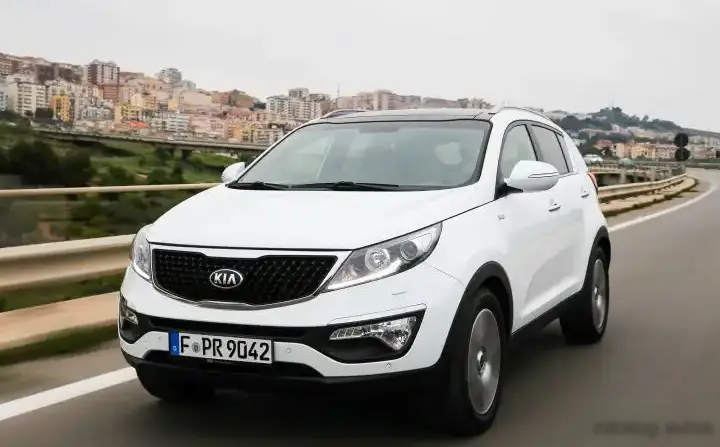
The Kia Sportage III (facelift, introduced in 2014) 2.0 CRDi 4WD represents a significant iteration of Kia’s popular compact SUV. Produced from 2014 to 2016, this variant occupied a middle ground within the Sportage III lineup, offering a balance between fuel efficiency, all-weather capability, and a reasonable price point. It was primarily aimed at buyers seeking a practical and versatile vehicle for family use, with the added security of a four-wheel-drive system. This model was a key component of Kia’s strategy to gain market share in the increasingly competitive European and global SUV segments.
Technical Specifications
| Brand | Kia |
| Model | Sportage |
| Generation | Sportage III (facelift, 2014) |
| Type (Engine) | 2.0 CRDi (136 Hp) 4WD |
| Start of production | 2014 |
| End of production | 2016 |
| Powertrain Architecture | Internal Combustion engine |
| Body type | SUV |
| Seats | 5 |
| Doors | 5 |
| Fuel consumption (urban) | 6.8 l/100 km (34.6 US mpg, 41.5 UK mpg, 14.7 km/l) |
| Fuel consumption (extra urban) | 5.1 l/100 km (46.1 US mpg, 55.4 UK mpg, 19.6 km/l) |
| Fuel consumption (combined) | 5.7 l/100 km (41.3 US mpg, 49.6 UK mpg, 17.5 km/l) |
| CO2 emissions | 149 g/km |
| Fuel Type | Diesel |
| Acceleration 0 – 100 km/h | 11.3 sec |
| Acceleration 0 – 62 mph | 11.3 sec |
| Acceleration 0 – 60 mph | 10.7 sec |
| Maximum speed | 181 km/h (112.47 mph) |
| Emission standard | Euro 5 |
| Weight-to-power ratio | 11.8 kg/Hp, 85 Hp/tonne |
| Weight-to-torque ratio | 5 kg/Nm, 199.4 Nm/tonne |
| Power | 136 Hp @ 4000 rpm |
| Power per litre | 68.2 Hp/l |
| Torque | 319 Nm @ 1800-2500 rpm (235.28 lb.-ft. @ 1800-2500 rpm) |
| Engine layout | Front, Transverse |
| Engine Model/Code | D4HA |
| Engine displacement | 1995 cm3 (121.74 cu. in.) |
| Number of cylinders | 4 |
| Engine configuration | Inline |
| Cylinder Bore | 84 mm (3.31 in.) |
| Piston Stroke | 90 mm (3.54 in.) |
| Compression ratio | 16.5:1 |
| Number of valves per cylinder | 4 |
| Fuel injection system | Diesel Commonrail |
| Engine aspiration | Turbocharger, Intercooler |
| Valvetrain | DOHC |
| Engine oil capacity | 8 l (8.45 US qt | 7.04 UK qt) |
| Coolant | 8.5 l (8.98 US qt | 7.48 UK qt) |
| Kerb Weight | 1600 kg (3527.4 lbs.) |
| Max. weight | 2140 kg (4717.89 lbs.) |
| Max load | 540 kg (1190.5 lbs.) |
| Trunk (boot) space – minimum | 564 l (19.92 cu. ft.) |
| Trunk (boot) space – maximum | 1353 l (47.78 cu. ft.) |
| Fuel tank capacity | 58 l (15.32 US gal | 12.76 UK gal) |
| Permitted trailer load with brakes (12%) | 2000 kg (4409.25 lbs.) |
| Permitted trailer load without brakes | 750 kg (1653.47 lbs.) |
| Length | 4440 mm (174.8 in.) |
| Width | 1855 mm (73.03 in.) |
| Height | 1635 mm (64.37 in.) |
| Wheelbase | 2640 mm (103.94 in.) |
| Front track | 1611 mm (63.43 in.) |
| Rear (Back) track | 1612 mm (63.46 in.) |
| Ride height (ground clearance) | 172 mm (6.77 in.) |
| Drag coefficient (Cd) | 0.37 |
| Minimum turning circle (turning diameter) | 10.58 m (34.71 ft.) |
| Approach angle | 22.7° |
| Departure angle | 28.2° |
| Ramp-over (brakeover) angle | 17.7° |
| Drive wheel | All wheel drive (4×4) |
| Number of gears and type of gearbox | 6 gears, manual transmission |
| Front brakes | Ventilated discs |
| Rear brakes | Disc |
| Assisting systems | ABS (Anti-lock braking system) |
| Steering type | Steering rack and pinion |
| Power steering | Electric Steering |
| Tires size | 225/60 R17 |
| Wheel rims size | 17 |
Powertrain & Engine Architecture
The heart of this Sportage variant is the D4HA 2.0-liter inline-four cylinder diesel engine. This engine, a mainstay in the Hyundai-Kia group, utilizes a common-rail direct injection system, delivering fuel at extremely high pressure for optimized combustion. The D4HA features a variable geometry turbocharger (VGT) and an intercooler, enhancing both power and torque output. The engine produces 136 horsepower at 4,000 rpm and a substantial 319 Nm (235 lb-ft) of torque between 1800 and 2500 rpm. This torque curve provides strong low-end and mid-range acceleration, making it well-suited for everyday driving and towing. The engine also incorporates a diesel particulate filter (DPF) to meet Euro 5 emission standards. The 6-speed manual transmission was standard, offering a balance between fuel efficiency and driver control.
Driving Characteristics
The 2.0 CRDi 4WD Sportage delivers a composed and capable driving experience. While not a performance-oriented vehicle, the engine’s torque provides adequate acceleration for merging onto highways and overtaking. The all-wheel-drive system enhances traction in slippery conditions, providing added confidence during inclement weather. The manual transmission allows for precise gear selection, although the shift quality isn’t particularly sporty. Compared to the higher-output 2.0 CRDi variants, this version feels less eager to rev, prioritizing fuel economy over outright performance. The 4WD system operates primarily in front-wheel drive, engaging the rear wheels when slip is detected, resulting in a seamless transition and minimal driver intervention.
Equipment & Trim Levels
The 2014-2016 Sportage 2.0 CRDi 4WD typically came equipped with a respectable level of standard features. These included air conditioning, power windows and mirrors, a basic audio system with USB connectivity, and ABS brakes. Higher trim levels added features such as alloy wheels, a touchscreen infotainment system, rear parking sensors, and automatic climate control. Interior upholstery was typically cloth, with leather options available as an upgrade. Safety features included multiple airbags and stability control.
Chassis & Braking
The Sportage III utilizes a MacPherson strut front suspension and a multi-link rear suspension, providing a comfortable ride quality. The 4WD system adds some weight, but the suspension is tuned to handle the increased mass effectively. Braking duties are handled by ventilated discs at the front and solid discs at the rear. ABS (Anti-lock Braking System) is standard, enhancing braking performance and stability. The steering is electrically assisted, providing a light and easy driving experience.
Market Reception & Comparison
The Kia Sportage III (facelift) 2.0 CRDi 4WD was generally well-received by automotive critics. It was praised for its practicality, spacious interior, and competitive pricing. The 2.0-liter diesel engine was considered a good compromise between performance and fuel economy. Compared to the more powerful 2.0 CRDi variants, this version offered lower running costs but lacked the same level of performance. Against competitors like the Nissan Qashqai and Hyundai ix35, the Sportage offered a compelling package with a generous warranty and a stylish design.
Legacy
The D4HA engine, when properly maintained, has proven to be a relatively reliable powertrain. Common issues include DPF clogging (particularly with frequent short trips) and potential wear in the turbocharger. The Sportage III, in general, has established a reputation for durability and value. On the used car market, this 2.0 CRDi 4WD variant represents a sensible choice for buyers seeking a practical and affordable SUV. Its combination of fuel efficiency, all-wheel-drive capability, and reasonable running costs continues to make it an attractive option.