
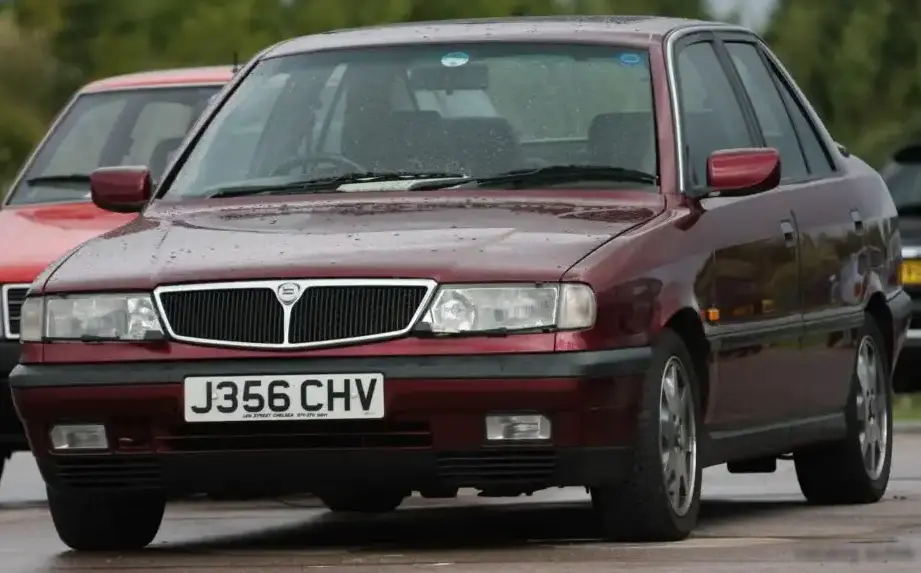
The Lancia Dedra 2.0 i.e. Turbo, produced between 1991 and 1999, represented a significant offering in the upper-midsize segment for the Italian automaker. Part of the 835 series, the Dedra aimed to blend Italian styling with respectable performance and a degree of practicality. This particular variant, equipped with the 2.0-liter turbocharged engine producing 162 horsepower, occupied a position towards the higher end of the Dedra lineup, appealing to drivers seeking a more spirited driving experience than the base models offered. It was a key model in Lancia’s attempt to regain market share in a competitive European market, particularly in Italy where front-wheel drive sedans were gaining popularity.
Technical Specifications
| Brand | Lancia |
| Model | Dedra |
| Generation | Dedra (835) |
| Type (Engine) | 2.0 i.e. Turbo (162 Hp) |
| Start of production | 1991 |
| End of production | 1999 |
| Powertrain Architecture | Internal Combustion engine |
| Body type | Sedan |
| Seats | 5 |
| Doors | 4 |
| Fuel consumption (urban) | 11.9 l/100 km (19.8 US mpg, 23.7 UK mpg, 8.4 km/l) |
| Fuel consumption (extra urban) | 7.2 l/100 km (32.7 US mpg, 39.2 UK mpg, 13.9 km/l) |
| Fuel consumption (combined) | 9.2 l/100 km (25.6 US mpg, 30.7 UK mpg, 10.9 km/l) |
| Fuel Type | Petrol (Gasoline) |
| Acceleration 0 – 100 km/h | 8.3 sec |
| Acceleration 0 – 62 mph | 8.3 sec |
| Acceleration 0 – 60 mph | 7.9 sec |
| Maximum speed | 215 km/h (133.59 mph) |
| Weight-to-power ratio | 7.7 kg/Hp, 130.1 Hp/tonne |
| Weight-to-torque ratio | 4.5 kg/Nm, 220.1 Nm/tonne |
| Power | 162 Hp @ 5500 rpm |
| Power per litre | 81.2 Hp/l |
| Torque | 274 Nm @ 3250 rpm (202.09 lb.-ft. @ 3250 rpm) |
| Engine layout | Front, Transverse |
| Engine Model/Code | 835 A8.046 |
| Engine displacement | 1995 cm3 (121.74 cu. in.) |
| Number of cylinders | 4 |
| Engine configuration | Inline |
| Cylinder Bore | 84 mm (3.31 in.) |
| Piston Stroke | 90 mm (3.54 in.) |
| Compression ratio | 7.5:1 |
| Number of valves per cylinder | 2 |
| Fuel injection system | Multi-port manifold injection |
| Engine aspiration | Turbocharger |
| Valvetrain | DOHC |
| Engine oil capacity | 5 l (5.28 US qt | 4.4 UK qt) |
| Coolant capacity | 7 l (7.4 US qt | 6.16 UK qt) |
| Kerb Weight | 1245 kg (2744.76 lbs.) |
| Max. weight | 1680 kg (3703.77 lbs.) |
| Max load | 435 kg (959.01 lbs.) |
| Trunk (boot) space – minimum | 480 l (16.95 cu. ft.) |
| Fuel tank capacity | 63 l (16.64 US gal | 13.86 UK gal) |
| Length | 4343 mm (170.98 in.) |
| Width | 1700 mm (66.93 in.) |
| Height | 1430 mm (56.3 in.) |
| Wheelbase | 2540 mm (100 in.) |
| Front track | 1436 mm (56.54 in.) |
| Rear (Back) track | 1415 mm (55.71 in.) |
| Drivetrain Architecture | Front wheel drive |
| Number of gears and type of gearbox | 5 gears, manual transmission |
| Front suspension | Spring Strut |
| Rear suspension | Trailing arm |
| Front brakes | Ventilated discs |
| Rear brakes | Disc |
| Assisting systems | ABS (Anti-lock braking system) |
| Steering type | Steering rack and pinion |
| Power steering | Hydraulic Steering |
| Tires size | 195/50 R15 |
Powertrain & Engine Architecture
The heart of the Dedra 2.0 i.e. Turbo was the 835 A8.046 engine, a 1995cc inline-four cylinder unit. This engine featured a turbocharger and multi-port fuel injection, allowing it to produce a respectable 162 horsepower at 5500 rpm and 274 Nm (202 lb-ft) of torque at 3250 rpm. The engine utilized a double overhead camshaft (DOHC) valvetrain with two valves per cylinder. The 7.5:1 compression ratio was a compromise between performance and the need to run on the available fuel grades in European markets. The engine was transversely mounted in the front of the vehicle, driving the front wheels. The five-speed manual transmission was the standard offering, providing a direct connection between the engine and the wheels. The transmission was chosen for its balance of durability and shift quality, although an automatic transmission was available as an option in some markets.
Driving Characteristics
The Dedra 2.0 i.e. Turbo offered a noticeably more engaging driving experience than the lower-powered versions. The turbocharger provided a surge of power in the mid-range, making overtaking and highway cruising effortless. While not a sports sedan in the truest sense, the Dedra Turbo could accelerate from 0 to 100 km/h (0-62 mph) in around 8.3 seconds, and reach a top speed of 215 km/h (133.59 mph). The five-speed manual transmission allowed drivers to keep the engine in its optimal power band. Compared to the naturally aspirated 1.8L and 2.0L models, the turbo variant felt significantly more responsive. The automatic transmission, while offering convenience, did diminish some of the engine’s performance, resulting in slightly slower acceleration times and a less direct feel.
Equipment & Trim Levels
The 2.0 i.e. Turbo trim typically included features such as central locking, electric windows, power steering, and an anti-lock braking system (ABS). Interior appointments generally consisted of cloth upholstery, although leather options were available. Higher-spec versions could be equipped with features like air conditioning, a sunroof, and upgraded audio systems. The dashboard layout was functional and typically featured wood trim accents. The Dedra aimed for a comfortable and refined interior, although it didn’t quite reach the levels of luxury offered by some of its German competitors.
Chassis & Braking
The Dedra utilized a front-wheel-drive layout with independent suspension at the front (Spring Strut) and a trailing arm setup at the rear. The front brakes were ventilated discs, providing good stopping power, while the rear brakes were solid discs. The suspension was tuned for comfort, offering a relatively smooth ride, but it also provided adequate handling for everyday driving. The steering was rack and pinion with hydraulic assistance, offering a reasonable level of feedback. The 195/50 R15 tires provided a good balance of grip and ride comfort.
Market Reception & Comparison
The Lancia Dedra 2.0 i.e. Turbo was generally well-received by automotive critics, who praised its performance and comfortable ride. However, it faced stiff competition from established players in the segment, such as the Ford Mondeo, Opel Vectra, and Volkswagen Passat. Compared to these rivals, the Dedra offered a more distinctive Italian style, but it often lagged behind in terms of brand recognition and perceived reliability. Fuel economy was reasonable for a turbocharged engine of its era, averaging around 9.2 l/100 km (25.6 US mpg). Reliability was a mixed bag, with some owners reporting issues with the turbocharger and electrical components.
Legacy
The Lancia Dedra, while not a commercial blockbuster, remains a fondly remembered car among enthusiasts. The 2.0 i.e. Turbo variant, in particular, is appreciated for its spirited performance and distinctive character. Today, well-maintained examples are becoming increasingly rare and sought after by collectors. The engine, while capable, requires regular maintenance to ensure its longevity. The Dedra’s legacy lies in its attempt to combine Italian flair with practical usability, offering a unique alternative to the more mainstream offerings in the upper-midsize segment. The 835 A8.046 engine, while not without its quirks, proved to be a robust and tunable powerplant, capable of providing years of reliable service with proper care.
