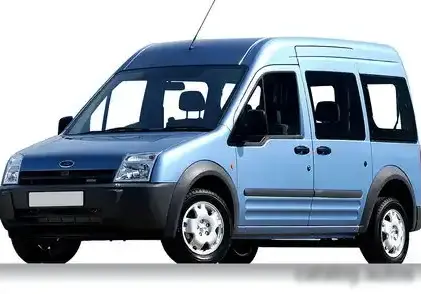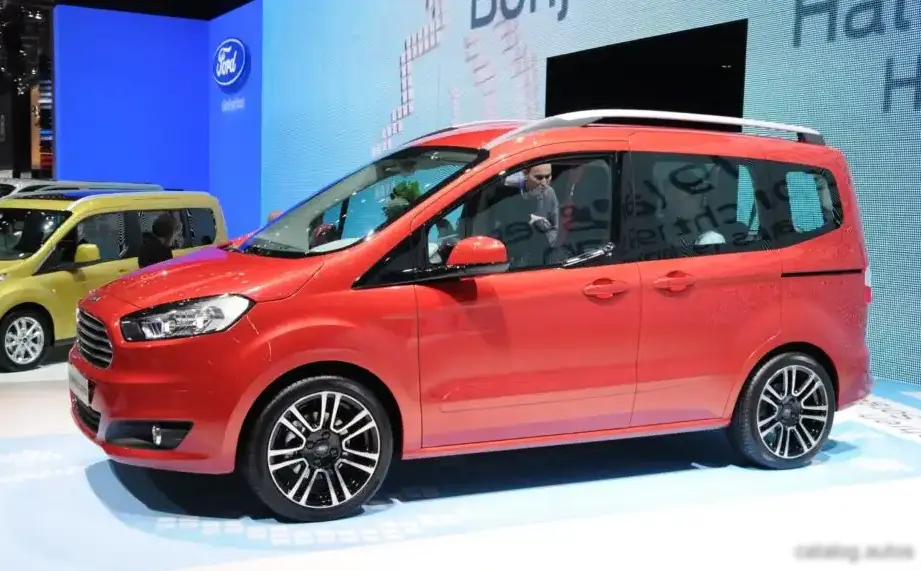
The Ford Tourneo Courier 1.0 EcoBoost (100 hp) S&S was a compact multi-purpose vehicle (MPV) produced by Ford between 2014 and 2018. Positioned as an entry-level offering within the first generation Tourneo Courier (2014-2018) range, it aimed to provide an affordable and fuel-efficient option for small families and urban drivers. The Tourneo Courier itself was based on the B-Max platform, sharing many components with the Fiesta subcompact, but offering a more practical, van-like body style. This particular 1.0 EcoBoost variant represented a key part of Ford’s strategy to offer downsized, turbocharged engines across its lineup, emphasizing fuel economy and reduced emissions.
Technical Specifications
| Brand | Ford |
| Model | Tourneo Courier |
| Generation | Tourneo Courier I |
| Type (Engine) | 1.0 EcoBoost (100 Hp) S&S |
| Start of production | 2014 |
| End of production | 2018 |
| Powertrain Architecture | Internal Combustion engine |
| Body type | MPV |
| Seats | 5 |
| Doors | 5 |
| Fuel consumption (urban) | 6.2 l/100 km (37.9 US mpg, 45.6 UK mpg, 16.1 km/l) |
| Fuel consumption (extra urban) | 4.7 l/100 km (50 US mpg, 60.1 UK mpg, 21.3 km/l) |
| Fuel consumption (combined) | 5.2 l/100 km (45.2 US mpg, 54.3 UK mpg, 19.2 km/l) |
| CO2 emissions | 119 g/km |
| Fuel Type | Petrol (Gasoline) |
| Acceleration 0 – 100 km/h | 12.3 sec |
| Acceleration 0 – 62 mph | 12.3 sec |
| Acceleration 0 – 60 mph | 11.7 sec |
| Maximum speed | 173 km/h (107.5 mph) |
| Emission standard | Euro 5 |
| Weight-to-power ratio | 12.7 kg/Hp, 79.1 Hp/tonne |
| Weight-to-torque ratio | 7.4 kg/Nm, 134.4 Nm/tonne |
| Power | 100 Hp @ 6000 rpm |
| Power per litre | 100.1 Hp/l |
| Torque | 170 Nm @ 1400-4000 rpm (125.39 lb.-ft. @ 1400-4000 rpm) |
| Engine layout | Front, Transverse |
| Engine Model/Code | M2GA, M2GB |
| Engine displacement | 999 cm3 (60.96 cu. in.) |
| Number of cylinders | 3 |
| Engine configuration | Inline |
| Cylinder Bore | 71.9 mm (2.83 in.) |
| Piston Stroke | 82 mm (3.23 in.) |
| Compression ratio | 10:1 |
| Number of valves per cylinder | 4 |
| Fuel injection system | Direct injection |
| Engine aspiration | Turbocharger, Intercooler |
| Valvetrain | DOHC |
| Engine oil capacity | 4.1 l (4.33 US qt | 3.61 UK qt) |
| Coolant capacity | 6.3 l (6.66 US qt | 5.54 UK qt) |
| Kerb Weight | 1265 kg (2788.85 lbs.) |
| Max. weight | 1765 kg (3891.16 lbs.) |
| Max load | 500 kg (1102.31 lbs.) |
| Trunk (boot) space – minimum | 395 l (13.95 cu. ft.) |
| Trunk (boot) space – maximum | 1656 l (58.48 cu. ft.) |
| Fuel tank capacity | 48 l (12.68 US gal | 10.56 UK gal) |
| Length | 4157 mm (163.66 in.) |
| Width | 1976 mm (77.8 in.) |
| Height | 1723 mm (67.83 in.) |
| Wheelbase | 2489 mm (97.99 in.) |
| Minimum turning circle | 10.9 m (35.76 ft.) |
| Drivetrain Architecture | Front wheel drive |
| Number of gears | 5 |
| Gearbox type | Manual transmission |
| Front suspension | Independent, McPherson with coil spring and anti-roll bar |
| Rear suspension | Semi-independent, coil spring |
| Front brakes | Ventilated discs |
| Rear brakes | Drum |
| Assisting systems | ABS (Anti-lock braking system) |
| Steering type | Steering rack and pinion |
| Tires size | 195/60 R15 |
| Wheel rims size | 6.0J x 15 |
INTRODUCTION
The Ford Tourneo Courier 1.0 EcoBoost (100 hp) S&S, launched in 2014, was a key component of Ford’s strategy to revitalize its small MPV offerings in Europe. Built on the global B-Max platform, the Tourneo Courier aimed to blend the practicality of a small van with the comfort and features expected of a passenger vehicle. The 1.0 EcoBoost engine, a three-cylinder turbocharged unit, was offered as a fuel-efficient alternative to larger, naturally aspirated engines. The “S&S” designation indicates the inclusion of Ford’s Auto-Start-Stop system, further enhancing fuel economy in urban driving conditions. This variant occupied the entry-level position in the Tourneo Courier lineup, appealing to buyers prioritizing affordability and running costs.
Powertrain & Engine Architecture
The heart of this Tourneo Courier variant is the 1.0-liter EcoBoost engine, specifically the M2GA or M2GB engine code depending on the specific production year and market. This engine is a highly advanced three-cylinder unit featuring direct fuel injection and a single turbocharger with an intercooler. The direct injection system allows for precise fuel delivery, optimizing combustion efficiency and reducing emissions. The turbocharger provides a significant boost in power despite the small displacement. The engine utilizes a double overhead camshaft (DOHC) valvetrain with four valves per cylinder, contributing to its responsive performance. The 100 hp output is achieved at 6000 rpm, while peak torque of 170 Nm (125 lb-ft) is available from 1400 to 4000 rpm. This broad torque band makes the engine surprisingly flexible for everyday driving. The engine is paired with a five-speed manual transmission, chosen for its simplicity and efficiency. Ford’s Auto-Start-Stop system automatically shuts off the engine when the vehicle is stationary (e.g., at traffic lights) and restarts it instantly when the driver depresses the clutch pedal, further reducing fuel consumption and emissions.
Driving Characteristics
The 1.0 EcoBoost engine in the Tourneo Courier, while not exceptionally powerful, provides adequate performance for typical urban and suburban driving. Acceleration from 0-60 mph takes around 11.7 seconds, and top speed is approximately 107.5 mph. The five-speed manual transmission is well-matched to the engine’s characteristics, offering smooth gear changes and allowing the driver to keep the engine within its optimal torque band. Compared to higher-output versions of the Tourneo Courier (which were not commonly offered), this variant feels less eager to accelerate, but it compensates with significantly improved fuel economy. The relatively light weight of the vehicle (around 1265 kg) helps to mitigate the effects of the modest power output. The steering is light and precise, making it easy to maneuver in tight spaces. The suspension, while tuned for comfort, provides reasonable handling stability.
Equipment & Trim Levels
The 1.0 EcoBoost S&S variant of the Tourneo Courier typically came equipped with a reasonable level of standard features. These included power steering, electric front windows, a basic audio system with USB connectivity, and ABS brakes. Safety features such as driver and passenger airbags were also standard. Interior upholstery was typically cloth, and the dashboard featured a functional, if somewhat basic, design. Optional extras included air conditioning, alloy wheels, a more advanced audio system with Bluetooth connectivity, and parking sensors. Higher trim levels offered additional features such as cruise control, automatic headlights, and rain-sensing wipers, but these were not typically available with the 1.0 EcoBoost engine.
Chassis & Braking
The Tourneo Courier utilizes a front-wheel-drive layout with an independent McPherson strut suspension at the front and a semi-independent coil spring suspension at the rear. The front suspension incorporates an anti-roll bar to reduce body roll during cornering. Braking duties are handled by ventilated discs at the front and drum brakes at the rear. ABS (Anti-lock Braking System) is standard, providing enhanced braking performance and stability in emergency situations. The relatively compact size and light weight of the vehicle contribute to its nimble handling characteristics.
Market Reception & Comparison
The Ford Tourneo Courier 1.0 EcoBoost S&S was generally well-received by critics for its fuel efficiency, practicality, and affordability. It was praised as a sensible choice for urban drivers and small families. However, some reviewers noted that the engine could feel strained when fully loaded or when tackling steep hills. Compared to other trims in the Tourneo Courier lineup, the 1.0 EcoBoost offered the best fuel economy but the lowest performance. It was positioned as a direct competitor to other small MPVs such as the Fiat Qubo and the Citroën Berlingo Multispace, offering a similar blend of practicality and affordability.
Legacy
The 1.0 EcoBoost engine has proven to be a reliable and durable powertrain, although some early models experienced issues with timing belt failures. Regular maintenance, including timely oil changes and timing belt replacements, is crucial for ensuring long-term reliability. On the used car market, the Tourneo Courier 1.0 EcoBoost S&S remains a popular choice for buyers seeking an affordable and fuel-efficient MPV. Its compact size, practical interior, and low running costs make it a sensible option for a variety of needs. The engine’s reputation for fuel economy and its relatively simple mechanical design contribute to its continued appeal.