
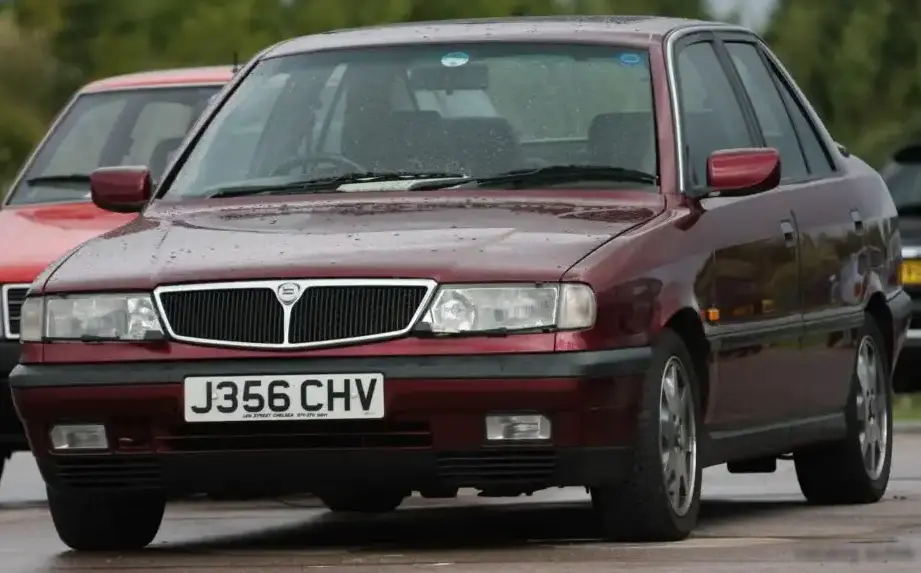
The Lancia Dedra (835) Integrale 2.0 i.e Turbo, produced between May 1991 and July 1993, represented the performance pinnacle of the Dedra range. Positioned as the flagship model, it combined a turbocharged 2.0-liter inline-four engine with a permanent all-wheel-drive system. The Dedra itself was Lancia’s replacement for the aging Delta and Prisma, built on the Tipo Four platform (also known as the 835 project) shared with Fiat, Alfa Romeo, and Saab. The Integrale variant aimed to deliver a blend of Italian style, rally-inspired performance, and a more refined driving experience than its predecessor, the Delta Integrale.
Technical Specifications
| Brand | Lancia |
| Model | Dedra |
| Generation | Dedra (835) |
| Type (Engine) | Integrale 2.0 i.e Turbo (172 Hp) AWD |
| Start of production | May, 1991 |
| End of production | July, 1993 |
| Powertrain Architecture | Internal Combustion engine |
| Body type | Sedan |
| Seats | 5 |
| Doors | 4 |
| Fuel consumption (urban) | 13 l/100 km (18.1 US mpg, 21.7 UK mpg, 7.7 km/l) |
| Fuel consumption (extra urban) | 7.8 l/100 km (30.2 US mpg, 36.2 UK mpg, 12.8 km/l) |
| Fuel Type | Petrol (Gasoline) |
| Acceleration 0 – 100 km/h | 8 sec |
| Acceleration 0 – 62 mph | 8 sec |
| Acceleration 0 – 60 mph | 7.6 sec |
| Maximum speed | 215 km/h (133.59 mph) |
| Weight-to-power ratio | 7.8 kg/Hp, 127.4 Hp/tonne |
| Weight-to-torque ratio | 5 kg/Nm, 200 Nm/tonne |
| Power | 172 Hp @ 5500 rpm |
| Power per litre | 86.2 Hp/l |
| Torque | 270 Nm @ 3250 rpm (199.14 lb.-ft. @ 3250 rpm) |
| Engine layout | Front, Transverse |
| Engine Model/Code | 836A3000 |
| Engine displacement | 1995 cm3 (121.74 cu. in.) |
| Number of cylinders | 4 |
| Engine configuration | Inline |
| Cylinder Bore | 84 mm (3.31 in.) |
| Piston Stroke | 90 mm (3.54 in.) |
| Compression ratio | 7.5:1 |
| Number of valves per cylinder | 4 |
| Fuel injection system | Multi-port manifold injection |
| Engine aspiration | Turbocharger, Intercooler |
| Valvetrain | DOHC |
| Engine oil capacity | 5.3 l (5.6 US qt | 4.66 UK qt) |
| Coolant | 8.2 l (8.66 US qt | 7.21 UK qt) |
| Kerb Weight | 1350 kg (2976.24 lbs.) |
| Trunk (boot) space – minimum | 405 l (14.3 cu. ft.) |
| Fuel tank capacity | 63 l (16.64 US gal | 13.86 UK gal) |
| Permitted trailer load with brakes (12%) | 1400 kg (3086.47 lbs.) |
| Length | 4343 mm (170.98 in.) |
| Width | 1700 mm (66.93 in.) |
| Height | 1430 mm (56.3 in.) |
| Wheelbase | 2540 mm (100 in.) |
| Front track | 1449 mm (57.05 in.) |
| Rear (Back) track | 1411 mm (55.55 in.) |
| Minimum turning circle | 10.5 m (34.45 ft.) |
| Drivetrain Architecture | The Internal combustion engine (ICE) drives permanently the four wheels of the vehicle. |
| Drive wheel | All wheel drive (4×4) |
| Number of gears and type of gearbox | 5 gears, manual transmission |
| Front suspension | Independent, type McPherson with coil spring and anti-roll bar |
| Rear suspension | Wishbone |
| Front brakes | Ventilated discs, 284 mm |
| Rear brakes | Disc, 240 mm |
| Assisting systems | ABS (Anti-lock braking system) |
| Steering type | Steering rack and pinion |
| Power steering | Hydraulic Steering |
| Tires size | 195/50 R15 |
| Wheel rims size | 6J x 15 |
Powertrain & Engine Architecture
The heart of the Integrale was the 836A3000 engine, a 1,995 cc (121.7 cu in) inline-four cylinder unit. This engine featured a Garrett T25 turbocharger with an intercooler, boosting power output to 172 horsepower at 5,500 rpm and 270 Nm (199 lb-ft) of torque at 3,250 rpm. The engine utilized multi-point fuel injection and a double overhead camshaft (DOHC) valvetrain, contributing to its relatively smooth power delivery. The compression ratio was set at 7.5:1. The five-speed manual transmission was the only gearbox option, chosen for its durability and ability to handle the engine’s torque. The drivetrain was a permanent all-wheel-drive system, utilizing a viscous coupling to distribute power between the front and rear axles, providing enhanced traction and stability.
Driving Characteristics
The Dedra Integrale 2.0 i.e Turbo offered a noticeably more engaging driving experience than its naturally aspirated siblings. While not as raw or focused as the Lancia Delta Integrale, it provided a good balance between performance and comfort. The turbocharger provided a surge of power in the mid-range, making overtaking maneuvers effortless. The all-wheel-drive system instilled confidence in various road conditions, particularly in wet or slippery environments. The five-speed manual transmission had well-chosen gear ratios, allowing the driver to keep the engine within its optimal power band. However, the car’s weight (1,350 kg / 2,976 lbs) meant that acceleration, while respectable at around 8 seconds to 60 mph, wasn’t blistering. The steering was precise, and the suspension provided a comfortable ride without sacrificing handling.
Equipment & Trim Levels
The Integrale trim level was relatively well-equipped for its time. Standard features included central locking, electric windows, power steering, and an anti-lock braking system (ABS). The interior typically featured cloth upholstery, although leather was available as an option. The dashboard layout was functional and driver-focused, with clear instrumentation. Optional extras included a sunroof, alloy wheels, and a more sophisticated audio system. The Integrale also featured unique exterior styling cues, such as a rear spoiler and distinctive alloy wheel designs, setting it apart from the lower-spec Dedra models.
Chassis & Braking
The Dedra Integrale utilized an independent McPherson strut suspension setup at the front, with a wishbone configuration at the rear. This suspension design provided a good balance between ride comfort and handling. The car was equipped with ventilated disc brakes at the front and solid discs at the rear. The ABS system helped to maintain steering control during hard braking. The steering was a rack-and-pinion system with hydraulic power assistance, providing precise and responsive steering feel.
Market Reception & Comparison
The Lancia Dedra Integrale 2.0 i.e Turbo was generally well-received by automotive critics. It was praised for its performance, handling, and all-weather capability. However, some critics noted that it lacked the outright sporting character of the Delta Integrale. Compared to the base Dedra models, the Integrale offered a significant performance upgrade, but at a higher price point. Against rivals like the Alfa Romeo 164 Quadrifoglio and the BMW 3 Series, the Dedra Integrale offered a unique blend of Italian flair and all-wheel-drive practicality. Fuel economy was reasonable for a turbocharged all-wheel-drive car of its era, averaging around 21.7 mpg (UK) or 18.1 mpg (US) in urban driving and 36.2 mpg (UK) or 30.2 mpg (US) on the highway.
Legacy
The Lancia Dedra Integrale 2.0 i.e Turbo, while not a massive sales success, remains a desirable classic car today. The 836A3000 engine, when properly maintained, is known for its durability. However, like all turbocharged engines, it requires regular servicing and attention to detail. Rust can be an issue on older examples, particularly in areas prone to corrosion. The all-wheel-drive system is generally reliable, but the viscous coupling may require replacement over time. In the used car market, the Integrale commands a premium over the standard Dedra models, appealing to enthusiasts who appreciate its performance, rarity, and unique Italian character. It represents a final flourish of Lancia’s rally-inspired engineering before the brand’s decline.
