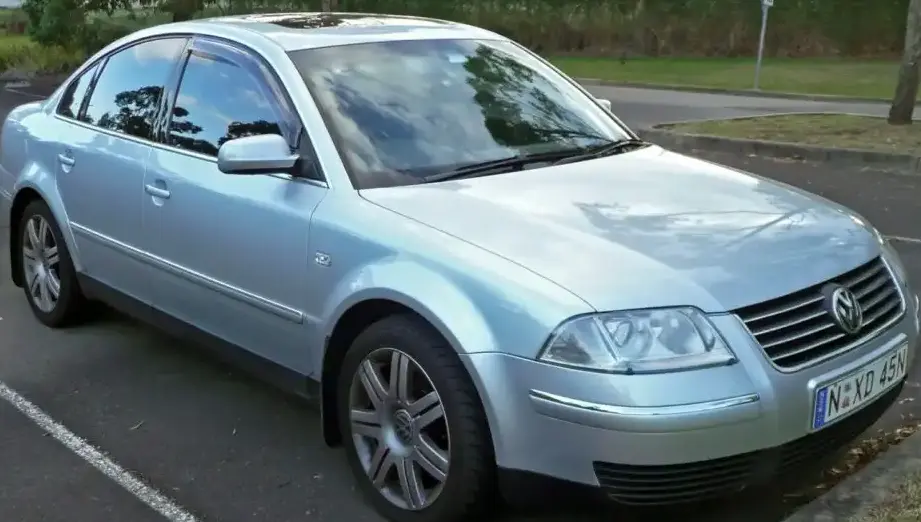
The Volkswagen Passat B5.5 4.0 W8 32V, produced from 2001 to 2004, represented a unique and ambitious offering within the Passat range. Positioned as the flagship trim level, it aimed to deliver a blend of luxury, performance, and all-weather capability. This variant was primarily marketed in Europe, where Volkswagen sought to offer a compelling alternative to premium brands with a distinctive engine configuration. The B5.5 designation refers to a significant mid-cycle refresh of the B5 Passat, bringing updated styling, improved interior materials, and technological advancements.
Technical Specifications
| Brand | Volkswagen |
| Model | Passat |
| Generation | Passat (B5.5) |
| Type (Engine) | 4.0 W8 32V (275 Hp) 4MOTION Tiptronic |
| Start of production | 2001 |
| End of production | 2004 |
| Powertrain Architecture | Internal Combustion engine |
| Body type | Sedan |
| Seats | 5 |
| Doors | 4 |
| Fuel consumption (economy) – urban (NEDC) | 19.4 l/100 km (12.1 US mpg, 14.6 UK mpg, 5.2 km/l) |
| Fuel consumption (economy) – extra urban (NEDC) | 9.5 l/100 km (24.8 US mpg, 29.7 UK mpg, 10.5 km/l) |
| Fuel consumption (economy) – combined (NEDC) | 13.1 l/100 km (18 US mpg, 21.6 UK mpg, 7.6 km/l) |
| CO2 emissions (NEDC) | 314 g/km |
| Fuel Type | Petrol (Gasoline) |
| Acceleration 0 – 100 km/h | 7.8 sec |
| Acceleration 0 – 62 mph | 7.8 sec |
| Acceleration 0 – 60 mph | 7.4 sec |
| Maximum speed | 250 km/h (155.34 mph), Electronically limited |
| Emission standard | Euro 4 |
| Power | 275 Hp @ 6000 rpm |
| Power per litre | 68.8 Hp/l |
| Torque | 370 Nm @ 2750 rpm (272.9 lb.-ft. @ 2750 rpm) |
| Engine layout | Front, Longitudinal |
| Engine Model/Code | BDN |
| Engine displacement | 3999 cm3 (244.03 cu. in.) |
| Number of cylinders | 8 |
| Engine configuration | W-engine |
| Cylinder Bore | 84 mm (3.31 in.) |
| Piston Stroke | 90.17 mm (3.55 in.) |
| Compression ratio | 10.8:1 |
| Number of valves per cylinder | 4 |
| Fuel injection system | Multi-port manifold injection |
| Engine aspiration | Naturally aspirated engine |
| Valvetrain | DOHC |
| Engine oil capacity | 8.3 l (8.77 US qt | 7.3 UK qt) |
| Coolant | 9 l (9.51 US qt | 7.92 UK qt) |
| Max. weight | 2300 kg (5070.63 lbs.) |
| Trunk (boot) space – minimum | 400 l (14.13 cu. ft.) |
| Fuel tank capacity | 80 l (21.13 US gal | 17.6 UK gal) |
| Max. roof load | 100 kg (220.46 lbs.) |
| Permitted trailer load with brakes (12%) | 2100 kg (4629.71 lbs.) |
| Permitted trailer load without brakes | 750 kg (1653.47 lbs.) |
| Length | 4703 mm (185.16 in.) |
| Width | 1746 mm (68.74 in.) |
| Height | 1461 mm (57.52 in.) |
| Wheelbase | 2702 mm (106.38 in.) |
| Front track | 1511 mm (59.49 in.) |
| Rear (Back) track | 1510 mm (59.45 in.) |
| Minimum turning circle (turning diameter) | 11.4 m (37.4 ft.) |
| Drivetrain Architecture | The Internal combustion engine (ICE) drives permanently the four wheels of the vehicle. |
| Drive wheel | All wheel drive (4×4) |
| Number of gears and type of gearbox | 5 gears, automatic transmission Tiptronic |
| Front suspension | Independent multi-link suspension, Transverse stabilizer |
| Rear suspension | Double wishbone, Transverse stabilizer |
| Front brakes | Ventilated discs |
| Rear brakes | Ventilated discs |
| Assisting systems | ABS (Anti-lock braking system) |
| Steering type | Steering rack and pinion |
| Power steering | Hydraulic Steering |
| Tires size | 225/45 R17 |
| Wheel rims size | 7.5J x 17 |
Powertrain & Engine Architecture
The heart of the Passat B5.5 W8 is the BDN engine, a 4.0-liter W8 engine. This engine is essentially two narrow-angle VR4 engines joined at the crankshaft, creating a compact V8-like configuration. The 32-valve DOHC cylinder head features four valves per cylinder, enhancing breathing and contributing to the engine’s power output. Fuel delivery is managed by a multi-port fuel injection system. The W8 engine was known for its relatively smooth operation and distinctive exhaust note. The 5-speed Tiptronic automatic transmission, a torque converter-based unit, was the sole transmission option. Tiptronic allowed for both fully automatic operation and driver-selected gear changes, offering a degree of control. The 4MOTION all-wheel-drive system utilizes a Torsen differential, providing a variable distribution of torque between the front and rear axles for enhanced traction.
Driving Characteristics
The 275 horsepower and 272.9 lb.-ft. of torque delivered by the W8 engine provided brisk acceleration, with a 0-60 mph time of around 7.4 seconds. However, the W8’s power delivery differed from that of more conventional engines. The peak torque arrived at a relatively low 2750 rpm, providing good mid-range response, but the engine needed to be revved to access its full potential. The Tiptronic transmission, while offering convenience, wasn’t as responsive as a manual gearbox. Compared to the 1.8T or even the diesel variants, the W8 offered a more refined and powerful driving experience, but at the cost of fuel economy. The 4MOTION system provided excellent grip in all weather conditions, making it a capable all-season vehicle.
Equipment & Trim Levels
The W8 trim was the most luxurious Passat B5.5 available. Standard features typically included leather upholstery, wood trim, automatic climate control, a premium audio system, and alloy wheels. Optional extras included navigation system, sunroof, and upgraded sound systems. The interior was designed to provide a comfortable and upscale environment, reflecting the W8’s positioning as the range-topping model.
Chassis & Braking
The Passat B5.5 W8 featured independent multi-link suspension at the front and a double wishbone setup at the rear, providing a comfortable ride and good handling characteristics. Stabilizer bars were fitted to both axles to reduce body roll. The braking system consisted of ventilated discs on all four wheels, providing ample stopping power. ABS (Anti-lock Braking System) was standard.
Market Reception & Comparison
The Passat W8 received mixed reviews. Critics praised its unique engine, comfortable ride, and luxurious interior. However, the high fuel consumption and relatively high price tag were often cited as drawbacks. Compared to the more popular 1.8T and TDI models, the W8 appealed to a niche market of buyers seeking a more exclusive and powerful Passat. The 1.8T offered a better balance of performance and fuel economy, while the TDI provided superior fuel efficiency and torque. The W8 was often seen as a competitor to entry-level luxury sedans from brands like BMW and Audi.
Legacy
The Volkswagen Passat B5.5 W8 remains a relatively rare and sought-after vehicle among enthusiasts. The W8 engine, while complex, is generally considered reliable if properly maintained. Common issues include oil leaks and occasional problems with the Tiptronic transmission. Today, the W8 represents a unique chapter in Volkswagen’s history, showcasing the company’s engineering ambition and willingness to experiment with unconventional engine configurations. The car’s distinctive character and relative rarity have contributed to its growing popularity in the used car market, particularly among those seeking a unique and rewarding driving experience.