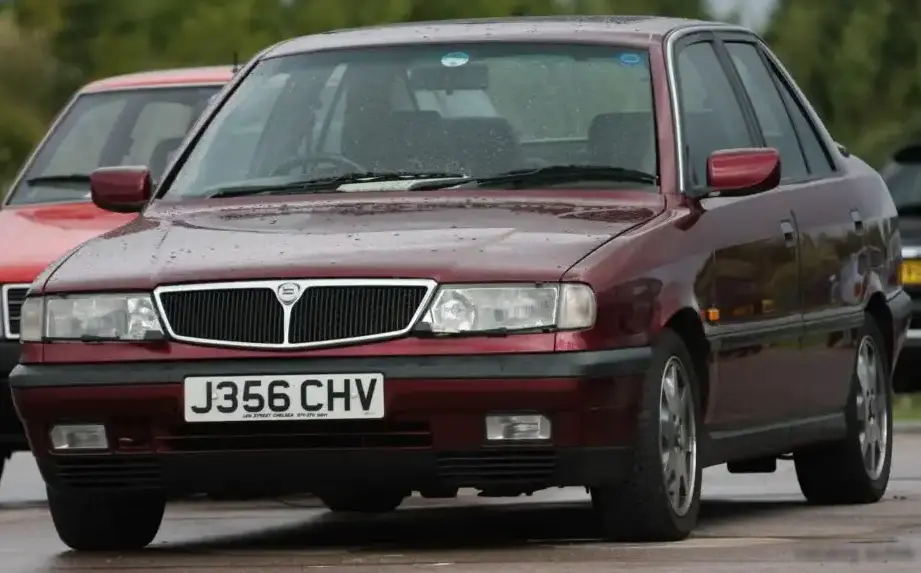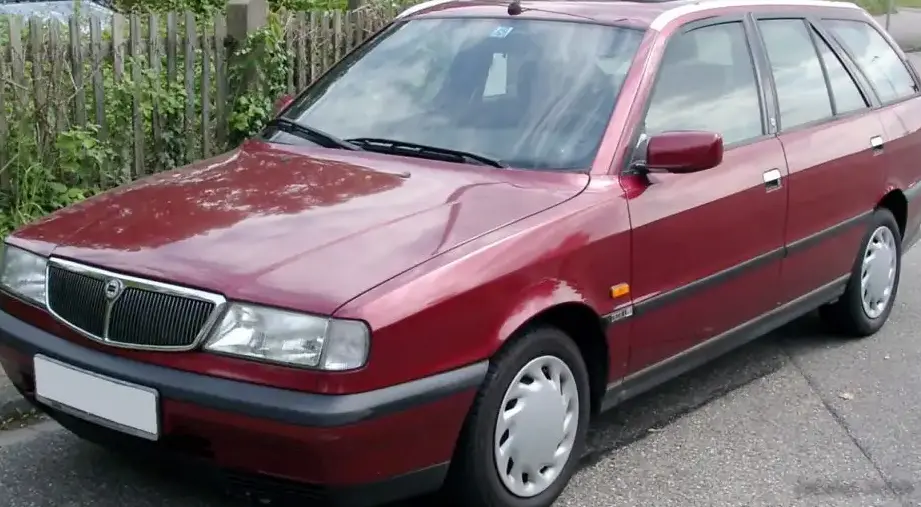
The Lancia Dedra Station Wagon (835) 1.8 GT 16V, produced between 1996 and 1999, represented a refined offering within the Dedra range. Positioned as a mid-range variant, it aimed to balance performance with practicality, appealing to buyers seeking a spacious family vehicle with a touch of Italian flair. The Dedra itself was a significant model for Lancia, built upon the Tipo-derived 835 platform (shared with the Fiat Chroma, Alfa Romeo 164, and Saab 9000) and represented a move upmarket for the brand. This particular 1.8 GT 16V trim combined a relatively potent 16-valve engine with a five-speed manual transmission, offering a more engaging driving experience than some of the lower-spec models.
Technical Specifications
| Brand | Lancia |
| Model | Dedra |
| Generation | Dedra Station Wagon (835) |
| Type (Engine) | 1.8 GT 16V (131 Hp) |
| Start of production | 1996 |
| End of production | 1999 |
| Powertrain Architecture | Internal Combustion engine |
| Body type | Station wagon (estate) |
| Seats | 5 |
| Doors | 5 |
| Fuel consumption (combined) | 8.4 l/100 km (28 US mpg, 33.6 UK mpg, 11.9 km/l) |
| Fuel Type | Petrol (Gasoline) |
| Acceleration 0 – 100 km/h | 10.4 sec |
| Acceleration 0 – 62 mph | 10.4 sec |
| Acceleration 0 – 60 mph | 9.9 sec |
| Maximum speed | 196 km/h (121.79 mph) |
| Weight-to-power ratio | 10.3 kg/Hp, 97 Hp/tonne |
| Weight-to-torque ratio | 8.2 kg/Nm, 121.5 Nm/tonne |
| Power | 131 Hp @ 6300 rpm |
| Power per litre | 75 Hp/l |
| Torque | 164 Nm @ 4000 rpm (120.96 lb.-ft. @ 4000 rpm) |
| Engine layout | Front, Transverse |
| Engine Model/Code | 183 A1.000 |
| Engine displacement | 1747 cm3 (106.61 cu. in.) |
| Number of cylinders | 4 |
| Engine configuration | Inline |
| Cylinder Bore | 82 mm (3.23 in.) |
| Piston Stroke | 82.7 mm (3.26 in.) |
| Compression ratio | 10.3:1 |
| Number of valves per cylinder | 4 |
| Fuel injection system | Multi-port manifold injection |
| Engine aspiration | Naturally aspirated engine |
| Valvetrain | DOHC |
| Engine oil capacity | 4.4 l (4.65 US qt | 3.87 UK qt) |
| Coolant capacity | 7 l (7.4 US qt | 6.16 UK qt) |
| Kerb Weight | 1350 kg (2976.24 lbs.) |
| Max. weight | 1775 kg (3913.21 lbs.) |
| Max load | 425 kg (936.96 lbs.) |
| Trunk (boot) space – minimum | 448 l (15.82 cu. ft.) |
| Trunk (boot) space – maximum | 1338 l (47.25 cu. ft.) |
| Fuel tank capacity | 63 l (16.64 US gal | 13.86 UK gal) |
| Length | 4343 mm (170.98 in.) |
| Width | 1700 mm (66.93 in.) |
| Height | 1446 mm (56.93 in.) |
| Wheelbase | 2540 mm (100 in.) |
| Front track | 1436 mm (56.54 in.) |
| Rear track | 1415 mm (55.71 in.) |
| Drivetrain Architecture | Front wheel drive |
| Number of gears and type of gearbox | 5 gears, manual transmission |
| Front suspension | Spring Strut |
| Rear suspension | Trailing arm |
| Front brakes | Ventilated discs |
| Rear brakes | Disc |
| Assisting systems | ABS (Anti-lock braking system) |
| Steering type | Steering rack and pinion |
| Power steering | Hydraulic Steering |
| Tires size | 185/60 R14 |
Powertrain & Engine Architecture
The heart of the Dedra 1.8 GT 16V is the 183A1.000 engine, a 1.8-liter (1747 cc) inline-four cylinder powerplant. This engine featured a dual overhead camshaft (DOHC) valvetrain with four valves per cylinder, contributing to its improved breathing and higher power output compared to single overhead cam (SOHC) versions. Fuel delivery was handled by a multi-port fuel injection system, providing precise fuel metering for optimal combustion. The 16-valve configuration, combined with a compression ratio of 10.3:1, allowed the engine to produce 131 horsepower at 6300 rpm and 164 Nm (120.96 lb-ft) of torque at 4000 rpm. The five-speed manual transmission offered precise gear changes and allowed drivers to fully exploit the engine’s powerband. This transmission was a key element in differentiating the GT 16V from lower-spec Dedras equipped with automatic gearboxes.
Driving Characteristics
The 1.8 GT 16V offered a noticeably more spirited driving experience than the base Dedra models. While not a sports car, the 131 hp engine provided adequate power for comfortable highway cruising and confident overtaking. The five-speed manual transmission allowed for precise control over the engine’s revs, and the gear ratios were well-suited to both city driving and longer journeys. Acceleration from 0 to 60 mph took approximately 9.9 seconds, and the car could reach a top speed of 196 km/h (121.79 mph). Compared to the automatic transmission versions, the manual offered better responsiveness and fuel economy. The manual also appealed to drivers who preferred a more involved driving experience.
Equipment & Trim Levels
The Dedra 1.8 GT 16V typically came equipped with a reasonable level of standard features. Interior appointments included cloth upholstery, although leather was often available as an option. Power windows and central locking were standard, as was a basic audio system. Optional extras included air conditioning, a sunroof, and upgraded sound systems. The dashboard layout was functional and typically featured a straightforward instrument cluster. The GT 16V trim generally offered a slightly more refined interior finish compared to the base models, with improved materials and detailing.
Chassis & Braking
The Dedra Station Wagon utilized a front-wheel-drive layout with independent suspension at the front (Spring Strut) and a trailing arm setup at the rear. This suspension configuration provided a comfortable ride quality, although it wasn’t particularly sporty. Braking duties were handled by ventilated discs at the front and solid discs at the rear, supplemented by an Anti-lock Braking System (ABS) for improved stopping power and stability. The hydraulic power steering provided light and easy steering, making the Dedra easy to maneuver in urban environments.
Market Reception & Comparison
The Lancia Dedra 1.8 GT 16V was generally well-received by automotive critics as a practical and comfortable family car with a decent level of performance. It was often praised for its spacious interior, comfortable ride, and relatively refined engine. Compared to other Dedra variants, the 1.8 GT 16V offered a significant performance upgrade over the lower-powered engines, while remaining more affordable than the top-of-the-line models. Fuel economy was respectable for its class, averaging around 28 US mpg. Reliability was generally considered average, with some owners reporting issues with electrical components and cooling system components.
Legacy
Today, the Lancia Dedra 1.8 GT 16V is a relatively rare sight on the roads. While not a highly sought-after classic, well-maintained examples are gaining recognition among enthusiasts who appreciate its Italian styling and practical nature. The 183A1.000 engine is generally considered a durable unit, although regular maintenance is essential to prevent issues. Parts availability can be a challenge, as the Dedra is no longer in production. However, a dedicated community of Lancia enthusiasts exists, and sourcing parts through specialist suppliers is often possible. The Dedra 1.8 GT 16V represents a unique blend of Italian design, practicality, and performance, making it a noteworthy vehicle from the 1990s.