Technical Specifications
| Brand | Ford |
| Model | Tourneo Courier |
| Generation | Tourneo Courier I |
| Type (Engine) | 1.6 TDCi (95 Hp) S&S |
| Start of production | 2014 |
| End of production | 2018 |
| Powertrain Architecture | Internal Combustion engine |
| Body type | MPV |
| Seats | 5 |
| Doors | 5 |
| Fuel consumption (urban) | 4.4 l/100 km (53.5 US mpg, 64.2 UK mpg, 22.7 km/l) |
| Fuel consumption (extra urban) | 3.5 l/100 km (67.2 US mpg, 80.7 UK mpg, 28.6 km/l) |
| Fuel consumption (combined) | 3.8 l/100 km (61.9 US mpg, 74.3 UK mpg, 26.3 km/l) |
| CO2 emissions | 100 g/km |
| Fuel Type | Diesel |
| Acceleration 0 – 100 km/h | 14 sec |
| Acceleration 0 – 62 mph | 14 sec |
| Acceleration 0 – 60 mph | 13.3 sec |
| Maximum speed | 170 km/h (105.63 mph) |
| Emission standard | Euro 5 |
| Weight-to-power ratio | 13.5 kg/Hp, 74.2 Hp/tonne |
| Weight-to-torque ratio | 6 kg/Nm, 168 Nm/tonne |
| Power | 95 Hp @ 3800 rpm |
| Power per litre | 60.9 Hp/l |
| Torque | 215 Nm @ 1750-2500 rpm (158.58 lb.-ft. @ 1750-2500 rpm) |
| Engine layout | Front, Transverse |
| Engine Model/Code | TZGA, TZGB |
| Engine displacement | 1560 cm3 (95.2 cu. in.) |
| Number of cylinders | 4 |
| Engine configuration | Inline |
| Cylinder Bore | 75 mm (2.95 in.) |
| Piston Stroke | 88.3 mm (3.48 in.) |
| Compression ratio | 16:1 |
| Number of valves per cylinder | 2 |
| Fuel injection system | Diesel Commonrail |
| Engine aspiration | Turbocharger, Intercooler |
| Valvetrain | SOHC |
| Engine oil capacity | 3.8 l (4.02 US qt | 3.34 UK qt) |
| Coolant | 6 l (6.34 US qt | 5.28 UK qt) |
| Kerb Weight | 1280 kg (2821.92 lbs.) |
| Max. weight | 1780 kg (3924.23 lbs.) |
| Max load | 500 kg (1102.31 lbs.) |
| Trunk (boot) space – minimum | 395 l (13.95 cu. ft.) |
| Trunk (boot) space – maximum | 1656 l (58.48 cu. ft.) |
| Fuel tank capacity | 48 l (12.68 US gal | 10.56 UK gal) |
| Length | 4157 mm (163.66 in.) |
| Width | 1976 mm (77.8 in.) |
| Height | 1723 mm (67.83 in.) |
| Wheelbase | 2489 mm (97.99 in.) |
| Minimum turning circle | 10.9 m (35.76 ft.) |
| Drivetrain Architecture | ICE, Front wheel drive |
| Drive wheel | Front wheel drive |
| Number of gears | 5 |
| Gearbox type | Manual transmission |
| Front suspension | Independent, McPherson with coil spring and anti-roll bar |
| Rear suspension | Semi-independent, coil spring |
| Front brakes | Ventilated discs |
| Rear brakes | Drum |
| Assisting systems | ABS |
| Steering type | Steering rack and pinion |
| Tires size | 195/60 R15 |
| Wheel rims size | 6.0J x 15 |
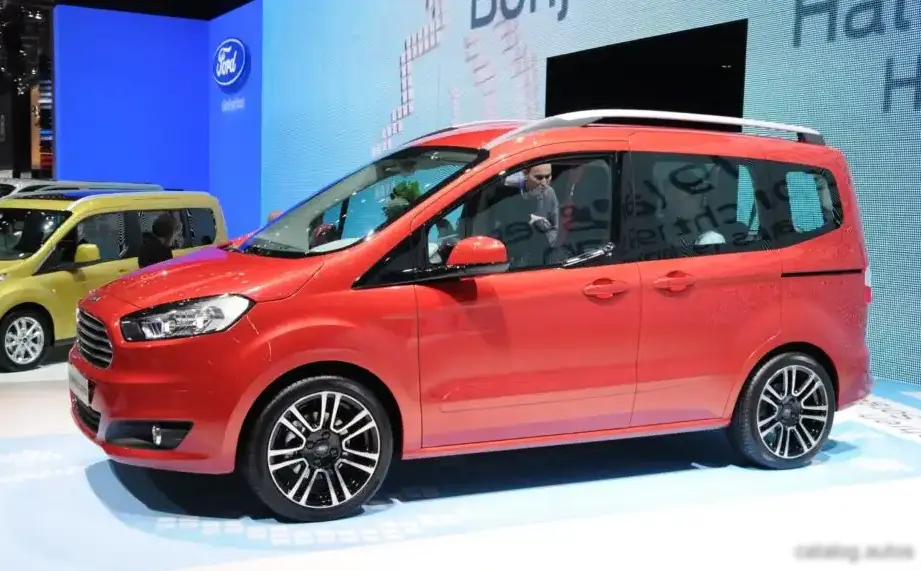
The Ford Tourneo Courier 1.6 TDCi 95 horsepower variant, produced from 2014 to 2018, represented an entry-level offering within the first generation (Tourneo Courier I) of Ford’s compact people carrier. Positioned as a practical and economical choice, it targeted buyers seeking a versatile small van for urban use and light commercial applications, as well as families needing a flexible five-seater. This model was built upon the B-platform, shared with the Ford Fiesta, and aimed to fill a gap in Ford’s lineup between the larger Tourneo Connect and smaller city cars. The “S&S” designation indicates the inclusion of Ford’s Auto Start/Stop technology, designed to improve fuel efficiency.
Powertrain & Engine Architecture
The Tourneo Courier 1.6 TDCi 95 utilizes the Ford Duratorq engine family, specifically the 1.6-liter four-cylinder diesel. Engine codes TZGA and TZGB were commonly assigned to this variant. This engine features a common-rail direct fuel injection system, delivering fuel at high pressure directly into the combustion chamber for improved efficiency and reduced emissions. A turbocharger with an intercooler is employed to boost power output, providing 95 horsepower at 3800 rpm and 215 Nm (158.58 lb-ft) of torque between 1750 and 2500 rpm. The engine employs a single overhead camshaft (SOHC) valvetrain with two valves per cylinder. The engine is transversely mounted at the front of the vehicle. The 5-speed manual transmission was the standard offering, chosen for its simplicity and cost-effectiveness. The Auto Start/Stop system, denoted by the “S&S” badge, automatically shuts off the engine when the vehicle is stationary (e.g., at traffic lights) and restarts it when the clutch pedal is depressed, further enhancing fuel economy.
Driving Characteristics
The 1.6 TDCi 95 hp engine, paired with the 5-speed manual transmission, provided adequate, though not exhilarating, performance. Acceleration from 0-60 mph took approximately 13.3 seconds, and top speed was around 105.63 mph. The engine’s torque delivery was relatively flat, making it suitable for everyday driving and carrying loads. However, it could feel strained when fully loaded or climbing steep hills. The gear ratios were geared towards fuel efficiency rather than outright performance. Compared to higher-output versions of the Tourneo Courier, such as the 1.0 EcoBoost petrol engine, the 1.6 TDCi offered significantly more torque at lower engine speeds, making it more practical for hauling cargo. However, the EcoBoost provided quicker acceleration and a more refined driving experience. The manual transmission offered precise shifts, but the clutch pedal could feel somewhat heavy during prolonged use.
Equipment & Trim Levels
The 1.6 TDCi 95 hp model typically came with a base level of equipment, focusing on practicality and affordability. Standard features included power steering, ABS, driver and passenger airbags, and a basic audio system with USB connectivity. Interior upholstery was typically cloth, and the dashboard featured a functional, if somewhat utilitarian, design. Optional extras included air conditioning, alloy wheels, parking sensors, and a more advanced audio system with Bluetooth connectivity. Higher trim levels, such as the Titanium, added more premium features like upgraded interior trim, automatic headlights, and rain-sensing wipers. The Tourneo Courier offered a configurable interior with folding rear seats, allowing for a maximum cargo capacity of 1656 liters (58.48 cu. ft.) with the rear seats folded down.
Chassis & Braking
The Tourneo Courier utilized a McPherson strut front suspension and a semi-independent coil spring rear suspension. This setup provided a reasonable balance between ride comfort and handling. The front brakes were ventilated discs, offering good stopping power, while the rear brakes were drums, a cost-saving measure for the entry-level model. A stabilizer bar was fitted to the front suspension to reduce body roll during cornering. The steering was a rack and pinion system, providing precise and responsive steering feel. The vehicle rode on 195/60 R15 tires, which offered a good compromise between grip and fuel efficiency.
Market Reception & Comparison
The Ford Tourneo Courier 1.6 TDCi 95 hp was generally well-received by critics as a practical and economical small van. Its fuel economy of around 61.9 US mpg combined was a major selling point. However, some reviewers noted that the engine could feel underpowered, especially when fully loaded. Compared to other small vans in its class, such as the Fiat Fiorino and Renault Kangoo, the Tourneo Courier offered a competitive level of practicality and fuel efficiency. The 1.6 TDCi engine was considered relatively reliable, but regular maintenance was essential to prevent issues with the turbocharger and fuel injection system. The manual transmission was generally considered durable, but clutch wear could be a concern for drivers who frequently drove in heavy traffic.
Legacy
The Ford Tourneo Courier 1.6 TDCi 95 hp remains a popular choice in the used car market due to its affordability, fuel efficiency, and practicality. The Duratorq engine, while not known for being particularly refined, has proven to be relatively durable with proper maintenance. Common issues include turbocharger failure, fuel injector problems, and clutch wear. However, these issues are generally well-documented and relatively inexpensive to repair. The Tourneo Courier’s versatile interior and compact dimensions continue to make it a useful vehicle for urban dwellers and small businesses. It represents a solid, if unspectacular, entry point into the world of compact commercial vehicles.